Young Guns October 2026 Feature
Building a Strong Company in a Competitive Market
Young Gun Erick Hernandez
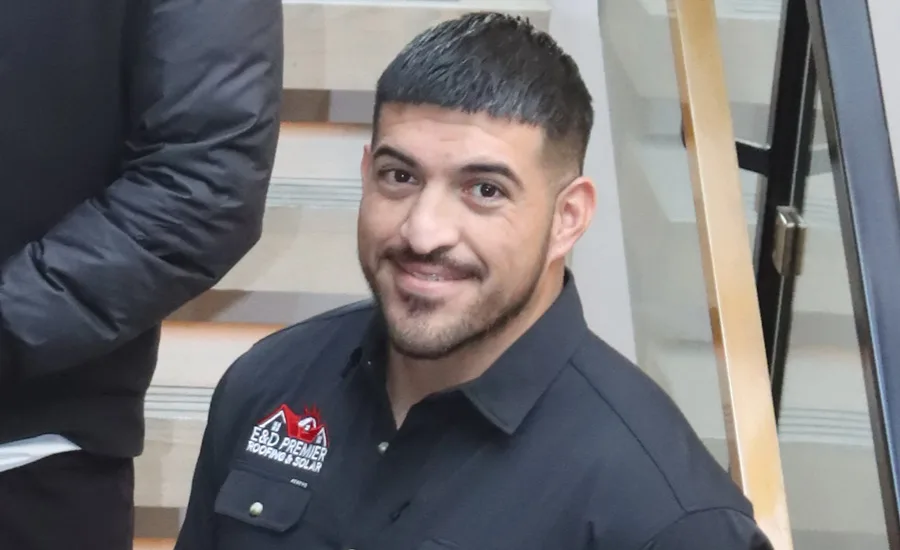
Erick Hernandez is focused on building a roofing company that can outlast him.
The 36-year-old owner of E&D Premier Roofing & Solar launched the Dallas-Fort Worth company in 2019 and has since shifted his focus from simply growing revenue to developing leaders, strengthening systems and expanding into commercial roofing.
Erick Hernandez, 36
Owner, E&D Premier Roofing & Solar
LOCATION: Dallas-Fort Worth, Tex.
WEBSITE: edpremierroofing.com
COLLEGE: I did not take the traditional college route. Most of my education has come through entrepreneurship, experience, mistakes, mentorship, and building a company from the ground up.
FAMILY STATUS: Married with three children. My wife Daisy has been an important part of both my life and the journey building our company.
What are you doing when you’re not thinking about roofing?
Spending time with my wife and three children, strength training, running and preparing for a 200-mile ultramarathon in December 2026.
For Roofing Contrator’s Young Guns series, Hernandez discusses lessons learned through growth and restructuring, competing in a crowded market and why he believes building a stronger company matters more than building the biggest one.
How long have you been in the roofing industry and how did you get your start?
EH: I’ve been in the roofing industry for approximately seven years. We started E&D Premier Roofing & Solar in 2019.
Like a lot of people in this industry, I didn’t grow up thinking I was going to own a roofing company. I found an opportunity and eventually realized that roofing could become much more than just a way to make money. I became fascinated with the business itself: sales, leadership, operations, construction, insurance restoration, recruiting, marketing and, eventually, commercial roofing. Over time, the vision became bigger. It stopped being about how many roofs I personally could sell and became about how many people we could develop, how strong a company we could build and what kind of organization could exist long after me.
What are the top reasons why your company is successful?
EH: I would narrow it down to five things:
- Our people. You cannot build a great roofing company by yourself. We’ve worked hard to build a culture where people have an opportunity to grow professionally, financially and personally.
- Resilience. We’ve had great years and extremely difficult years. We’ve made mistakes. We’ve had to restructure. We’ve had to reduce expenses and rethink the way we operate. But we’ve never stopped moving forward.
- Willingness to adapt. The roofing industry changes constantly. Insurance changes, customer acquisition changes, technology changes and market changes. We’re willing to admit when something isn’t working and change direction.
- Investing in leadership and systems. We’re working toward building a company that doesn’t depend on one person. That means developing leaders, creating accountability, improving processes, tracking numbers and building repeatable systems.
- Thinking beyond residential roofing. We’ve invested in the last several years in developing our commercial division. That meant doing hundreds of inspections and walkthroughs, building manufacturer and industry relationships, learning systems and sometimes doing a tremendous amount of work without immediately seeing the payoff. We’re now executing significantly larger commercial projects, and seeing that investment begin to produce results has been extremely rewarding.
What are the big challenges in your market and how is the company addressing them?
EH: The Dallas-Fort Worth roofing market is extremely competitive. There is no shortage of roofing companies, particularly after major storms. One of the biggest challenges is differentiation. Customers can have dozens of contractors trying to earn their business, and unfortunately, our industry also has companies that disappear after storms, communicate poorly or don’t perform the work correctly. That affects the reputation of everyone in roofing. We’re addressing that by focusing heavily on becoming a recognizable, trusted local brand rather than simply chasing storms. We’re investing more in our local presence, customer experience, commercial capabilities, training, systems, documentation and long-term relationships.
Another major challenge is profitability. Revenue by itself doesn’t mean you have a healthy company. I’ve learned that lesson firsthand. Today, I’m much more focused on gross margin, overhead, cash flow, operational efficiency and sustainable net profit - not simply the top-line revenue number. I want to build a company that can survive bad years just as well as it can capitalize on great ones.
Do you see your age as an advantage or disadvantage in this business?
EH: I see it as an advantage. At 36, I feel like I’m in an interesting position. I’m young enough to have a tremendous amount of energy and ambition, but I’ve also been in business long enough to have some scars. And I think the scars matter. I’ve experienced growth, success, mistakes, financial pressure, difficult decisions, restructuring, leadership challenges and the responsibility that comes with having employees and families depending on the decisions you make. At the same time, my generation grew up during a massive technological shift. Social media, digital marketing, automation, data, AI and technology are changing the way roofing companies operate. I think younger contractors who combine that technology with old-school fundamentals - relationships, knocking on doors, answering the phone, doing what you say you’re going to do and taking care of people - have an enormous opportunity.
What area of the roofing business are you most passionate about?
EH: Leadership and sales. I love sales because sales creates opportunities. Without revenue, none of the other pieces of the company exist. But as I’ve grown as an owner, I’ve become even more passionate about developing people. There’s something extremely rewarding about watching someone come into your organization and then watching their life change because they learned how to sell, lead, communicate, manage money and believe bigger for themselves. My goal isn’t to create a company full of people who depend on me. I want to create leaders. I want people to eventually look back and say that being part of this organization helped them become a better salesperson, leader, spouse, parent, entrepreneur or person. That’s much bigger than roofing.
What did you get from attending the Young Guns meeting at Best of Success?
EH: The biggest thing was perspective. Being around other young leaders in the roofing industry reminds you that although our companies may be different, we’re dealing with many of the same challenges: growth, leadership, profitability, recruiting, culture, systems and figuring out what comes next. I also believe strongly that your environment matters. Being in a room with ambitious people who are willing to openly discuss what is working, what isn’t working and what they’ve learned compresses years of experience into conversations. Sometimes one relationship or one conversation can completely change the direction of your business. That’s the value I see in Young Guns and Best of Success.
What are your future plans for the business?
EH: The next chapter is about building something bigger, but also building it smarter. We are continuing to strengthen our residential operation while making a significant push into commercial roofing. We’ve spent several years laying the groundwork for that division, and we’re now beginning to see the results.
We’re also focused on creating a stronger presence in the communities we serve, developing our leadership team, improving systems and continuing to reduce the company’s dependence on me personally.
My vision isn’t simply to build a roofing company that generates a large revenue number. I want to build an organization with multiple leaders, multiple divisions, strong margins, strong systems and a culture that creates opportunities for people. I also want to continue challenging myself personally.
One thing endurance sports have taught me is that the finish line you’re chasing today eventually becomes the starting line for something bigger. Business is very similar. There was a time when simply owning a roofing company seemed like the destination. Then it was hitting certain revenue numbers. Then, it became building a team. Now I’m thinking about leadership development, commercial roofing, multiple divisions, long-term enterprise value and what this organization could look like 10 or 20 years from now.
I’m no longer interested in building the biggest company I can build. I’m interested in building the strongest company I can build and developing people who can eventually build something even bigger than I did.









Looking for a reprint of this article?
From high-res PDFs to custom plaques, order your copy today!