Quarterly Report
U.S. Shingle Shipments Fall 13% in Third Quarter
Modified bitumen and BUR shipments rise as residential construction remains under pressure
U.S. asphalt shingle shipments fell 13% in the third quarter of 2026, deepening the year-to-date decline, according to the Asphalt Roofing Manufacturers Association. The drop came amid continued pressure in the residential market, with builder confidence falling to a 14-year low in October.
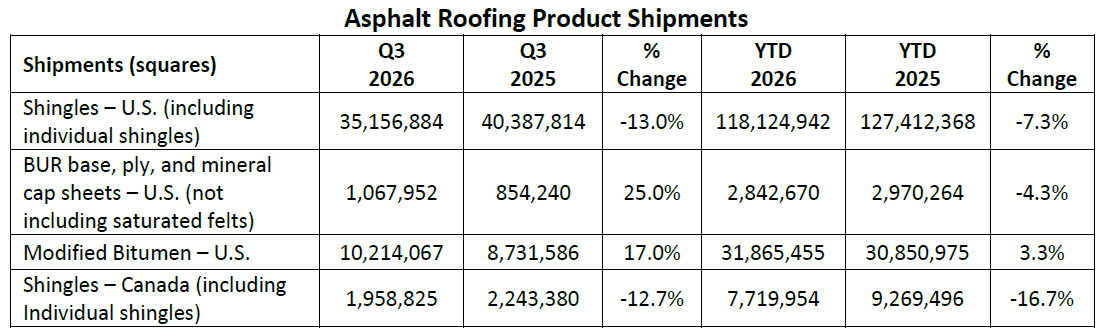
ARMA reported U.S. shingle shipments of 35,156,884 squares during the quarter, down from 40,387,814 squares during the third quarter of 2025. Through September, shipments totaled 118,124,942 squares, a 7.3% decline from 127,412,368 squares during the same period last year.
The third-quarter results represent a sharper year-over-year decline than earlier in the year. ARMA's second-quarter report showed U.S. shingle shipments had been running 4.7% below 2025 levels.
 Source: Asphalt Roofing Manufacturers Association
Builder Confidence Hits a 14-Year Low
The pressure on residential construction has continued into the fourth quarter. Builder confidence in the market for newly built single-family homes fell three points to 29 in October, its lowest level since June 2012, according to the National Association of Home Builders/Wells Fargo Housing Market Index.
NAHB cited rising mortgage rates, energy and material costs, affordability challenges and weaker buyer traffic. The October survey found 43% of builders cut home prices, the highest share recorded since 2020, while 65% reported using sales incentives.
New construction is only one part of asphalt shingle demand, however, with reroofing and repair representing another important part of the market. The latest outlook for homeowner improvement spending also points to relatively slow growth.
Harvard University's Joint Center for Housing Studies said Oct. 22 that annual spending on home improvements and repairs is expected to remain relatively flat through late 2027. Its latest Leading Indicator of Remodeling Activity projects year-over-year growth of 1.5% by the third quarter of 2027, with annual spending hovering around $525 billion.
Harvard cited flat-to-negative retail spending on building products, stagnant remodeling permits and broader housing-market weakness. The forecast covers the overall home improvement and repair market and is not specific to roofing.
Modified Bitumen Posts Double-Digit Gain
Low-slope asphalt roofing products showed a different pattern during the quarter. U.S. modified bitumen shipments increased 17% year over year, from 8,731,586 squares in the third quarter of 2025 to 10,214,067 squares this year. Through September, modified bitumen shipments reached 31,865,455 squares, up 3.3% from 30,850,975 squares during the first nine months of 2025.
Built-up roofing products also posted a strong quarter. Shipments of BUR base, ply and mineral cap sheets increased 25%, from 854,240 squares a year ago to 1,067,952 squares. However, the quarterly increase was not enough to erase earlier declines. Year-to-date BUR shipments totaled 2,842,670 squares, down 4.3% from the same period last year.
Those results come as nonresidential construction continues to outperform residential activity. Dodge reported nonresidential building starts were up 23.7% by value through September. Commercial and industrial starts increased 46.3%, while institutional starts declined 1.8%. September was softer, with nonresidential starts down 6.3% from August, but year-to-date figures still show a substantial gap between residential and nonresidential construction activity.
Construction starts and roofing-material shipments measure different stages of the market, and the Dodge figures include building types and roofing systems beyond asphalt products. Still, the data illustrate the broader divergence between residential and nonresidential construction activity in 2026.
The pressure on residential construction has continued into the fourth quarter. Builder confidence in the market for newly built single-family homes fell three points to 29 in October, its lowest level since June 2012, according to the National Association of Home Builders/Wells Fargo Housing Market Index.
NAHB cited rising mortgage rates, energy and material costs, affordability challenges and weaker buyer traffic. The October survey found 43% of builders cut home prices, the highest share recorded since 2020, while 65% reported using sales incentives. New construction is only one part of asphalt shingle demand, however, with reroofing and repair representing another important part of the market. The latest outlook for homeowner improvement spending also points to relatively slow growth.
Harvard University's Joint Center for Housing Studies said Oct. 22 that annual spending on home improvements and repairs is expected to remain relatively flat through late 2027. Its latest Leading Indicator of Remodeling Activity projects 1.5% year-over-year growth by the third quarter of 2027, with annual spending hovering around $525 billion.
Harvard cited flat-to-negative retail spending on building products, stagnant remodeling permits and broader housing-market weakness. The forecast covers home improvement and repair spending on owner-occupied homes and is not specific to roofing.
Canadian Shingle Shipments Remain Down
Canadian asphalt shingle shipments also remained well below 2025 levels. Manufacturers shipped 1,958,825 squares during the third quarter, down 12.7% from 2,243,380 squares a year earlier. Through September, Canadian shipments totaled 7,719,954 squares, a 16.7% decline from 9,269,496 squares during the same period in 2025.
The decline in shingle shipments was considerably steeper than the decline in Canadian housing starts. CMHC reported 170,964 housing starts in population centers of 10,000 or more through September, down 4% from the same period in 2025. Single-detached starts, a more relevant comparison for asphalt shingles, declined 6%, from 31,232 to 29,314 units.
Actual September housing starts fell 11% year over year, although CMHC's six-month trend was virtually flat, increasing 0.6% from August.
The figures show shingle shipment volumes declining more sharply than new-home construction, although the measures are not directly comparable. Shipment timing, inventories, reroofing activity and product mix could also affect shipment totals, and ARMA's quarterly report does not provide enough detail to identify the causes.
Looking for a reprint of this article?
From high-res PDFs to custom plaques, order your copy today!