Quarterly Report
U.S. Asphalt Shingle Shipments Fall 10% in Q3 2025
ARMA’s latest report shows declines across key segments
The Asphalt Roofing Manufacturers Association (ARMA) shipment data for the third quarter of 2025 shows a clear slowdown in the asphalt roofing industry, particularly in the U.S. market.
In the Q3 2025 Quarterly Product Shipment Report from the association, shipments — tracked in squares — of domestic and Canadian shingles, modified bitumen and BUR all declined compared to the previous quarter, as seen below:
- U.S. shingles: 40.4 million, down 9.7%
- BUR: 854,240 down 23.4%
- Modified bitumen: 8.7 million, down 21.8%
- Canadian shingles: 2.2 million, down 32.9%
In the third quarter of 2025, the asphalt roofing industry experienced a notable downturn compared to the same period in 2024, according to ARMA’s quarterly shipment data. U.S. asphalt shingle shipments totaled 40.4 million squares in Q3 2025, down 10% from 44.9 million squares in Q3 2024, reflecting a slowdown in residential roofing activity and housing construction.
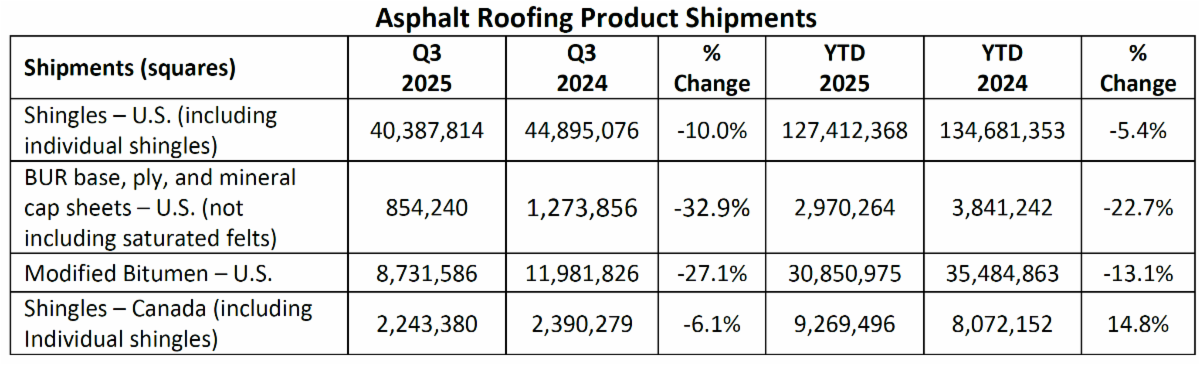
The BUR (built-up roofing) base, ply, and mineral cap sheet category saw the steepest decline, falling 32.9% year-over-year to 854,240 squares, indicating sustained weakness in the commercial low-slope roofing market.
Similarly, modified bitumen products dropped 27.1%, with shipments declining from 11.98 million squares in Q3 2024 to 8.73 million squares in Q3 2025, continuing a downward trend in demand for bituminous membrane systems.
In contrast, the Canadian market remained comparatively stable, with shipments of asphalt shingles down only 6.1%, from 2.39 million squares in Q3 2024 to 2.24 million squares in Q3 2025. Despite this slight quarterly decline, Canada’s year-to-date performance was stronger than that of the U.S., with shipments totaling 9.27 million squares through Q3 2025—up 14.8% compared to 8.07 million squares in 2024. Meanwhile, U.S. YTD shipments painted a more subdued picture: shingles fell 5.4%, BUR products dropped 22.7%, and modified bitumen declined 13.1%.
Overall, the comparison between Q3 2025 and Q3 2024 underscores a broad contraction in U.S. asphalt roofing shipments, driven largely by reduced residential demand and continued softness in commercial sectors.
However, Canada’s roofing market showed resilience, buoyed by strong early-year performance that offset late-summer declines. The data suggests that while North America’s asphalt roofing sector faced headwinds in 2025, regional differences remain pronounced, with Canada outperforming the U.S. in both volume stability and year-to-date growth.
RELATED: U.S. Commercial Construction Backlogs Stay Strong Despite Shutdown
Material Pricing
Adding further context, according to Associated Builders & Contractors (ABC), construction-input prices rose modestly in August 2025 by 0.2 % month over month, and were up 2.3 % year-over-year (2.6 % for non-residential inputs). Notably, iron and steel input prices rose 9.2 % year-over-year, while copper wire and cable prices were up 13.8 %.
The data suggest that even as shipments of roofing materials contract, upward pressure on some raw material costs remains. For the asphalt-roofing sector, this means margin pressures: lower volumes combined with elevated input costs (especially steel or metal components in roofing systems, fasteners, or accessory metal) could squeeze profitability or force price increases downward in response to demand softness.
Outlook
Despite the overall decline in roofing shipments through Q3 2025, new home sales data for August 2025 offers a cautiously optimistic signal for future roofing demand. According to the U.S. Department of Housing and Urban Development and the U.S. Census Bureau, sales of newly built single-family homes surged 20.5% in August to an annualized rate of 800,000 units, marking a 15.4% increase from a year earlier.
Residential building starts increased 3.6% in September to a seasonally adjusted annual rate of $379 billion, according to Dodge Construction Network. Single-family starts increased 1.7%, while multifamily starts expanded 6.4%. On a year-to-date basis through September, residential starts are down 4.2% – with single-family starts down 12.1% and multifamily starts up 13.2%.
This rebound, fueled by a modest drop in mortgage rates to an average of 6.26%—their lowest since October 2024—suggests that housing activity could strengthen heading into Q4. Builder confidence remains subdued, but the combination of easing borrowing costs, selective price incentives, and a gradual reduction in home inventories could stimulate new residential construction.
“This downward trend in rates, combined with the recent Fed interest rate cut, signals a positive outlook for future housing demand," said Jing Fu, NAHB senior director of forecasting and analysis. "If this momentum continues, we expect new home sales to gain traction as more buyers reenter the market in the final quarter of 2025.”
Nonresidential building starts increased 11.9% in September to a seasonally adjusted annual rate of $478 billion, according to Dodge. Commercial starts were up 21.2%, as only retail failed to grow over the month. For the 12 months ending September 2025, total nonresidential starts were up 6.8% compared to the 12 months ending September 2024. Commercial starts were up 22.5%, institutional starts improved 5.0%, and manufacturing starts were down 23.6% over the same period.
Overall, while roofing shipments remain soft, the latest housing and construction indicators point to a potential turning point. Easing mortgage rates, a rebound in new home sales, and strong nonresidential activity suggest that demand for roofing materials could stabilize heading into late 2025. If economic conditions hold and builder confidence improves, the roofing sector may soon see the first signs of recovery after a challenging year.
Looking for a reprint of this article?
From high-res PDFs to custom plaques, order your copy today!