Commercial Roofing
Commercial Roof Performance Under Intensifying Storm Pressure
Flashing failures, edge securement and aging systems are emerging as key vulnerabilities as insurers push for performance beyond code minimums.
Key Takeaways
- Severe storms are driving record insurance losses — and roofs are central to the risk.
- Most commercial roof failures start at the perimeter, not the field.
- Documentation, upgrades and maintenance now influence coverage outcomes.
When severe convective storms became the second-costliest insured disaster category of 2025 — trailing only the Los Angeles wildfires, according to Munich Re — the roofing industry took notice. For commercial building owners and contractors, the message is no longer subtle: how a roof performs in a storm increasingly determines whether the aftermath is a repair call or a financial crisis.
The scale of the shift is hard to ignore. In 2024 alone, 27 U.S. catastrophe events each topped $1 billion in damages — a pattern Munich Re, the global reinsurer, characterizes as a troubling acceleration in both frequency and cost. Rising construction costs and post-pandemic inflation have compounded the problem, amplifying losses even from moderate storm events.
"We can't simply address this by increasing premiums and imposing more restrictions," said Mike Quigley, executive vice president and head of property underwriting at Munich Re US. "We need to focus not just on pricing current exposure but on how we can bend that cost curve down."
That reframing carries real consequences for the roofing industry. For insurers, it means moving beyond traditional risk transfer and investing more deeply in building science and mitigation strategies. For roofing contractors, it translates directly to the job site: installation quality, attachment strength and documentation are under a level of scrutiny that simply didn't exist a few years ago.
A Convergence of Risk Factors
Ross Haigler, ASP, senior director of commercial lines at the Insurance Institute for Business & Home Safety (IBHS), says escalating commercial losses rarely stem from a single weakness.
“It’s a combination of storm intensity, new development in high-risk corridors, aging infrastructure, construction practices and material performance,” Haigler said. “When you combine dense development with older buildings that may not meet modern code provisions, losses can increase quickly.”
As development expands across the central and southern United States, more insured value sits in the path of high-wind and hail events. At the same time, many commercial roofs in service today were installed 15 to 25 years ago under older wind design standards — and may now be experiencing fastener fatigue, seam stress and perimeter deterioration.
Contractors say they are seeing that convergence play out on job sites.
“It seemed like there used to be a storm event every few years,” said John Chan, EVP of Durable Slate in Columbus, Ohio. “Now it seems like there are storm events every year or more than once a year.”
The Perimeter Problem
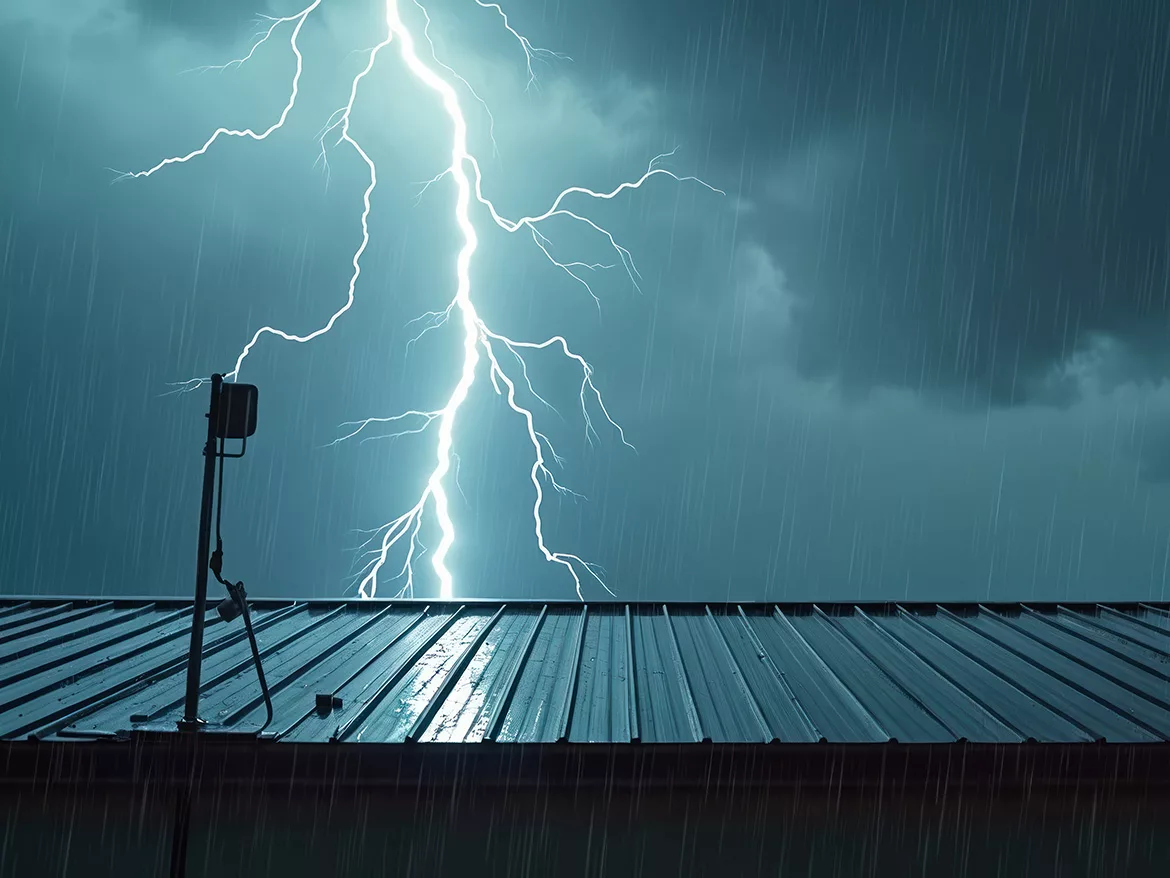
IBHS testing consistently identifies flashing failures, perimeter securement and rooftop equipment attachment as primary commercial vulnerabilities during high-wind events.
“Flashing secures the roof covering to the building,” Haigler said. “When flashing fails — whether it’s loose, rusted or missing — the roof covering becomes vulnerable to uplift. Once wind gets underneath, water follows.”
Contractors report similar patterns in the field.
“With high wind events, I’m seeing rake and eave edges blown up,” Chan said. “With hail events, I’m seeing dented and torn metal flashings.”
John Malko, owner of Mighty Dog Roofing in Arizona’s Southeast Valley, says failures rarely begin in the center of the roof.
“It’s the edges — the perimeter metal, the coping, the flashing, the fastener lines,” Malko said. “That’s where wind pressure exerts the most force. If those areas loosen even slightly, the whole roofing system can start to break.”
Mike Feazel, CEO of Roof Maxx, says that once perimeter conditions are compromised, membrane systems can peel back rapidly.
“As soon as wind compromises those areas, it can get under the membrane and cause rapid peel back,” Feazel said. On mechanically attached single-ply systems, he adds, fastener fatigue and seam stress are showing up more frequently, particularly on older roofs installed to minimum code.
How a Repair-First Approach Can Lower Costs and Improve Hurricane Recovery
Secondary Water Damage Drives Severity
While wind often initiates failure, water intrusion frequently determines the size of the claim.
“Water follows the path of least resistance,” Haigler said. “The leak you see inside may not be directly below the failure point.”
He notes that one inch of rain on an unsealed 2,000 to 2,500-square-foot roof can introduce the equivalent of nine bathtubs of water into a structure.
Hail damage can also be deceptive. “Bruised insulation and weakened cover boards don’t leak immediately, but they absolutely shorten the roof’s life,” Feazel said. Malko added that hidden damage discovered during tear-offs often explains why seemingly minor storms later lead to larger claims.
As catastrophe losses escalate, insurers are paying closer attention to these damage amplifiers. Munich Re has identified sealed roof decks as one of the clearest examples of mitigation reducing loss severity. Eliminating water intrusion through sealed decking can prevent damage that would otherwise amplify total losses by 30% or more, according to the company’s analysis.
“In many cases, sealing the deck is a relatively low-cost upgrade compared to the potential loss reduction,” Haigler said.
Insurance Scrutiny and Documentation
Contractors say insurers are more involved in specifications and post-loss inspections than in previous cycles.
“Yes, I think insurers have become more involved,” Chan said.
Feazel notes that adjusters are increasingly requesting moisture scans, engineering reports and detailed maintenance documentation.
“Adjusters are taking a close look at fastener spacing, uplift ratings and whether the roof originally met code,” Malko added. “In many cases, they’re requesting moisture scans or core samples before making a final decision.”
For some building owners, that scrutiny is prompting discussions about upgraded fastening patterns and higher wind ratings. “Property owners in storm-prone markets are increasingly asking for upgraded fastening patterns and higher wind ratings,” Feazel said. “But many roofs still get built to the lowest acceptable standard.”
IBHS recommends that older commercial buildings undergo engineering evaluations to determine whether roof systems meet current design pressures. Envelope components, such as large overhead doors, also affect performance.
“When wind enters through a failed door, it creates a balloon effect,” Haigler said. “Internal pressure pushes up on the roof and contributes to catastrophic failure.”
Related: Building Your Roster by Focusing on Repair and Maintenance
Focus on Maintenance
Routine inspection remains one of the most underutilized risk controls.
“Maintenance is a major loss driver,” Haigler said. “Just routine inspections can make a significant difference.”
Annual reviews of flashing, edge metal, rooftop equipment and drainage systems can identify vulnerabilities before a storm exposes them. Yet deferred maintenance continues to contribute to avoidable failures — and, increasingly, to insurance scrutiny.
The scale of recent catastrophe losses is reshaping the insurance landscape. Rising premiums, higher deductibles and tighter underwriting standards in storm-prone regions reflect mounting pressure on traditional risk transfer models.
“We need to focus on how we can bend that cost curve down,” Quigley said.
To help building owners move from reactive repairs to proactive planning, IBHS offers its Thunderstorm Ready guide, a step-by-step resource designed to help property owners evaluate vulnerabilities, prioritize upgrades and strengthen their buildings before the next storm hits.
For commercial roofing contractors, the direction is clear. Roof performance is now central to how insurers and property owners evaluate risk — and the details that may have felt like finishing touches are anything but. Perimeter detailing, attachment strength, equipment securement, sealed decks, and documented maintenance have moved from the fine print to the front of the conversation.
Looking for a reprint of this article?
From high-res PDFs to custom plaques, order your copy today!