5 Growth Strategies for Roofing Contractors in 2026
Roofing contractor panel explores how growing a roofing business involves so much more than increasing revenue
What does it mean to successfully grow a roofing business? Is growth necessarily accompanied by more customers, more locations, and more revenue? And, most importantly, what are the drivers that nurture and sustain growth over time?
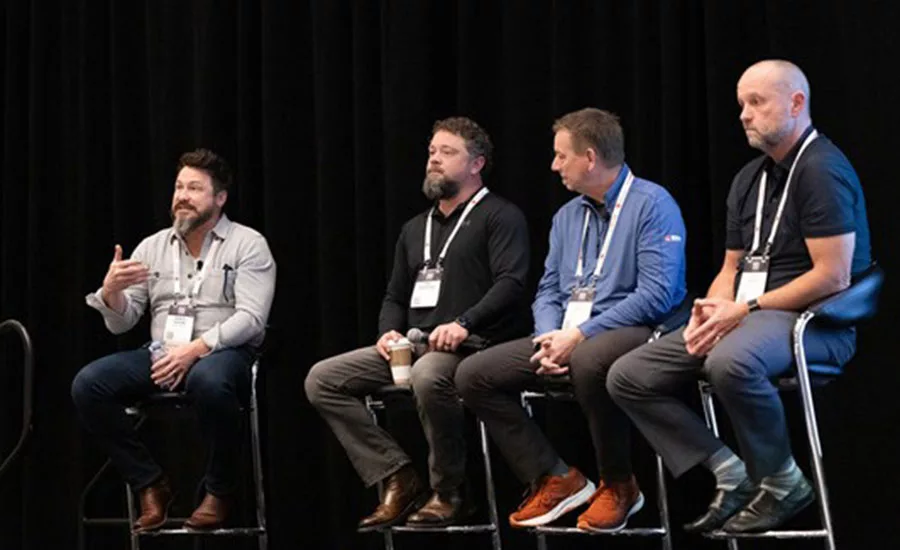
At a recent meeting of roofing contractors hosted by Owens Corning, three high-performing Owens Corning Roofing Platinum Preferred Contractors shared their perspectives on growth during a panel conversation. Moderator Andrew Schmidt, managing partner at Core Roofing + Solar, along with panelists Scott Mullins, founder of Legacy Roofing; Merlin Bartel, owner of Epic Roofing and Exteriors; and Chris Zimmerman, owner of At Your Service Roofing and Remodelling, discussed how growing a business involves so much more than increasing year-over-year revenue.
While the panelists’ roofing businesses operate in different markets and offer varying exterior and interior services, there was widespread agreement when it comes to business practices that can help support sustained growth.
1. Prioritize Systems And Procedures Over Hustle and Scale
Scale has become a buzzword in today’s business conversations, typically referring to investments that drive efficiency. But foundational pillars should be prioritized before targeting improved efficiencies, according to the panelists.
“In companies that focus on revenue only, it’s all about ‘grow baby grow, scale baby scale,’ and that can become a house of cards,” Zimmerman said. “Most of those companies are not building business; they’re building hustles.”
He added that focusing too acutely on revenue does not allow for the unexpected events that can throw a business off course.
“When a change hits, like a pandemic or the loss of a key employee, a company can suddenly find they’re not building on a firm foundation,” he said.
What’s a good starting point to optimize growth? A mission statement and core values supported with standard operating procedures, systems, and processes are the foundational cornerstones that can support a business’s long-term growth and stability when a disruptor occurs.
“There are ways to grow a business that go beyond revenue and support enhanced margins,” Zimmerman said. “I would much rather do higher margin than higher revenue.”
Once the foundational pillars, including mission statement, core values, operating procedures, and standards are in place, technology investments can be tools to bolster efficiency and margins. Virtual assistants are one example of technology that may increase a company’s bottom line without increasing its topline expense.
2. Innovate New Approaches To Old Problems
Albert Einstein famously stated, “The problems we have today cannot be solved at the same level of thinking with which we created them.” For Epic Roofing & Exteriors, the problem of landfill waste and the challenge of meeting more stringent regulations in Canada inspired an innovative approach to shingle recycling.
The company invested in Razphalt, a technology that converts old shingles into an asphalt alternative that lays down on roadways better than gravel. Razphalt is made of recycled shingles, according to Bartel. He noted that the approach addresses Canada’s stringent environmental regulations and has helped keep more than 500 homes’ shingles from ending up in landfills.
3. Pair Systems With Culture
You’ve probably heard the statement “culture eats strategy for breakfast,” meaning that no matter how strong a strategic plan is, its efficacy will be held back if team members do not buy into the culture. Having a clear mission and core values supported by solid, well-documented systems can make it easy to build a culture within an organization. A common culture is especially critical when adding locations.
“If you have really good systems and processes in place, it makes it easier to build a culture following an acquisition,” said Mullins.
Culture must be paired with the foundational cornerstones, and both must be regularly assessed.
“Keep in mind that standards and processes must continually be developed and refined. The things that worked in the past will need to be modified in the future as the business grows,” he added.
4. Consider Proximity When Expanding
Growing a business through acquisitions may be easier when locations are in the same region. In Alberta, Canada, Epic Roofing & Exteriors has kept its focus on expanding in nearby communities and “watching what’s happening in our own backyard versus leapfrogging markets,” according to Bartel.
5. Apply A First-Class Cabin Practice
When Schmidt asked the panelists what “best practices” they follow to nurture their leadership skills, reading topped the list.
“Spend as much time reading as you can. I don’t know if there is any better advice,” said Bartel.
The panel also talked about a tip gleaned from a peek into the first-class cabin. One panelist described the setting.
“A look around the first-class cabin revealed that every traveler was reading. But guess what passengers were doing in the rest of the plane? Looking at their phones!” Mullins said. “You can’t give away what you don’t have, and spending an hour a day reading and learning is a huge opportunity to invest in the business.”
Remarking on the panel session, Jon Gardner, Owens Corning’s senior leader of learning and development and strategic partnerships, said: “Education is a critical component in small business growth, and Owens Corning is committed to hosting contractor events, teaming up with business partners, and delivering Owens Corning University courses that help contractors grow their businesses beyond revenue.”
Looking for a reprint of this article?
From high-res PDFs to custom plaques, order your copy today!