search
cart
facebook twitter linkedin youtube instagram Spotify Podcasts Apple Podcasts Spotify Podcasts Apple Podcasts
  • Sign In
  • Create Account
  • Sign Out
  • My Account
  • NEWS
  • TOPICS
    • Cool Roofing
    • Event News
    • Latinos in Roofing
    • Low Slope
    • Legal
    • Metal
    • Project Profiles
    • Roofing Supply Pro
    • Roofing Safety
    • Steep Slope
    • Sustainable Roofing
    • Technology
  • EXCLUSIVES
    • Best of Success
    • Contractor Profile
    • IRE Show
    • Roofing Contractor of the Year
    • Top 100
      • Enter the Top 100
    • Young Guns
    • State of the Industry
  • MULTIMEDIA
    • Videos
    • Podcasts
    • Roofing Quizzes
    • IRE Videos
    • Webinars
    • Infographics
  • PRODUCTS
    • New Products
    • Featured Products
  • COLUMNS
    • Editor's Note
    • Exit Planning
    • Guest Column
  • EVENTS
    • International Roofing Expo
    • Webinars
    • Best of Success Conference
    • Industry Events
  • DIRECTORY
    • Associations
    • Distributors
    • Manufacturer/Supplier
    • Business Services
    • Get Listed
  • MORE
    • Roofing Contractor Newsletters
    • Techos y Más Advisory Board
    • RC Store
    • Roofing Supply Pro
    • Custom Content & Marketing Services
    • Market Research
    • Sponsor Insights
    • Company Spotlights
    • Classifieds
      • Auctions
      • Business For Sale
      • Business Opportunities
      • Equipment For Sale
      • Positions Available
      • Products
      • Safety
      • Software
      • Services
      • Training
    • Contact Us
  • EMAGAZINE
    • eMagazine
    • Advertise
      • Editorial Calendar
      • Contact
    • Archive Issues
  • SIGN UP!
Low Slope Roofing

Single-Ply Roofing

A Beginner’s Guide to Single-Ply Roofing Membranes

While PVC and TPO appear extremely similar, the chemistry behind each plays a big role in how they perform and which membrane is best suited for a given project

By Peter Gross
KEE membrane application on a roof
Siplast
July 3, 2026

When learning the ropes of the single-ply roofing world, beginners will find that the two main players are PVC and TPO. In these stages of their career, professionals will want to ensure they approach a roofing project equipped with all of the necessary information, and it is essential to understand the difference between the two and when to use them. Single-ply is a popular roof system used on commercial and industrial buildings, especially low-slope rooftops, and offers a solid balance of durability, ease of installation, and energy efficiency. And while PVC and TPO appear extremely similar, the chemistry behind each plays a big role in how they perform and which membrane is best suited for a given project.

Getting to Know Single-Ply Roofing

Single-ply systems use one layer of flexible membrane to weatherproof and protect a building. These membranes are mechanically fastened, adhesively connected, or induction-welded to the substrate. In some instances, a combination of attachment methods can be used to secure a roofing system. Both TPO and PVC membranes are designed to resist UV rays, reduce rooftop temperatures, and stand up to the elements. But the materials themselves have significant differences, hence why it is important to understand the fundamental aspects that separate them.

PVC (Polyvinyl Chloride) is a thermoplastic membrane made primarily from vinyl and has been used in roofing for decades. One key characteristic that sets PVC apart is its ability to protect against chemical exposures such as grease, oils, and certain industrial pollutants. Some versions are enhanced with KEE (Ketone Ethylene Ester) for added flexibility and durability. PVC membranes used in the roofing industry meet ASTM D4434, Standard Specification for Poly(Vinyl Chloride) Sheet Roofing.

TPO (Thermoplastic Polyolefin) is a blend of rubber and plastic (typically ethylene-propylene and polypropylene-based). TPO does not require additional plasticizers to remain flexible, which gives it an advantage in long-term movement and expansion/contraction cycling. TPO  also does not include any Redlist materials, helping building owners meet their environmental goals. TPO membranes used in the roofing industry meet ASTM D6878, Standard Specification for Thermoplastic Polyolefin-Based Sheet Roofing.

How to Choose Your Roofing Membrane

To best determine what kind of roofing membrane is suitable for a particular structure, a thorough analysis of the site must be conducted to ensure the completed roof will suit the building’s intended use. The key considerations can be summarized as: occupancy type, geography, and function. In practice, this will mean considering the location's weather patterns and climate, identifying the building's intended use, and assessing any potential stressors on the roof, all of which will determine which membrane provides the most durable and resilient solution.  
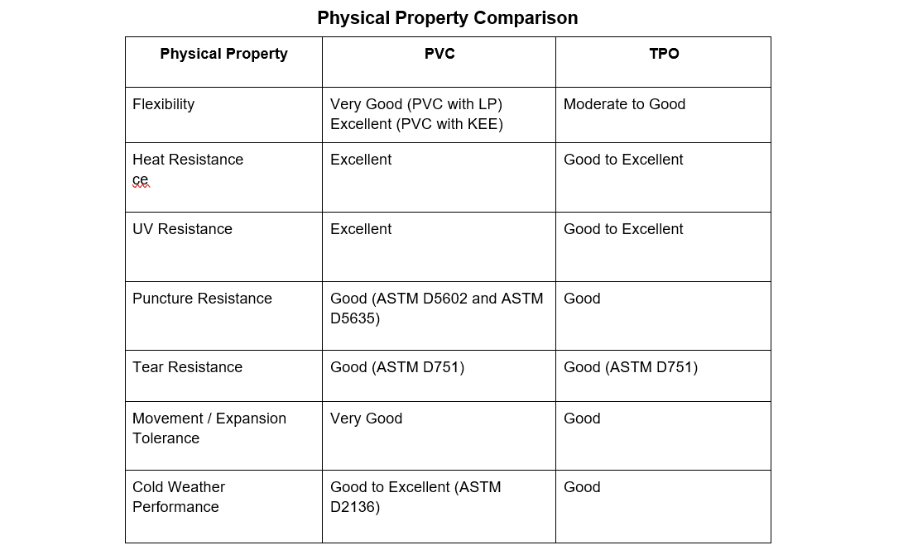
Chart courtesy of Siplast

Due to the protection it provides against grease, oils, and certain industrial pollutants, PVC KEE is a strong choice for any roof over a kitchen, restaurant, or industrial facility. Rooftops exposed to a wide temperature swing or are likely to experience more wear over time are good candidates for a durable and high-performing TPO. While these are generally good rules for assigning TPO or PVC for a given project, there are always nuances to consider to ensure the membrane is, in fact, the best option. Roofing is not a one-size-fits-all all, and there is rarely an immediately obvious option, but these characteristics provide an easy starting point to begin determining which membrane to choose. Working closely with the developer, designer, contractor, and installer will increase project efficiency and help ensure a seamless roof installation that meets the end user's needs and satisfies the owner.


Related: Best Practices for Commercial Roofing Installations


Installation and Maintenance Guidance

Installation methods for PVC and TPO are similar as they can both be either mechanically attached, adhered, or induction welded. The key to long-term performance includes proper design and proper preparation, meaning the roofing and construction professionals are well acquainted with the chosen membrane and informed about why it was selected. Experienced installers will be familiar with both systems, which is essential for executing a quality installation. This will also require specifying compatible components and high-quality materials.

Another consideration when choosing, installing, and maintaining the roof is ensuring proper slope and drainage, which may require using tapered insulation as needed. Contractors and installers will also have to ensure chemical compatibility and long-term fastening with adhesives and substrates, as well as consult local code requirements for fire resistance, wind uplift resistance, impact resistance, and energy efficiency.

Despite the high durability of PVC and TPO, which makes them a preferred choice for most applications, basic maintenance is still critically important for roof performance.. Keeping the roof surface free of debris, maintaining proper drainage, and inspecting the system regularly are crucial to ensure seams, flashings, and penetrations remain watertight. It is recommended to inspect the system at least twice a year, usually in the spring or fall, as well as after any major weather events or storms, and following instances of heavy foot traffic. With proper care, PVC and TPO roofing systems may have a service life of 20 to 30 years, depending on the installation method, membrane thickness, manufacturer specifications, and membrane chemistry quality. Membranes that are thicker, well-adhered, and installed with high-quality workmanship typically last longer and may qualify for longer-duration warranties or guarantees.

A highly durable single-ply roofing system is most easily achieved when all structural considerations are taken into account, including occupancy type, geography, and location. Closely analyzing how external factors and the project's intended use will affect the roof will provide professionals with the information needed to recommend PVC or TPO. Working with knowledgeable and experienced professionals to evaluate the site, design the system, and install the membrane is necessary for achieving a functional roof that will serve its intended purpose for several years. By following this outline, roofing professionals can become better acquainted with these two common single-ply roofing options and will serve as an informed resource for clients and other design and construction professionals.

This article was originally posted on www.buildingenclosureonline.com.
KEYWORDS: installation PVC (Polyvinyl Chloride) single-ply roofing Siplast TPO

Share This Story

Looking for a reprint of this article?
From high-res PDFs to custom plaques, order your copy today!
Peter Gross has led Siplast’s North American business development for single‑ply roofing and the company’s complete insulation portfolio, turning technical advantages into specification standards that architects and consultants can rely on. With nearly 25 years in the commercial roofing industry, Peter’s expertise and experience range from estimating complex assemblies to executive oversight on the contracting side. He continues to translate market intelligence into actionable roadmaps for R&D, manufacturing, and field sales, ensuring that innovative ideas move smoothly from lab bench to basis‑of‑design. As building‑envelope demands evolve, Peter is committed to keeping Siplast the partner of choice when performance matters most.

Recommended Content

JOIN TODAY
to unlock your recommendations.

Already have an account? Sign In

  • KEE membrane application on a roof

    A Beginner’s Guide to Single-Ply Roofing Membranes

    While PVC and TPO appear extremely similar, the chemistry...
    Low Slope Roofing
    By: Peter Gross
  • QXO TopBuild Graphic

    QXO’s $17B TopBuild Deal Expands Reach Across Roofing And Insulation

    Analysts say the acquisition expands QXO’s reach beyond...
    Roofing Supply Pro
    By: Tanja Kern
  • A couple stands facing a very nice home

    The Homeowner's Roofing Journey in 2026

    RC asked homeowners what their roofing journey was like,...
    Steep Slope Roofing
    By: Art Aisner
You must login or register in order to post a comment.

Report Abusive Comment

Manage My Account
  • eMagazine Subscription
  • Sign Up for the Newsletter
  • Online Registration
  • Manage My Preferences
  • Subscription Customer Service

More Videos

Sponsored Content

Sponsored Content is a special paid section where industry companies provide high quality, objective, non-commercial content around topics of interest to the Roofing Contractor audience. All Sponsored Content is supplied by the advertising company and any opinions expressed in this article are those of the author and not necessarily reflect the views of Roofing Contractor or its parent company, BNP Media. Interested in participating in our Sponsored Content section? Contact your local rep!

close
  • 3 roofers unrolling a roofing membrane
    Sponsored byGAF Commercial

    PVC: Protection. Versatility. Convenience.

  • You can't bring a dollar amount to peace of mind.
    Sponsored byDaVinci® Roofscapes

    Why Homeowners Are Investing in Premium Roofing Systems

  • A layeresd image including metal roofing
    Sponsored byFlashCo

    5 Common Misconceptions about ES-1 Edge Metal

Popular Stories

Vista North in Bemidji, Minn.

Minnesota Roofing Company Loses Most of Its Crew After ICE Arrests

St. Louis Skyline and Arch

Acusan a contratista de roofing de aprovecharse de víctimas de tornados

logos

SRS Acquires CORCO Commercial Roofing Business

Events

July 30, 2026

Pushing the Envelope - Going Beyond Conceptual Design

Credits: 1 AIA LU/HSW; 1 IIBEC CEH; 0.1 ICC CEU

The focus of this presentation is to dive deeper, beyond the concept, and into proper building envelope design.

December 7, 2026

Best of Success

Join roofing professionals from across the nation at the 2026 Best of Success conference, the ultimate destination for roofing professionals seeking the latest industry insights and networking opportunities. Pick up strategies for critical challenges like workforce shortage with innovative solutions, explore the latest advancements in roofing technology and sustainable practices, and gain valuable insights from industry leaders on navigating the evolving roofing landscape.

View All Submit An Event

Related Articles

  • Duro-Last®, Inc. Earns Highest Level of Sustainability Certification for Single-Ply Roofing Membranes

    See More
  • durolast

    Duro-Last Earns Sustainability Certifications on Single-Ply Roofing Membranes

    See More
  • Duro-Last Releases First Product-Specific PVC Environmental Product Declaration for Single-Ply PVC Roofing Membranes

    See More

Related Products

See More Products
  • Green Roof Systems: A Guide to the Planning, Design and Construction of Building Over Structure

  • roofingpic.jpg

    Managing the Profitable Construction Business: The Contractor's Guide to Success and Survival Strategies

See More Products

Related Directories

  • Duro-Last

    Duro-Last® is a leading manufacturer of custom-fabricated thermoplastic single-ply roofing systems. Known as the “World’s Best Roof®,” Duro-Last delivers durable, sustainable solutions with factory-controlled precision that eliminates up to 85% of field seams, reducing labor costs. Over 2 billion square feet are installed across North America.
×

Be in the forefront of the roofing industry!

Join thousands of professionals today. Shouldn’t you know what they know?

JOIN NOW!
  • RESOURCES
    • Advertise
    • Contact Us
    • Directories
    • Store
    • Want More
  • SIGN UP TODAY
    • Create Account
    • eMagazine
    • Newsletters
    • Customer Service
    • Manage Preferences
  • SERVICES
    • Marketing Services
    • Reprints
    • Market Research
    • List Rental
    • Survey/Respondent Access
  • STAY CONNECTED
    • LinkedIn
    • Facebook
    • Instagram
    • YouTube
    • X
  • PRIVACY
    • PRIVACY POLICY
    • TERMS & CONDITIONS
    • DO NOT SELL MY PERSONAL INFORMATION
    • PRIVACY REQUEST
    • ACCESSIBILITY

Copyright ©2026. All Rights Reserved BNP Media, Inc. and BNP Media II, LLC.

Design, CMS, Hosting & Web Development :: ePublishing