Dear Anna
AI In Construction—Transforming Client Acquisition
As decision-makers turn to AI instead of Google, contractors must rethink their websites and trust signals to stay visible and competitive.
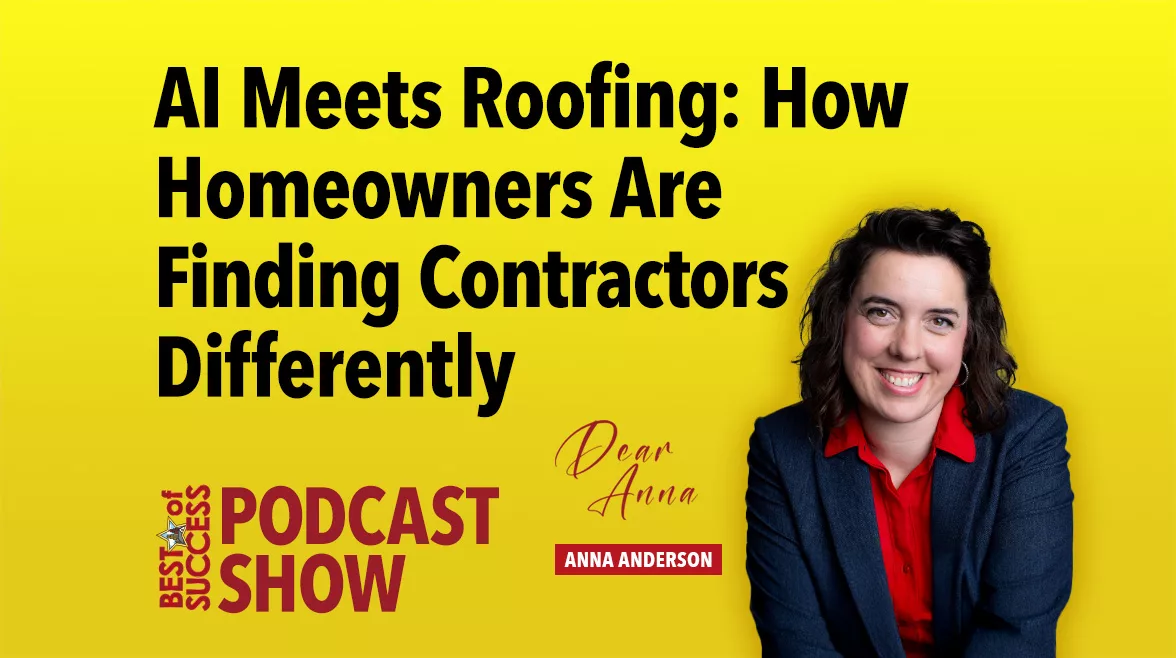
More and more homeowners—and commercial decision-makers—are skipping traditional Google searches and turning to AI tools like ChatGPT to find local contractors. That shift has huge implications for the construction industry, because unlike a search engine results page filled with links, AI typically recommends just three options, complete with personalized explanations for why those businesses made the list.
On a recent episode of “Dear Anna” on the Best of Success podcast, Jill Bloom, group publisher of Roofing Contractor and other brands, chatted with Anna Anderson, CEO of Art Unlimited, to unpack what this AI-driven search revolution means for contractors—and what they can do now to get ahead of it.

How Homeowners Are Finding Contractors Differently
In the latest “Dear Anna” podcast, marketing expert Anna Anderson reviews how decision-makers turn to AI instead of Google, and how contractors must rethink their websites and trust signals to stay visible and competitive.
Why the AI Search Shift Can’t Be Ignored
According to Anderson, consumer behavior has already crossed a critical threshold. Some data sources suggest that up to 50% of users now rely on AI to gather information digitally. Google itself has introduced forward-facing AI into search, signaling that this isn’t a trend—it’s the new baseline.
“The way businesses used to show up was through blue hyperlinks, map pack listings, and paid ads,” Anderson explained. “Now that experience is transforming. We’re moving away from pure pay-to-play and toward trust-driven visibility.”
What’s changed most dramatically is who—or what—is doing the searching. Instead of humans directly browsing websites, AI agents increasingly gather information on a user’s behalf, evaluate it, and present a short list of recommendations. For contractors, that means their websites must communicate trust, credibility, and clarity not just to people, but to machines interpreting their content.
Early Adopters Have the Advantage
Contractors who adapt early are far better positioned to succeed in this new environment. Anderson noted that longevity and consistency matter more than ever. Businesses that start building the right signals now will be better prepared as AI technology continues to evolve and intensify.
At the same time, contractors are navigating two parallel worlds: traditional paid lead generation through Google and emerging AI-driven discovery. The good news? Improving trust signals on your website benefits both.
“If you build trust into your website, you’ll see stronger performance across Google and AI platforms,” Anderson said. “That means better conversions and more leads.”
The Risk of Not Making the Top Three
One of the most unsettling realities for contractors is the idea that AI may only recommend three businesses. If you’re not in that group, you’re effectively invisible.
So what does it take to land there?
Anderson outlined six key website fixes contractors can make right now, starting with three foundational elements:
1. Clear pricing guidance. Even broad cost ranges help AI and decision-makers understand what to expect.
2. Strong reviews and testimonials. These should live on your website and across multiple review platforms—not just Google.
3. A robust “About Us” or team page. People still want to connect with people, and AI recognizes those human signals too.
Headshots, tenure, and team details don’t just reassure potential customers—they also reinforce credibility when AI agents cross-check information with platforms like LinkedIn.
Address Objections and Make Content Crawlable
The remaining three fixes focus on how your content is structured and delivered.
Contractors should use their core service pages to directly address common customer objections, whether through written explanations, visuals, or video. Sales teams already know what questions customers ask—those insights should be embedded into the website itself.
Project galleries and case studies also matter, but only if they can be crawled by search engines and AI tools. Many popular sales or pricing tools look great to humans but are invisible to AI.
“That’s why contractors need to start asking their software providers tougher questions,” Anderson said. “Is this indexable? Is it compatible with AI crawlers or generative engine optimization?”
Preparing for What’s Next
To help contractors understand where they stand, Art Unlimited has introduced an AI audit that evaluates how well a business aligns with both traditional SEO and emerging AI visibility standards.
“This is an incredible opportunity for forward-thinking business owners,” Anderson said. “If you ask the right questions now and get compliant early, you can get ahead of your competition instead of scrambling to catch up.”
As AI reshapes how customers discover contractors, one thing is clear: visibility is no longer about being everywhere—it’s about being trusted, understood, and chosen by intelligent systems acting on behalf of your future customers.Looking for a reprint of this article?
From high-res PDFs to custom plaques, order your copy today!