Techos Y Más Preview
From $3M to $36M: How One Roofer Spotted 'False Profit’
Tracking net cash flow exposed jobs losing money

Key Takeaways
- Gross profit doesn't equal cash flow. A roofing job showing a 30% gross profit margin may leave just 4% in net cash flow after overhead, taxes, debt payments and reserves.
- Unprofitable jobs can undermine growth. One roofing company discovered it was losing money on 25% of its jobs, representing more than $180,000 in potential additional net profit.
- Job costing should guide every estimate. Contractors can improve pricing decisions by calculating projected net cash flow before accepting a job and comparing estimates with actual costs afterward.
- Small cost overruns can erase profits. On a $16,000 roofing job, a $500 discount and $200 labor overrun reduced projected net cash flow from $689 to just $111.
- Cash flow discipline supports sustainable growth. Tracking the money remaining from each project helps roofing contractors avoid unprofitable work, manage expenses and fund expansion.
In its first year, a Georgia residential roofing company we worked with sold $3 million. Today, it brings in $36 million a year, does commercial work in several states and, for many years, grew without tapping its line of credit.
Its owner, Tomás, is not a finance person. He is a great salesperson who has always wanted to do things the right way. Good leadership, solid operation, outstanding customer service and quality people are behind the company’s growth. But one key difference is rarely mentioned.
Tomás did not settle for knowing the gross profit on each job, what most roofing companies call “job profitability.” Before signing, he decided to know the net cash flow from each roof: the money he would actually have left after paying everything.
He did not do it alone. His bookkeeper began filling out the Job Costing Tool for each job, and his operations manager took charge of tracking it, comparing estimates with actual results.
What they discovered changed everything: They were losing money on 25% of their jobs. If they had not taken those jobs, their net profit would have been more than $180,000 higher. With 80 fewer roofs. With fewer headaches, fewer crews tied up on jobs that did not pay and less legal risk.
They were selling more, working more and keeping less. “The Job Costing Tool opened our eyes to mistakes we were not seeing and transformed the way we make decisions,” Tomás says.
Since then, every job has faced the same question before it is signed: How much cash will it leave us? If the number does not work, the price is adjusted or the job is passed up. Because each roof is priced to generate cash, growth funds itself. That discipline, first mastered in residential work, allowed the company to enter the commercial market. There, the analysis became more sophisticated and even more important because jobs are larger, payments take longer and one poorly estimated job can sink the entire company.
False Profit
I call what that company learned to recognize false profit: Not everything you see as gross profit is really yours.
Consider a 31-square roof quoted at $16,000 plus sales tax. Variable costs total $11,386: wages and payroll taxes ($4,346), materials ($3,900), sales commission ($1,600) and other costs such as permits and dumpster fees. That leaves $4,926 in gross profit, or 30%. That is the number most people celebrate.
But that roof also must pay for its share of the office, insurance, vehicles and administrative staff: $3,423. The job’s net profit drops to $1,503, or 9%.
And it does not stop there. From that amount, $183 goes to taxes, $151 to debt payments and $480 to a contingency reserve for the unexpected. The roof’s net cash flow is $689.
Four percent. The owner saw $4,926. In reality, he keeps $689.
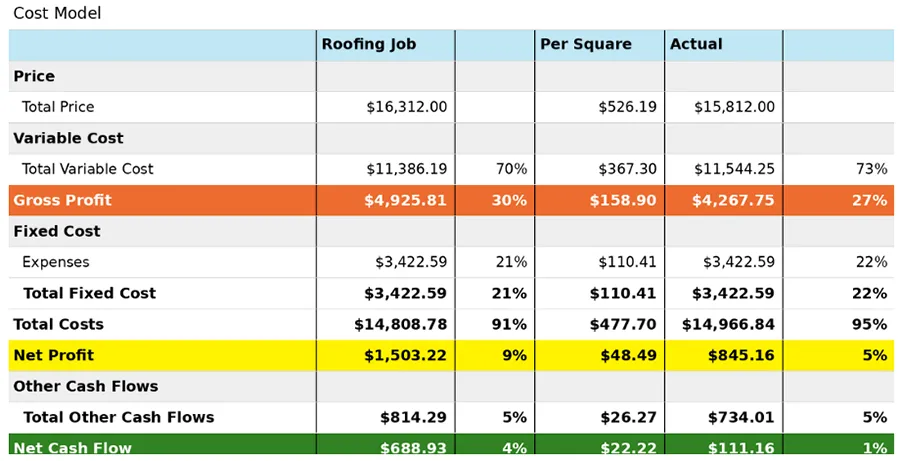
The same roof, estimated versus actual. A small difference in price and labor took more than 80% of the net cash flow.
Now look at the actual column. To close the sale, the price was reduced by $500, and labor cost $200 more than estimated. Gross profit fell to $4,268, still 27%, which looks good on paper. But net profit fell to $845, or 5%, and net cash flow to $111. One percent. One more discount and that roof would have cost the company money.
When we ask a contractor about the margin on a job, the answer is almost always the gross
profit margin: 20% to 30%. Their actual net profit is usually 5% to 10%, and their net cash flow is 0% to 5%. No one taught them to look at the right number.
This roof confirms a pattern we see again and again: If your net profit is close to 10%, your net cash flow is closer to 5%. If your net profit is 5%, you are practically at the break-even point.
That is why a company can look very good on paper and still be short on cash.
“Taxes and Debt Are Not Job Costs”
It is the objection we hear most often: The owner pays the taxes, and the debt belongs to the company, not the roof. But that money has to come from somewhere, and the company has only one source: the jobs it does. Every truck loan payment, every tax payment and every unexpected expense is paid from the net profit of some roof.
If you do not include it, you will still pay it with money you thought was yours. Net cash flow, what remains after those obligations, is the only money you truly have left: money you can reinvest, save or take home.
The Most Important Tool You Have
The Seven Steps of the Job Costing Tool
- Job price.
- Minus variable costs: wages, payroll taxes, materials, commissions, permits, dumpster fees, financing and card fees.
- Equals gross profit. This is where most people stop, and that is the danger.
- Minus fixed costs: the share of your annual overhead assigned to this job.
- Equals net profit.
- Minus other cash outflows: taxes, debt payments and a 3% to 5% contingency reserve.
- Equals net cash flow: your gold nugget.
Of all the financial tools available to a roofing business owner, the most important for managing the company’s finances and operations is the Job Costing Tool, as long as it goes all the way to net cash flow. In our sessions, we call that final number the “gold nugget.”
Start This Week
Take your last 10 roofs and calculate the net cash flow for each one. Write it in dollars, not as a percentage. You will probably find jobs that cost you money without realizing it. You do not have to do it alone: Rely on your bookkeeper and operations manager, as Tomás did. Then make it a rule: No estimate goes out without its gold nugget calculated. Every job, every time.
Tomás’ company did not grow from $3 million to $36 million just by selling more. It grew because it knew how much each sale was truly its own.
I’ll See You at Techos y Más
On Monday, Dec. 7, 2026, at the Hyatt Coconut Point in Bonita Springs, Florida, I will present “From Every Roof to Your Pocket: How to Keep More and Grow with Confidence.” For one hour, in Spanish, we will build a real Job Costing Tool together, step by step, from the price to the gold nugget.
You will leave knowing how to calculate net cash flow on your own jobs, how to spot the roofs that are costing you money and how to decide which jobs to take based on numbers, not gut feelings.
Bring the numbers from your last three jobs. That hour may be the most profitable one of your year.
Looking for a reprint of this article?
From high-res PDFs to custom plaques, order your copy today!