Keeping Humans Safe on the Job
How AI Helps Protect Workers At Heights
The use of AI in everyday tasks has spread over several industries, and fall protection is no exception
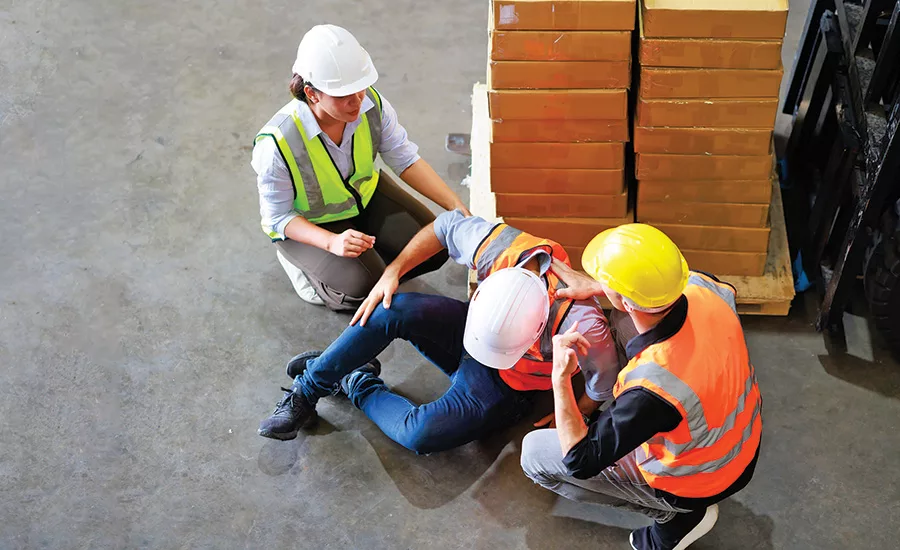
Fall protection is one of the oldest forms of workplace safety equipment, with scaffolds, rope access, safety railings, and ladders dating back to the construction of the Great Pyramids in ancient Egypt. Back then, workers used the latest technology to change how they worked and stay safer. Today, the latest technology—artificial intelligence (AI)—helps design the systems and equipment workers use, aiming to optimize productivity without compromising worker safety.
Current Uses for AI
AI use in everyday tasks has spread across several industries, and fall protection is no exception. Today, companies use AI to bolster their workers and field technicians with real-time, relevant data by searching company-organized knowledge databases. Instead of providing a legacy of company knowledge during the first few weeks of onboarding and hoping workers absorb it all, AI tools help employees answer questions without the legwork of manually retrieving the company data needed to find the right solution. It can also help project managers and other customer-facing roles by providing insights that enable better, more proactive service to clients. It can also help with necessary but time-consuming computational tasks, like writing code to develop software or entering data into metric-tracking programs.
Project Managers
Before an upcoming meeting with a client, the project manager’s AI assistant can conjure past meetings and communications, bring up relevant photos/videos/visually accessible work files (PDFs, social media posts, etc.), and offer “insights” into the customer’s meeting. It might provide reminders like, “follow up on the project’s start date to coordinate installation schedule,” or “ask if they figured out a solution for X problem?” In a world of back-to-back Teams calls, a quick debriefing before every meeting can help workers be more present and more effective for their customers.
Field Technicians and Inspectors
Once a field visit is scheduled, the AI assistant will generate all necessary inspection forms and other required reports based on the visit details, along with a customer debrief for the field agent to read before starting work. When a field agent visits a customer site, their AI assistant will pull up a “to-do” list of equipment that must be inspected or verified. This ensures effective use of the agent’s time and resources in the field and assures the client that the services being performed are thorough. Upon completing the service and inputting all the meeting data, the technician could then verify the results of the AI-performed paperwork to ensure consistency, instead of having to manually generate that paperwork themselves. It helps the field service team increase project completion rates and frees up time and mental load for the field agent.
Sales and Estimating
When a client provides a building in need of fall protection, the process is pretty cyclical: take measurements, design fall protection system(s), identify raw materials and components to manufacture, estimate costs, and present the plan to the client. Once you can identify a process, you can automate it. After training, the AI agents can design a fall protection system for a given rooftop. The estimator can then use that initial design as a starting point before finishing the project. Certain aspects, like user preference, client budget, or aesthetic design choices, are harder to program into AI bots, so a human is still required to ensure the project is thoroughly completed and all aspects are considered. After all, end users will rely on these systems to prevent injury and fatality. Qualified individuals must still verify accuracy and compliance with local regulations.
Product Design
AI also helps manufacturing and design teams for fall protection system designers. Manufacturing AI assistants help organize raw materials, production schedules, and other factors to optimize manufacturing capability for system components. For software development, AI bots can handle much of the daunting coding required to create simple software that helps customers configure rooftop guardrail designs for their own buildings. Developing these tools will help companies become more proactive in mitigating rooftop fall hazards and, eventually, lead to more fall protection solutions being installed.
Assistance with Data Entry
In our digitized world, employees must be masters of their craft and able to enter task-relevant data and details into computers. Data entry is its own job, but over time, companies lumped in the data-entry side of every task with performing the task itself. AI assistants can help close that gap so workers can focus on their work, while AI bots input data into our software for metric tracking and corporate visibility. Our data is valuable, but entering it into databases is daunting. AI is there to perform the repetitive, mundane tasks so humans can stay present in more nuanced or complicated tasks.
How AI Becomes More Helpful
As we feed these machines, they learn how to apply fall protection in an efficient, computational manner. This method does not guarantee to solve every solution correctly, most feasibly, or even most effectively with its first try (yet), but it helps provide a dedicated expert with an educated and calculated starting point to begin looking for “failures” in the system.
The task being completed is not half as sophisticated or complicated as the manner of knowing how to complete the task. But once a process is identified, it can then be automated. We must first program machines to perform the task for us, but programming that functionality into an AI agent requires a firm, fundamental understanding of how to perform the task itself. In this case, it’s about providing effective fall protection systems to protect workers from a range of hazards that could injure or unalive a worker. To increase AI’s effectiveness and helpfulness in protecting workers, we must ensure the people teaching those AI machines are competent, qualified, and capable.
Going Forward
It’s exciting to consider the potential capabilities of feeding machine-learning AI agents, as the possibilities are limitless. As these machines learn and draft limitless “first draft” proposals for rooftop fall protection solutions, they can then proactively find other areas where that solution (or a very similar one) could be applied. From a business perspective, producing something once takes effort; producing it again is just following a process. While every rooftop is different, many follow a similar, rectangular or basic-shaped outline. An AI agent could then identify other buildings with similar rooftops and provide draft proposals for those rooftops as well. Over time, the data compiled on occupational injuries and wellness will build a consensus on which solutions can address occupational hazards. AI bots can pull data from real-life projects with field-tested solutions and then compose solutions for future projects.
Since OSHA enforces compliance equally across all buildings, any fall hazards would not only be subject to citation but, more importantly, would remain dormant hazards vulnerable to activation by an unsuspecting or complacent worker. To prevent future falls across all facilities, AI agents could proactively offer building owners and employers fall protection services and, at a minimum, provide solutions for potential rooftop hazards. While every company will implement fall protection at its own pace and need, it is important that every company is on a steady path toward eventually mitigating all known hazards in their workplace.
Conclusion
AI can help us perform some tasks faster, more thoroughly, and more efficiently, but it can never hope to replace the need for humans to remain present and involved in the work being performed. We may be able to monitor a machine delegated to handle repetitive or monotonous parts of a larger task, but even the most sophisticated algorithm will never synthesize the nuance and critical thinking required to understand more important aspects of a project. These machines learn from us and how we follow procedures, so their capabilities will also be limited to our ability to communicate the information required to fully complete a task.
The use of AI in the workplace does not negate our need to use our unique human talents and abilities to help each other. Providing fall protection is difficult to program into a machine because it is a craft that requires empathy towards another person and a desire to keep them safe. It is observing a worker facing a potential hazard that could jeopardize their health, well-being, and overall quality of life. A machine looks at a problem and quickly identifies a solution. A human looks at a problem and quickly identifies another human who needs help.
Help comes in many nuanced ways, and while providing a comprehensive fall protection solution for your building’s rooftop is certainly one of them, it takes an educated expert to understand how to deliver this service effectively. The best fall protection solution is not always the most efficient in terms of components, or the most sophisticated in fancy engineered solutions; nor is it the most cost-effective, but it is the one that keeps workers safe every day. Over time, this new technology will become even more useful and capable of helping us protect workers, prevent falls, and save lives.
AI might not have a body, but it can help protect everybody from falls.
Looking for a reprint of this article?
From high-res PDFs to custom plaques, order your copy today!