Technology News
A New Houzz Report Says AI Can Save Construction Pros $170K
AI innovation in construction and design creates a competitive advantage for pros who adopt it.

Photo courtesy Pixabay. Edited by Tanja Kern.
While tech giants like Microsoft, Meta, and Amazon are reshaping their workforces and investing billions of dollars in artificial intelligence infrastructure, the AI revolution is quietly transforming traditional industries, including residential construction.
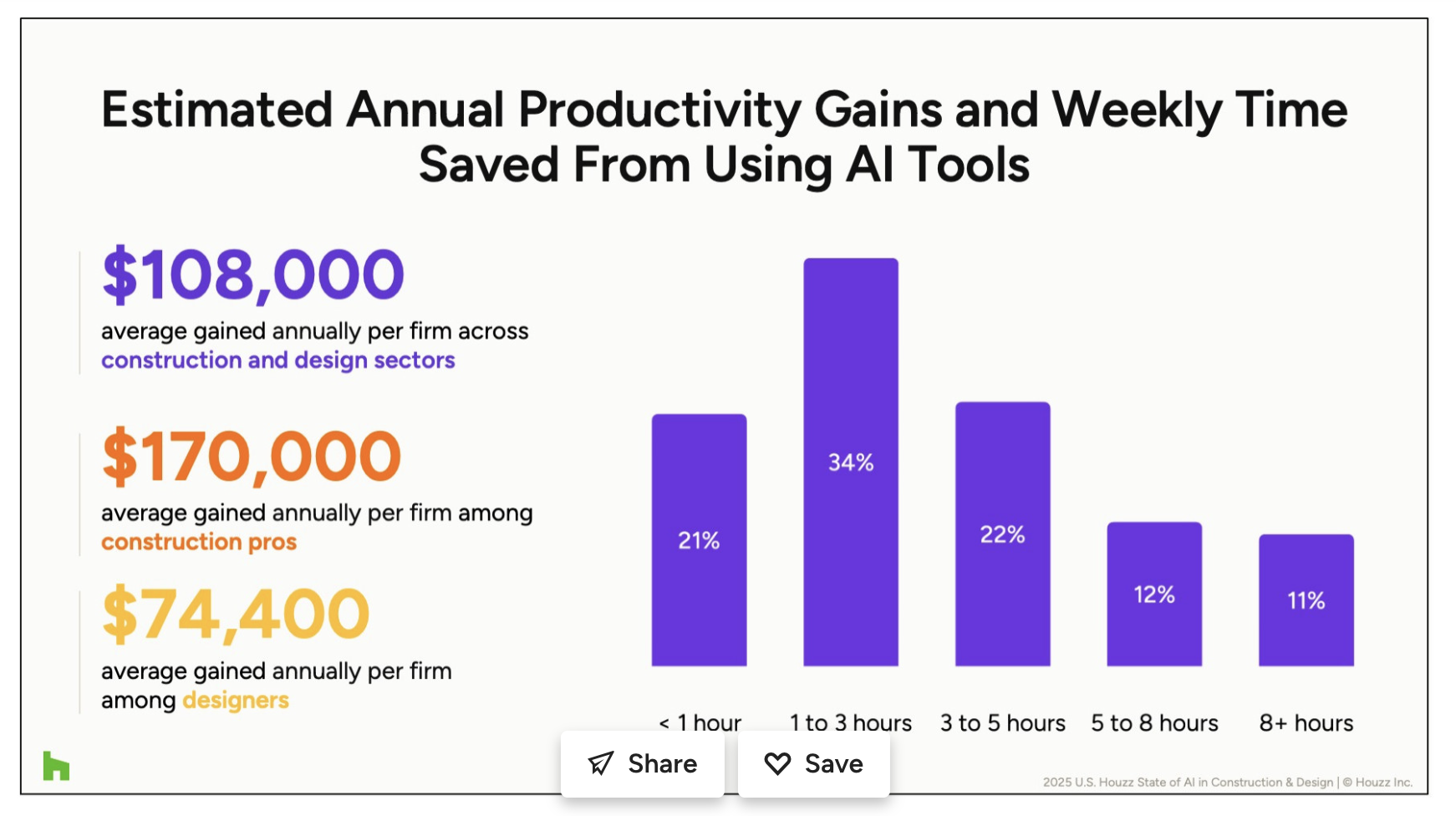
A new report from Houzz reveals that AI is rapidly gaining traction in the construction and design sectors, with nearly one-third of construction professionals already incorporating AI tools into their businesses. The 2025 U.S. Houzz State of AI in Construction and Design Report, based on a survey of over 700 professionals, reveals that 32% of construction professionals are currently utilizing AI, saving an average of more than three hours per week—productivity gains that translate to approximately $170,000 annually for construction firms.
"AI innovation in construction and design is accelerating, creating a competitive advantage for pros who adopt it," said Houzz Co-Founder and CEO Alon Cohen. "The next wave of transformation will be driven by AI solutions that integrate seamlessly into workflows for greater efficiency and accuracy."
The data reveals a clear split in the industry's approach to AI adoption. While nearly three-quarters of construction businesses (74%) report experimenting with AI in at least some parts of their workflow, most are taking a cautious approach—only 28% have integrated AI across many or all areas of their business.
This hesitancy is particularly pronounced among smaller firms. Large construction companies with 10 or more employees show adoption rates roughly twice as high as the industry average, suggesting that scale provides the resources needed to test and implement new technologies. These larger firms are more likely to have dedicated staff for specialized functions like marketing and estimating, making AI integration more manageable.
Joe Marchionni, owner of Amity Home Maintenance Solutions in Branford, Conn., exemplifies this measured approach. He's been testing ChatGPT and Claude AI for several months to create proposals and website content, but maintains human oversight.
"I don't rely on it to answer entire questions, but it is nice for getting the base of the answer in place, then I can go through it manually and tweak as needed to provide further explanation on what I found on someone's roof, like flashing issues, chimney issues, siding issues, etcetera," Marchionni said.
Practical Applications Drive Adoption
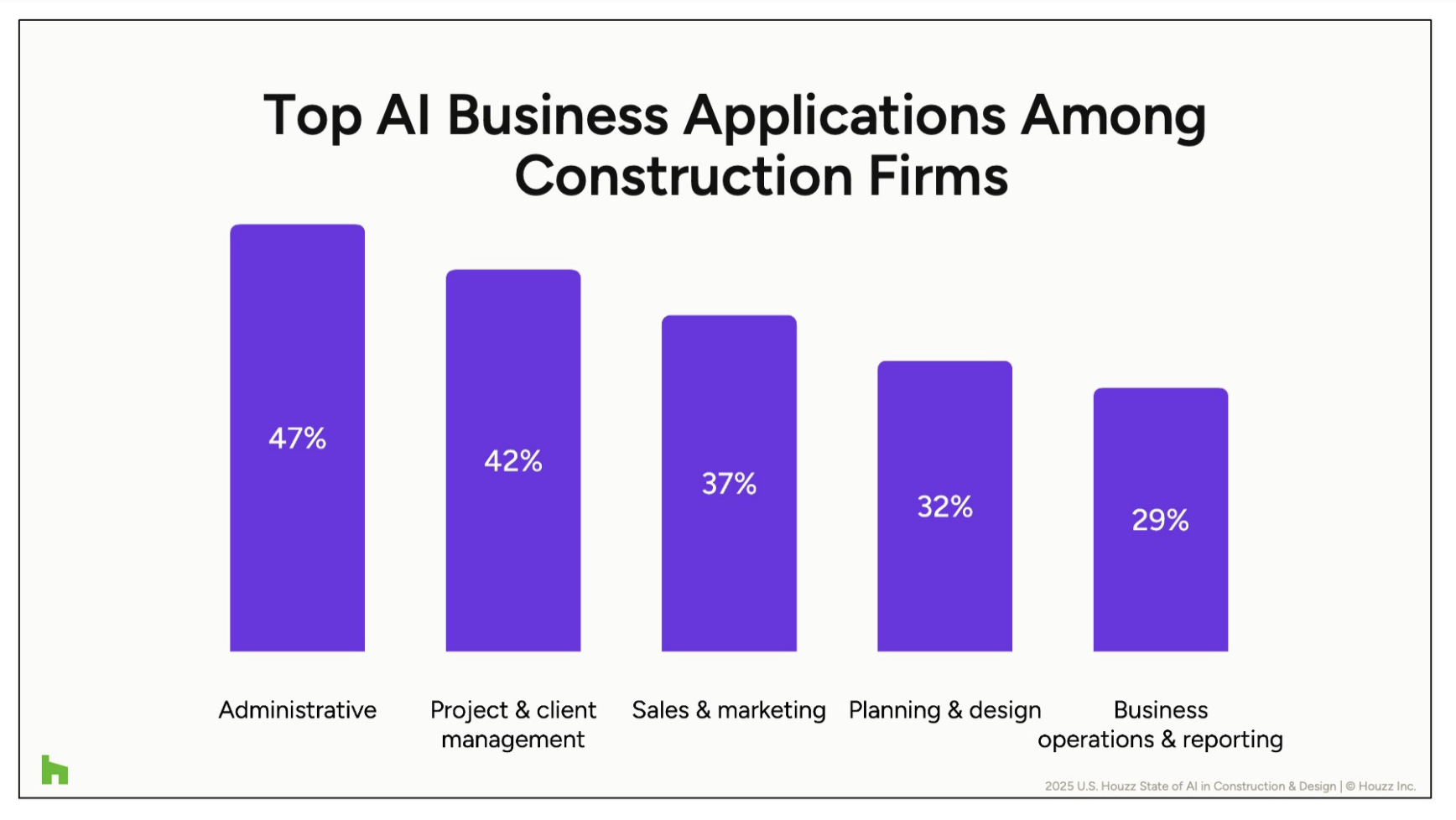
Construction professionals are focusing AI use on areas that deliver immediate efficiency gains. Nearly half (47%) use AI for administrative tasks, while 42% apply it to project and client management—routine but time-intensive functions where automation can quickly reduce workload.
Andre Kazimierski, co-owner and president of HomeHero Roofing in Downers Grove, Ill., said his company prioritizes maintaining direct customer relationships while selectively using AI behind the scenes.
"When you do work like we do, it's so important to focus on building strong relationships with your customers and establishing trust, so we don't use AI chatbots or implement AI in many customer-forward ways," Kazimierski explained. "We know that our customers want to speak to us directly."
However, he's found value in AI for project management and marketing analytics, emphasizing that any AI implementation must deliver "substantial value in return."
The technology shows particular promise in visual applications. Dan Staupe, owner of Compass Exteriors in the Twin Cities metro area, highlighted AI rendering as a game-changer for client presentations.
"I cannot emphasize enough how nice it is to be able to illustrate to a client exactly what something is going to look like," Staupe said. "You can show a client how different roofs would look like, different colors, materials, pitches—it's obviously fantastic for the client to be able to get an idea of what it's going to look like, because roof replacement is huge expense."
RELATED: Dear Anna: How Do I Optimize for AI-Overviews?
Despite growing adoption, the industry faces a significant training challenge. The vast majority of construction professionals using AI—more than 90%—report having no formal instruction in how to apply the technology to their work, according to the Houzz survey.
This skills gap could become a competitive differentiator as AI tools become more sophisticated and widespread. Companies that invest in training and systematic AI integration may find themselves with substantial advantages over competitors who rely solely on ad-hoc experimentation.
Looking for a reprint of this article?
From high-res PDFs to custom plaques, order your copy today!