Storm Watch
Arizona Hail Could Mean a Month or Two of Roofing Work
Arizona roofing contractors report damaged roofs as homeowners begin assessing the effects of two days of severe weather
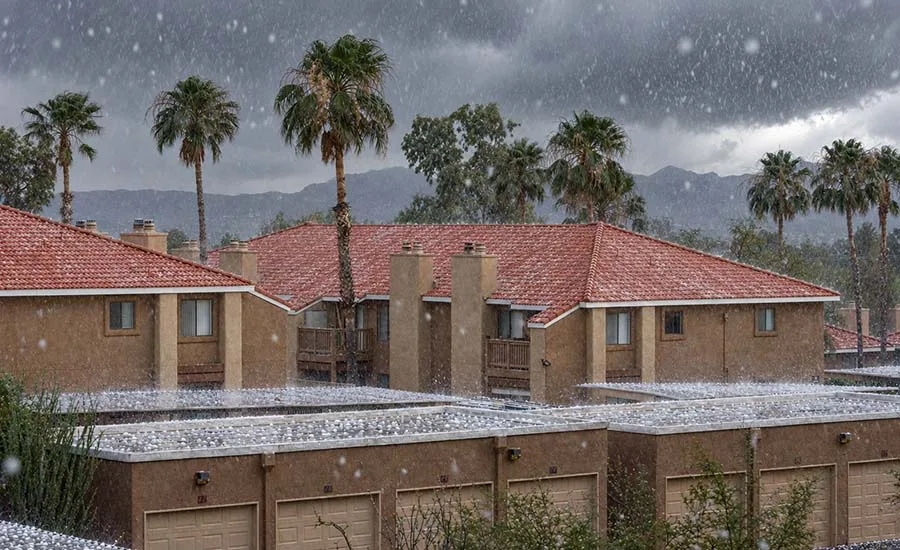
Roofing contractors across the Phoenix metropolitan area are assessing damaged roofs after two days of severe thunderstorms brought large hail, damaging winds and heavy rain to parts of the Valley.
The storms struck different sections of the metro area Oct. 20-21, with contractors reporting damage stretching from Chandler and Mesa to North Phoenix and Deer Valley.
A video taken during a hailstorm on October 21, 2026, by Tyler Johnson, owner of Johnson Roofing in Mesa, Arizona
The National Weather Service in Phoenix described the first round as a supercell that traveled from Chandler northeast through Mesa and produced several reports of large hail. Preliminary storm reports included a photograph of hailstones measuring roughly 1 to 2 inches about 3 miles east-northeast of Mesa. Downed power lines were also reported nearby. The threat continued Wednesday as a strong low-pressure system brought additional rounds of storms across central and eastern Arizona.
Early modeling suggests the storms could produce significant insurance losses. Canopy Weather, a private weather-data and analytics company, estimates the Oct. 21 hail outbreak could generate about 10,300 claims and $242.5 million in losses across Arizona, Nevada, Utah and New Mexico, with roughly 136,000 structures potentially affected. The company’s broader three-day estimate puts potential losses across nine Arizona counties at $379 million. The figures are modeled projections, not verified claims or actual insured losses.
Contractors Find Roof Damage
For Tyler Johnson, owner of Johnson Roofing in Mesa, determining the extent of the damage has already begun.
"We're in the thick of assessing the hail damage," Johnson told Roofing Contractor.
Johnson said much of the damage his company is encountering is on asphalt shingle roofs.
"The most significant damage has been to shingles, but clay tiles also took damage because they are more brittle than concrete," Johnson said. "Flat foam roofs also took damage. Concrete not so much."
Johnson described the hardest-hit area his company is seeing as centered around Mesa, with the storm moving from Chandler northeast through Mesa and Fountain Hills.
That assessment closely tracks the National Weather Service's description of the supercell moving from Chandler northeast through Mesa. The NWS also issued a severe thunderstorm warning late Oct. 20 for a storm north of Mesa moving northeast toward Fountain Hills. The agency warned that hail and 60-mph winds could damage vehicles, roofs, siding and trees.
Another round of severe weather Wednesday brought hail to North Phoenix and Deer Valley, expanding the area where contractors are watching for roof damage. Jeff Gordun, vice president of delivery for Power Home Remodeling's Phoenix territory, said the company had received only a handful of homeowner calls immediately following the storms, but he expects inspection requests to increase.
"Since we're not too far out from the storm, we've only received a handful of calls from homeowners concerned about potential damage to their roofs," Gordun said. "However, I anticipate receiving many messages reporting damage or simply asking for a quick inspection from homeowners in the North Phoenix region."
Based on what he has seen and reports from the area, Gordun identified North Phoenix and Deer Valley as the areas of greatest concern. He said Scottsdale, Mesa, Chandler, Gilbert and Tempe also received hail, although damage varied.
"Some roof damage may take time for homeowners to discover," he said. "Sometimes, it's hard to tell at a quick glance whether a tile or a shingle looks damaged, but as you get up close, you'll be able to see any cracks, chips, or broken pieces," Gordun said.
He cautioned homeowners against climbing onto roofs themselves, particularly while surfaces remain wet or potentially damaged. Gordun said roof age and hail size will play roles in determining the severity of damage, with older roofing systems potentially more vulnerable. He also pointed to another potential concern for contractors and homeowners: rooftop solar. For homeowners with solar, I recommend they also get their systems looked at, Gordun said.
Like roofs, solar is also impact-rated and tested, but sometimes after harsh storms like this one, the solar system might be working as usual but is still damaged.
How Much Roofing Work Will Follow?
Despite the size of the hail, Johnson doesn't expect the event to approach the magnitude of the historic 2010 Arizona hailstorm.
"The size of the hail was massive, but the duration was short, so it could be a month or two of work, but nothing like the 2010 hailstorm that kept us backed up for a year," Johnson said. "The breadth of the storm was not severe over a large area."
Gordun also expects the storms to affect contractor workloads and insurance claims, although he said it remains too early to quantify the impact.
"The last time we've had a storm on this level was back in 2010, and at that time, there were billions reported in general property damage," he said. "There's definitely damage here which will impact contractors' workloads and insurance claims, but it s too soon to tell."
That uncertainty makes the next several weeks important for determining whether the storms produce a relatively short surge in repairs or a more substantial reroofing event.
Meanwhile, inspections underway across the Phoenix metro should give Arizona roofing contractors a clearer picture of the storm's impact in the days ahead.
Johnson's early assessment suggests the hail was severe enough to damage multiple roofing materials but may have been too geographically concentrated to create the kind of prolonged roofing backlog that followed Arizona's historic 2010 hailstorm.
"The breadth of the storm was not severe over a large area," he said.
Looking for a reprint of this article?
From high-res PDFs to custom plaques, order your copy today!