Roof Ventilation
Why Are Ridge Vents Popular with Roofers?
Roofing contractors are asking if there are maximum building widths and rafter run limitations.
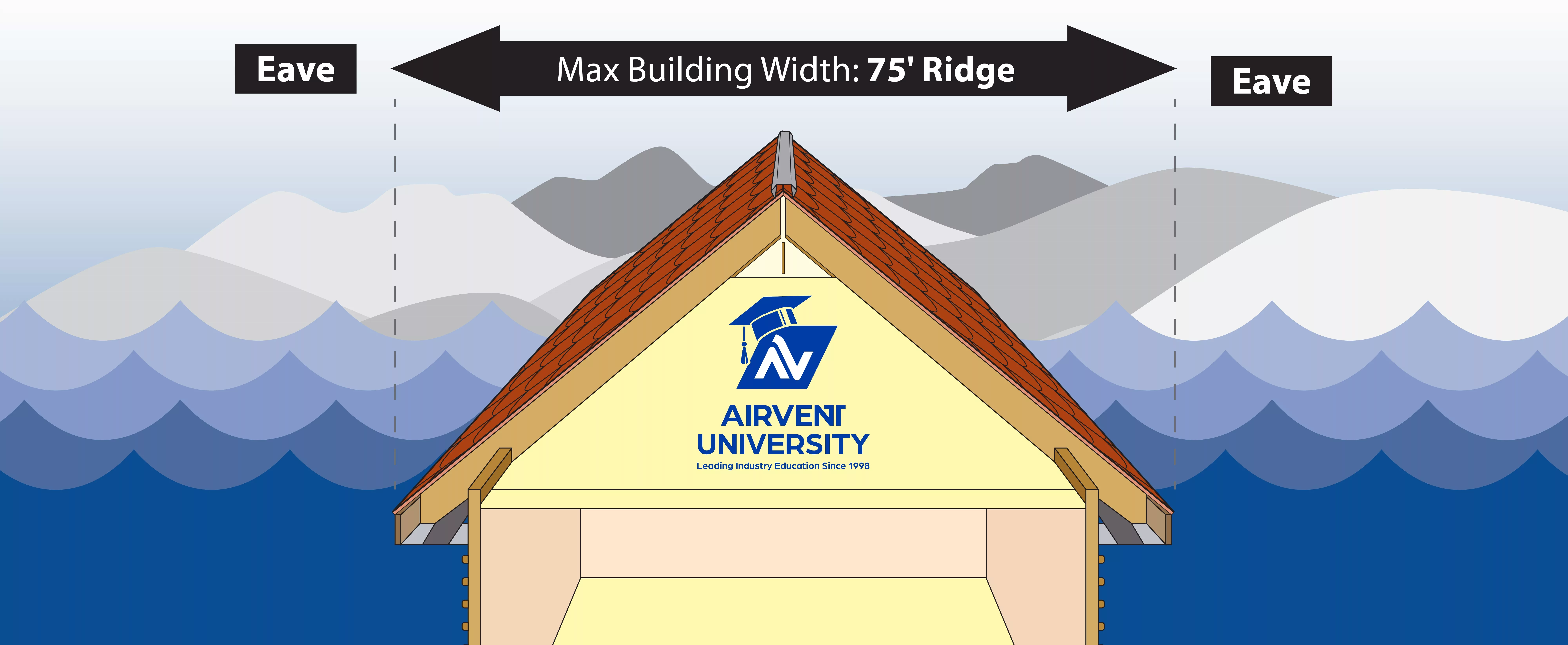
Ridge vents have become a popular attic exhaust vent choice because of the combination of their low-profile, nearly invisible appearance on the roof and their continuous, uniform airflow performance. Unlike the other four categories of attic exhaust vents – wind turbines, box vents/off-ridge vents, gable vents, and power fans – ridge vents are installed all along the peak of the roof to provide non-stop exhaust airflow. If the house is well suited to their use, ridge vents are an excellent attic exhaust solution.
But is there a point at which the house or building is too wide, making the ridge vent ineffective? It’s a common question asked at our seminars.
I’ll define house/building “width” as the distance from eave to eave in plan view straight across the house or building. Picture a tape measure in my hand and I’m running a straight horizontal line from one eave to the other eave, regardless of the roof pitch.
75-Foot Rule
With that in mind, a combination of ridge vent (for attic exhaust airflow) and a balanced amount of intake airflow (pick the most suitable type of intake for the project) will be effective on a roof that is 75 feet wide or less. This assumes the ridge vent being used provides 18 square inches of Net Free Area per linear foot – which is common in the industry – and is balanced with sufficient intake ventilation.
This 75-foot maximum width is based on establishing absolute minimum International Residential Code (IRC) requirements for airflow through an attic @ 1 square foot of Net Free Area for every 300 square feet of attic floor space balanced with 50% intake and 50% exhaust airflow. To stay within the 1/150 IRC building code airflow requirements (1 square foot of Net Free Area for every 150 square feet of attic floor space balanced with half intake and half exhaust airflow the maximum) the total width would have to be 37 ½ feet or less. Again, that’s a straight line eave to eave across the roof.
These maximum width numbers are based on the building code requirements and the Net Free Area specifications of the ridge vent.
What About Rafter Runs?
Another common question we receive from the roofing industry is, “What’s the maximum rafter run on which you can use a ridge vent?” By rafter run they’re asking about the distance from the eave to the peak of the roof on one side of the roof.
There are two answers to this question, depending on the type of attic involved.
- If it’s a traditional attic with a flat floor on which you can walk or crawl around in the attic, store items in the attic if you want, there is no limit to the rafter run. It does not matter what the distance is from the eave to the peak of the roof. But please keep in mind what was explained above regarding the maximum width of the house or building.
- If it’s a cathedral ceiling attic – defined as the 1.5-inch-wide gap between the roof deck and the attic insulation that was supposed to be factored in during the original build – the rafter run max is 35 feet. That means the combination of balanced intake ventilation with a ridge vent for exhaust will provide proper airflow through the 1.5-inch wide cathedral ceiling attic with rafter runs up to 35 feet.
For cathedral-ceiling attics with rafter runs longer than 35 feet, the airflow gap between the roof deck and the insulation should be at least 2 to 3 inches to provide a clearer path for air to travel over the extra distance.
Visit the Learning Hub at gibraltarbuildingproducts.com for more information.
Looking for a reprint of this article?
From high-res PDFs to custom plaques, order your copy today!