Ventilation
Be Careful Cutting that Ridge Vent Airflow Slot
Wider is not better, experts say

We are often asked if cutting a wider airflow slot for the ridge vent will allow it to exhaust more air from the attic. The answer is “No.” In fact, wider is potentially problematic.
Here are some general tips based on the incoming questions we field, but remember: always follow the installation instructions of the specific brand of ridge vent you are installing.
When there is a center board (also called ridge board or ridge pole) at the peak of the roof, cut a three-fourths-inch wide airflow slot on each side of the center board after clearing the width of the center board itself. This will result in an overall airflow slot that is approximately 3 inches wide. However, 1.5 inches of the slot is obstructed by the center board. That’s OK because the ridge vent will still have an airflow slot that is 1.5 inches wide, clear and free (see “Ridge Pole” illustration).
For truss construction, there isn’t a center board involved at the peak of the roof. There’s no ridge board. There’s no ridge pole. That means there’s no center board to clear when cutting. Instead, the airflow slot is cut 1.5 inches wide total (see “Truss Construction” illustration).
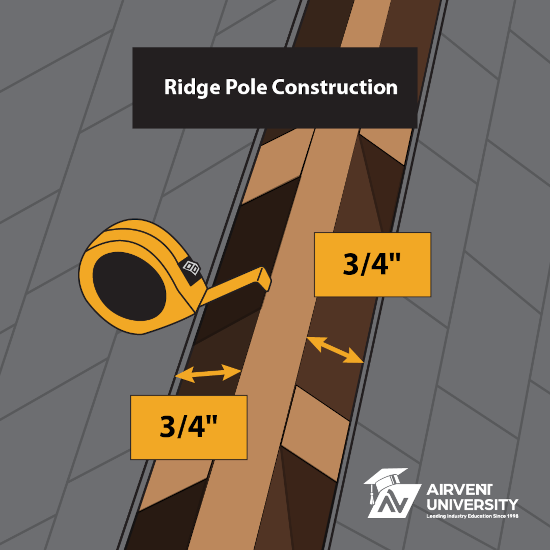
Image courtesy of AirVent Inc.
Listed NFA Value
As it turns out, the slot width is designed to match the amount of Net Free Area, or NFA, or airflow capacity provided by the ridge vent itself. For example, a ridge vent listed as having 18 square inches of NFA per linear foot has physical airflow openings on the vent that allow 18 square inches of NFA per linear foot. Over the span of 1 linear foot, a 1.5-inch-wide airflow slot cut into the roof's peak will also allow 18 square inches of NFA per linear foot, which then passes through the ridge vent itself. Look at it this way: 1 linear foot is represented by the number 12. If you multiply 12 by 1.5 (which is the width of the airflow slot), it equals 18.
Likewise, a three-fourths-inch wide slot on both sides of a ridge pole over the span of 1 linear foot equals 18 square inches of NFA per linear foot, which then passes through the ridge vent itself. Let’s look at that another way: 12 (which is 1 linear foot) multiplied by .75 (or three-fourths of an inch representing the airflow slot) equals 9. That’s 9 on the left side of the ridge vent and 9 on the right side for a total of 18 per linear foot.
Cutting the ridge vent slot wider than the installation instructions require does not increase the ridge vent’s NFA capacity. That’s because the actual airflow through the vent (once the ridge vent airflow slot in the roof deck is cut correctly) is restricted by the airflow openings on the vent itself. The ridge vent only allows so much air to pass through.
While it may seem logical that cutting an extra-wide slot into the peak of the roof deck allows more air to pass through the ridge vent, the fact is that the manufacturer designed the vent with a specific number of airflow openings. Those airflow openings in the ridge vent determine the amount of air that passes through the vent, regardless of how extra wide the slot is cut into the roof deck. They are the final passage point.
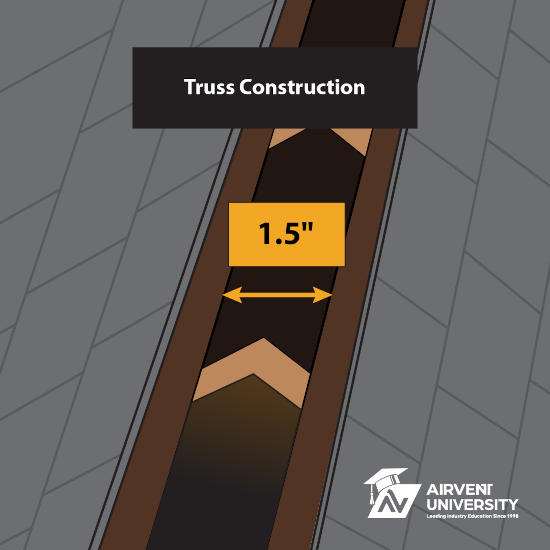
Image courtesy of AirVent Inc.
Word of Caution: Weather
There is the potential for weather infiltration if the airflow slot is cut too wide. The ridge vent must fully cover the airflow slot cut in the roof deck without that slot getting close to the vent’s airflow openings, which could then allow weather entry. Again, refer to the ridge vent’s installation instructions.
For the airflow slot length, cut it along the ridgeline 6 inches from the end wall or hip intersection. Cut the slot length 12 inches from a chimney or an intersecting ridgeline. For maximum curbside appeal that homeowners tell us they love, run the actual ridge vent to the end of the horizontal peak of the roof (even though the airflow slot stops short of the end of the roof peak). This results in a clean, continuous, uniform line or profile at the top of the roof instead of an uneven, discontinued line or profile when the ridge vent stops short of the end of the roof.
Inside the Learning Hub of our website is AirVent University, where we introduce a monthly Lesson Plan and a fast 5-Question Pop Quiz. Check it out for more topics that tackle tricky roofs and common mistakes to avoid.
Looking for a reprint of this article?
From high-res PDFs to custom plaques, order your copy today!