Roofing at Scale
How Best Choice Roofing Is Scaling AI Across 80 Locations
The national roofing giant is standardizing its operations as it pushes toward $350M in annual revenue.
Key Takeaways
- Standardization is the precondition for AI, not an afterthought: Best Choice didn't deploy AI and then figure out the data problem: They built consistent workflows across 80-plus locations first and layered intelligence on top.
- The operators winning at scale are growing revenue without growing overhead. The most successful contractors on the platform are processing more jobs with the same back-office footprint.
- Fear is the roofing industry's biggest technology gap: Barnett is candid that most of his peers are scared of AI, not ready for it. That gap is a competitive advantage for early movers.
When Bryce Barnett describes the roofing industry’s relationship with artificial intelligence, he reaches for a statistic. “Ninety percent of the world hasn’t even opened up ChatGPT yet,” he said. “To me, that’s a weird thing to wrap your head around—but it’s legitimately true.”
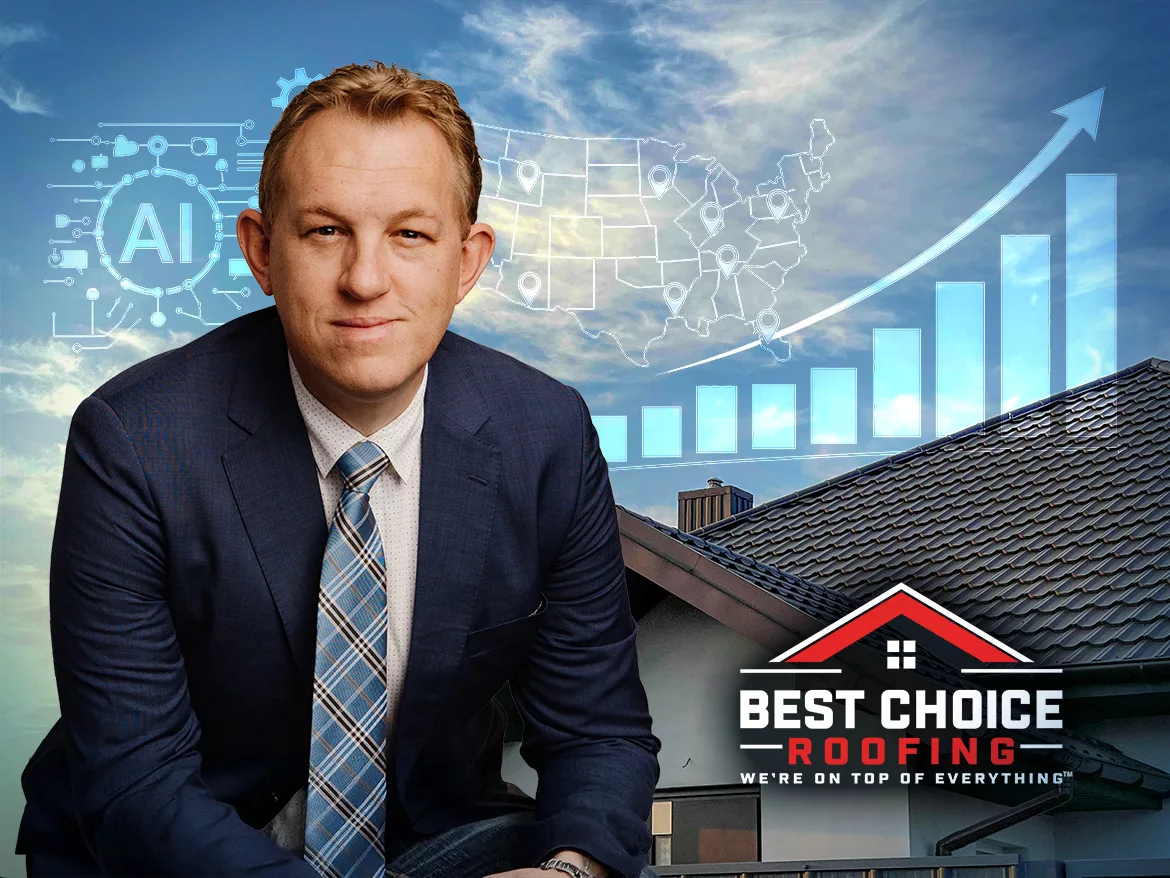
Barnett is CEO of Best Choice Roofing, one of the top 10 residential roofing contractors in the United States. Founded in 2009, the company now spans more than 80 branches across 25-plus states, has completed over 150,000 projects, and surpassed one billion shingles installed. The company reported over $297 million in revenue in 2024.
That kind of growth is not managed off a whiteboard. Best Choice has standardized its operations on ServiceTitan, the trades software platform that went public on Nasdaq in 2024.
Consistency First, AI Second
Before a multi-location operator can think seriously about AI, it has to solve a more foundational problem: consistency. “To truly get an ROI out of AI, what you need first is data,” said Nina Katsman, general manager of exteriors at ServiceTitan. “To have data, you need all of your people on one system, doing the same things at the same time.”
Barnett has one word that breaks a multi-location business: inconsistency. “We’re constantly trying to battle the need to get out of tribal knowledge," he said. "Every homeowner needs the same excellent experience, whether we’re in Huntsville, Alabama, or Bowling Green, Kentucky.”
The platform is configurable rather than customizable—a distinction that matters at Best Choice’s scale. The company operates in both insurance-driven markets across the Southeast and retail-focused markets like Portland and Phoenix where storm claims are less prevalent.
“Once you have that set up, the end user has a consistent, predictable workflow they don’t need to think through every single time," Katsman said.

41 Days to Under 20
Eighteen months ago, Best Choice averaged 41 days between contract signing and roof installation. Today, that number is below 20.
“Because of that visibility, we can start asking deeper questions: Why is it taking so long? What can we do to make it a really delightful experience?” Barnett said.
The answer comes back to basics: homeowners want to protect their most valuable asset and move on. Cutting the timeline in half is the goal.
Field teams now carry iPads running ServiceTitan’s mobile application. A sales rep sitting at a homeowner’s kitchen table can generate an estimate, tie it to a contract, and digitally order materials before leaving.
“These are $15,000 to $20,000 decisions,” Barnett said. “Being able to sit down with that scope in hand makes it so much more powerful.”
For Barnett, standardization is just the starting point. Best Choice has deployed four AI technologies in the past six months, with three more launching in the next 90 days. The most operationally significant is in recruiting: with thousands of hires annually and 250 to 300 people onboarded each week, the company implemented an AI system that handles job postings, conducts initial screening interviews, and schedules final interviews with branch managers. “You can’t do that without having technology behind you,” Barnett said.
The second focus is operational normalization. Barnett’s goal is to use AI to surface shortfalls across branches and push specific, prioritized recommendations to managers. The clean, consistent data flow is what makes those overlays possible. Katsman describes the most successful operators on the platform as those who “grow without scaling the back office as quickly,” adding revenue and processing more jobs without adding proportional overhead.
For all his own confidence around AI, Barnett sees fear as the dominant emotion among his peers. “Short term, for most of our industry, it’s an incredibly scary proposition,” he said. “Lots of people are talking about it, but they don’t know how to implement it.”
His prescription: dive in.
“Each company gets to use it how they need to. It scales the same way whether you’re opening your 82nd branch or your second.”
Katsman adds that patience through the change management process is non-negotiable. “Consistency gives employees the boundaries within which they can flourish."
In roofing, standardization is what makes AI actually work. With a PE backer and 10 to 15 new locations on the horizon, Barnett is building the foundation before he needs it.
Looking for a reprint of this article?
From high-res PDFs to custom plaques, order your copy today!