Negative Review Scams: How Roofing Contractors are Fighting Back
Contractors share their horror stories and how they saved their reputations against negative review onslaughts
DryTech Exteriors of Ohio takes pride in its Google review rating, maintaining an impressive 5.0 based on 655 reviews as of the end of 2025.
But it wasn’t always this pristine, and they had to fight to keep it that way.
Back in 2023, Allie Hosler, co-owner of DryTech, recalls receiving a push notification from Google on her phone about their latest review. Her stomach dropped upon seeing the content.
“This was a one-star review, not from a customer, but from an account located in Bangladesh,” she said.
This was soon followed by a series of one-star reviews over two weeks. The reviews accused the company of bad behavior, like leaving a “horrific mess all over my yard,” and provided what the reviewers claimed were photos of the offenses.
After the deluge of reviews, the company received a call from someone in India demanding a ransom in exchange for removing the one-star reviews.
“Our society has become review-driven consumers,” Hosler said. “Whether it’s a $10 sandwich or a $20,000 roof, everyone checks reviews. Good or bad, it’s a system that, if not monitored, can be devastating, and scammers know this.”
Roofing Review Scams
Spotting a Fake Review
Anna Anderson, CEO of marketing agency Art Unlimited, said there are a few things contractors can keep in mind when managing reviews to determine if they’re legit or fake.
“You have to have enough context on these reviews before you are able to patch together what’s happening,” she said.
- Determine if the reviewer is legit. If a reviewer’s profile was recently created, or they have a history of leaving bad reviews, their review may not be genuine.
- Check company records. Determine if any details match up to company records or jobs within the timeframe.
- Look for anomalies. If the content in the review is suspect, such as quirky wording or mentioning services you don’t provide, it may be spam or fraudulent.
The timing matters. If the negative review arrived with a slew of others, it might be part of a coordinated effort and likely a scam.
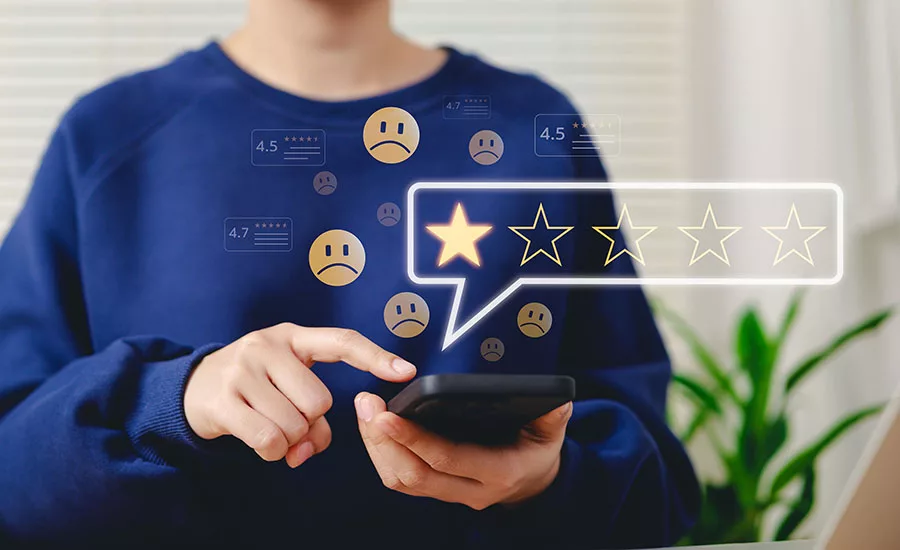
Overloading a company or service with bad reviews is not new, nor is it limited to roofing. Sometimes called “review bombing,” users post multiple negative reviews to either influence the creators or distributors of the product in question or distort a company’s public perception.
Regardless of the motive, for a roofing company, negative reviews can ruin its reputation and result in a loss of revenue and leads. RC’s 2025 Homeowner Survey shows 67% of homeowners rate online views as “very” or “extremely” important in their purchasing decision. Another 28% say they’re important.
Sam Stilley, owner of Amstill Roofing in Texas, spoke about his company’s experience at the 2025 Best of Success conference. He woke up one day to find his company bombarded by 300 one-star reviews.
Though Amstill Roofing has nearly 1,600 Google reviews and a 4.9 these days, 300 bad reviews can sink a business. They dropped to 3.2 out of 5 in a matter of hours.
“Ninety-five percent of my business is from leads calling us, warm leads,” he said.
At least three more victims reported review scams in the past six months alone. In Tennessee, Tim Leeper Roofing and Centennial Roofing spoke with News Channel 5 about being flooded with one-star Google reviews.
In Florida, 3LP Roofing received a flurry of negative reviews last October. Owner Jeff Arnold then received messages asking for payment to remove them.
“It was very disheartening and discouraging, and we just felt helpless,” Arnold told Fox 35.
What Should Contractors Do?
Anna Anderson, CEO of marketing agency Art Unlimited, said the first thing contractors should do is verify if a negative review is from a real customer. It’s recommended that the company address a legit review on the platform, which can potentially turn it into a positive one.
If a review turns out to be fake or a scam, contractors are advised to make a record of it and contact the platform, such as Google, to dispute it and have it removed.
“Being able to prove this is an erratic behavior is going to be key to your success,” Anderson said.
Hosler said when they were the victim of a review scam in 2023, it was such a widespread problem that it appeared Google couldn’t keep up with the flagged reviews happening all over the country.
She said the difficulty they ran into was that Google’s reachable departments were not the review handlers. As such, the contractor found itself in an endless loop of reporting reviews, creating cases, and following up. Finally, they took matters into their own hands and were relentless in contacting the tech giant.
“I’m told you can’t call Google. With our business at stake, I relentlessly discovered, you can,” Hosler said. “We were unyielding in our persistence until we got results and the fake reviews slowly began to disappear, one by one, over two months’ time.”
This wouldn’t be the last time they dealt with Google. In 2025, the contractor realized one day they had zero Google reviews and zero stars. They hired marketing and legal consultants and took up their “squeaky wheel” strategy. As it turns out, there was a glitch, and they were able to contact the right person at Google to fix it.
“Bring professionals on board with the knowledge and experience of having dealt with these issues,” Hosler said.
Stilley, when dealing with his 300 one-star review bomb, was asked by Google to provide proof that the reviews were fake. About three months after reporting the issue, they were able to have them removed.
“It required us to get the due diligence of finding these one-star reviews, cross-referencing them to other roofing companies that had received one-star reviews in the nation, putting together a nice PDF … and then emailing it to Google,” he said.
He said one way to combat negative reviews is to make it a company goal to gain positive ones. He said Amstill Roofing rewards staff with events like work parties for hitting their monthly goal of positive reviews.
“As soon as I saw the detriment we could face and how long it could take on, I said, ‘I can’t sit here and wait for the next Google review storm of 200, 300 negative reviews. How can we just prevent the impact it would cause? By having a tremendous amount of Google reviews,’” Stilley said.
Contractors should also expand their horizons. Google reviews are important, but diversifying into other platforms like Yelp or the Better Business Bureau can provide a robust and rounded picture of your company.
“We are seeing with AI searches that your business BBB listing, and reviews left on that platform, seem to be gaining traction as an authoritative source,” Anderson said.
Anderson said having someone on staff dedicated to responding to reviews can help. They can quickly react to a review and monitor platforms for any strange behavior.
Looking for a reprint of this article?
From high-res PDFs to custom plaques, order your copy today!