Can Gen Z Save the Skilled Trades?
Roofing’s Future Depends on Winning Over Gen Z
Part 1 of a 2-part series

As roofing contractors struggle to fill crews amid an aging skilled trades workforce, the industry faces a critical question: Can it attract a generation raised to believe college is the only path to success?
With experienced roofers retiring faster than young workers are entering the field, roofing contractors across America are confronting a labor crisis that threatens their ability to meet growing demand. The answer should be Generation Z, a generation that watched older peers accumulate crushing student debt while blue-collar workers earned solid livings without loans. Yet a complex web of stigma, misinformation, and cultural barriers keeps many young Americans—particularly Gen Z, those born between the mid-1990s and the early 2010s—from considering roofing as a career.
The irony is stark: roofing offers exactly what Gen Z claims to want—job security that can't be automated away, competitive pay without degree requirements, and work that makes a tangible difference in communities. Despite their understanding of the trades' value, this generation is reluctant to pursue roofing careers, influenced by societal pressures favoring traditional four-year degrees.
QUICK READ: 5 Takeaways
- Roofing Faces a Critical Labor Shortage: Experienced workers are retiring faster than young talent is entering the field.
- Gen Z Could Fill the Gap: However, stigma, misinformation and school messaging still steer them to four-year degrees.
- Gen Z Has Different Motivations: Today’s young workers value purpose, flexibility and safety as much as pay—and they want clear training opportunities and career paths.
- Companies are Trying New Recruitment Strategies: Recruiting firms are responding with paid apprenticeships, school partnerships, and financial support for trade education.
- Roofing Offers Future-Proof Careers: Roofing offers careers that resist automation, deliver strong income, and provide a visible impact in local communities.
The College Default Gap
According to Harris Poll research, 91% of Americans agree that trade jobs are just as important to society as white-collar positions. Yet only 38% of Gen Z believe skilled trades offer the best job opportunities today—compared to 59% of Boomers.
"We're at a crossroads," said Sam Pillar, CEO of Jobber. "Gen Z is entering the workforce at a time of rising costs, shrinking job security, and rapid automation. Yet despite these challenges, too many are still defaulting to college."
The numbers tell the story: 75% of Gen Z still plan to attend a four-year college, despite only 16% of their parents believing that a degree guarantees long-term job security. The actual cost of a bachelor's degree now exceeds $500,000 when factoring in loans and lost income.
Meanwhile, skilled trade businesses demonstrate strong earning potential. Plumbing and HVAC companies report median gross sales of $416,120 and $390,594, respectively, according to Jobber data.
The Construction Squeeze
The skilled labor shortage isn't theoretical; it's already disrupting industries across the nation. McKinsey & Company research projects that by 2032, there will be roughly 22 times more new hires needed in critical skilled-trades roles than new jobs created. This churn could cost U.S. companies more than $5.3 billion annually in talent acquisition and training costs alone.
The construction industry faces particular pressure. The Associated Builders and Contractors estimates the sector will need to attract 439,000 net new workers in 2025 to meet anticipated demand.
"As fewer younger people enter the trades, it has become a common industry-wide sentiment that companies are feeling the pinch, particularly as older and more experienced roofers retire," said Michael Feazel, CEO of Roof Maxx, a roof rejuvenation service based in Westerville, Ohio.
The roofing industry exemplifies this challenge.
"Like most trade-based businesses across the country, we've seen a steady decline in the number of skilled workers entering the labor pool in recent years," said Kortney Paul, president and CEO at Ideal Partners, a Dallas-based property management firm that offers roofing. "Right now, the average technician age is over 50, and we are not seeing new people enter the field at the same rate as the older roofers are retiring at."
RELATED: Gen Z, Roofing's Workforce of Tomorrow, Gathers at SkillsUSA
What Gen Z Actually Wants
When McKinsey surveyed Gen Z manufacturing workers, they found priorities that diverge sharply from those of older generations. While Boomers rank compensation as their top job factor, Gen Z places it sixth. Instead, this generation prioritizes psychological safety and respect, as well as meaningful work and clear development opportunities. Gen Z is the only age group to list physical and mental safety—security in their environment and respect for their contributions as a top-three retention factor. Money matters, but meaning matters more.
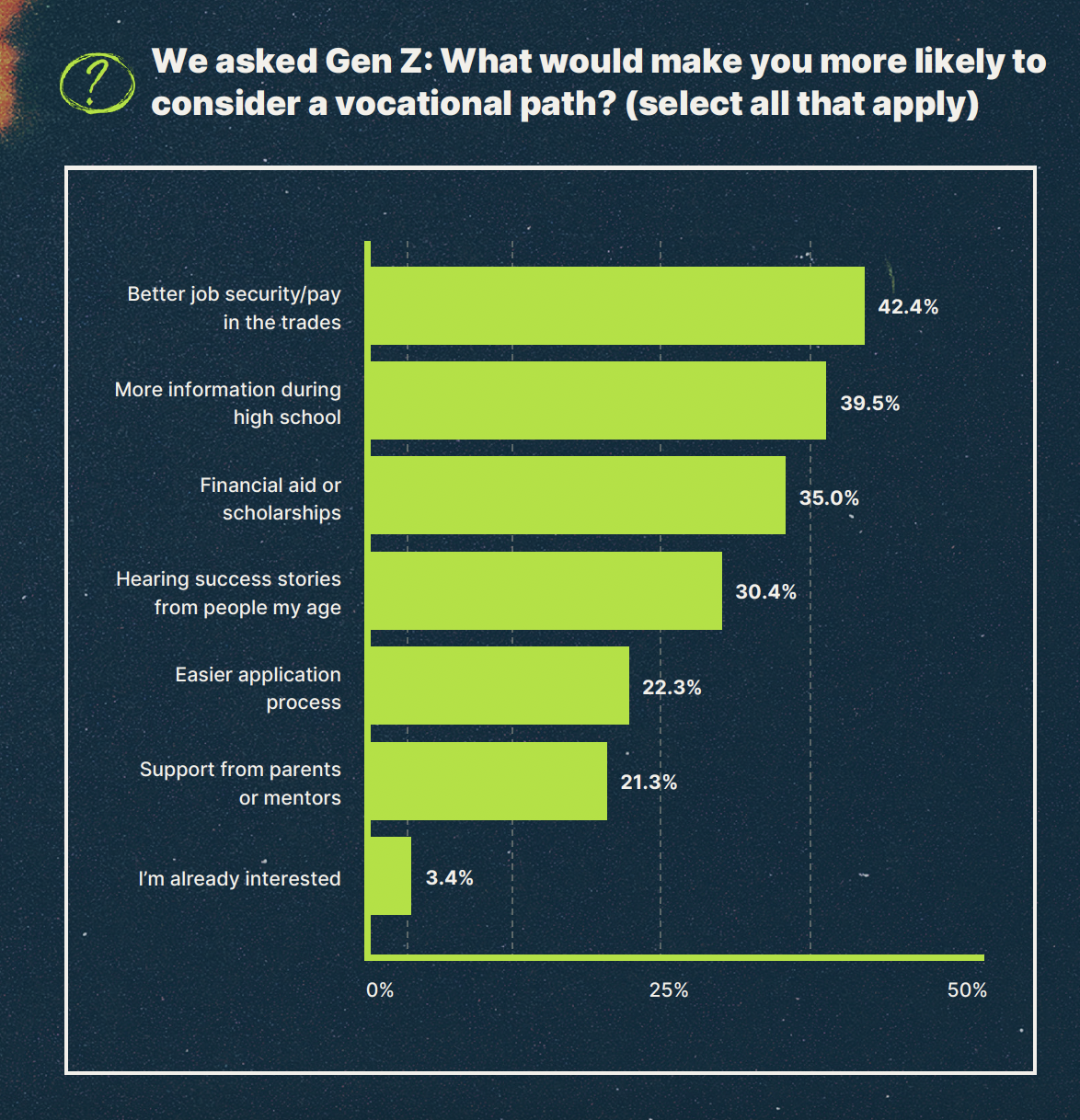 Chart: Jobber. "I think broadly, and this doesn't just apply to the trades or roofing industry, but to many more industries as well," Feazel said. "Gen Z views working differently from Boomers did. Flexibility, purpose, and work-life balance are almost as necessary (if not more important for some) as the paycheck. The idea of building something tangible and contributing to a team appeals to them, but only if we frame it that way."
The Ready to Hire study confirms this pattern: 70% of Gen Z are "extremely likely" to pursue programs offering paid training that leads directly to employment. But they also expect clear communication about advancement pathways and access to career-building certifications.
The Barrier Breakdown
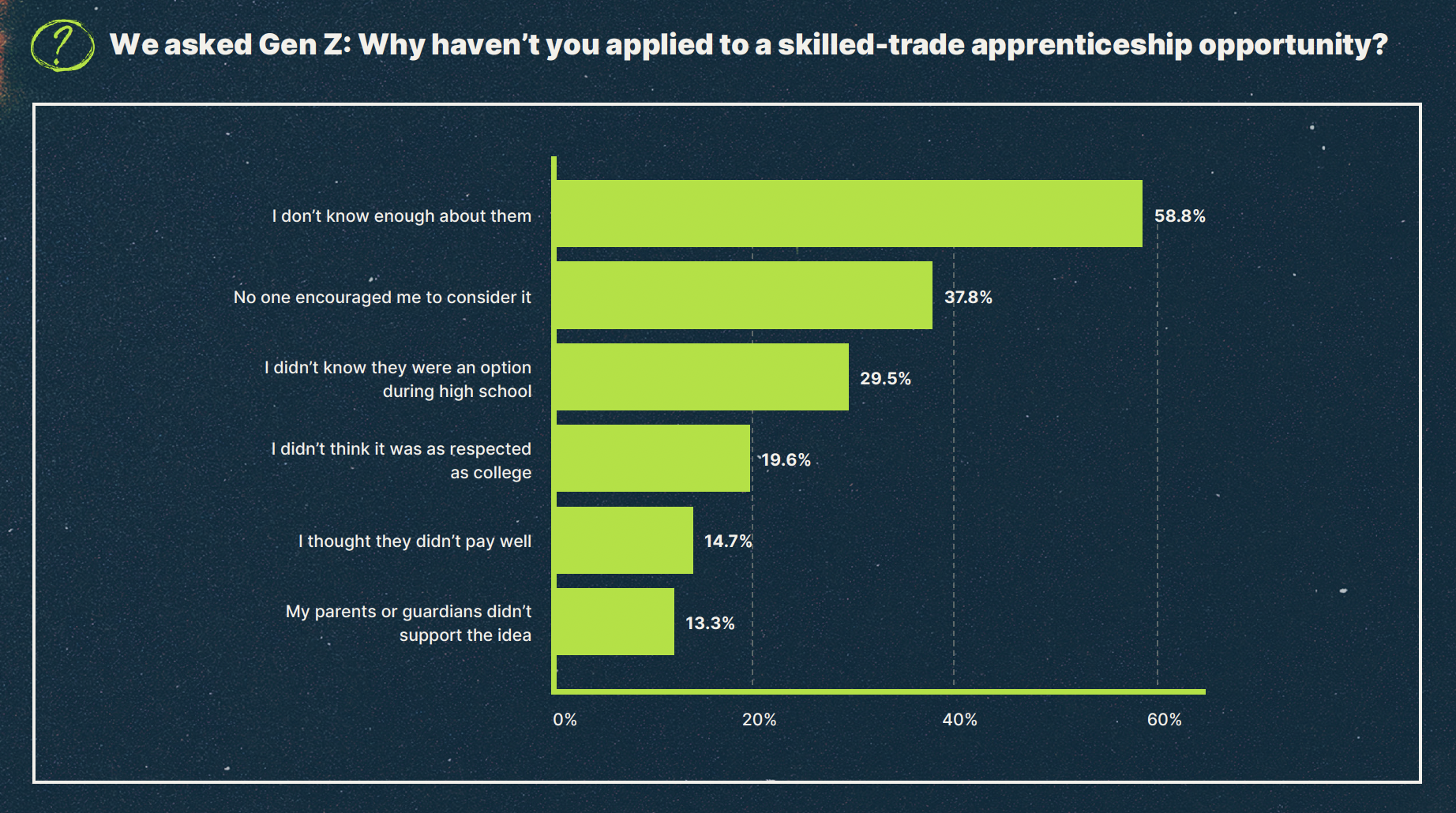
Harris Poll identified the primary obstacles preventing Gen Z from entering the trades, with stigma topping the list. Skilled trades are still perceived as less prestigious than white-collar careers—a perception reinforced throughout high school.
According to the Jobber report, 76% of Gen Z respondents say that a four-year college was actively promoted in their schools, while only 31% remember trade school being encouraged. Among survey respondents, 74% perceived stigma associated with choosing a vocational school over a traditional university, and 79% said their parents wanted them to pursue a college education.
"Starting most noticeably with Millennials, there's been a strong cultural push toward traditional four-year colleges and corporate careers as the 'default'," Paul said. "Unfortunately, that's come at the expense of trade careers like roofing, which offer reliable, consistent work, strong income potential, and clear advancement opportunities."
Financial barriers compound the problem. The Ready to Hire survey found that 38% cite training costs as the most significant barrier to pursuing skilled trades—yet 85% would "definitely" pursue these careers if financial support was guaranteed.
Gen Z worries about job security from automation, lack of flexible career options, and, for Black Americans specifically, the absence of visible role models in skilled trades.
Looking for a reprint of this article?
From high-res PDFs to custom plaques, order your copy today!

.webp?height=740&t=1781278983&width=auto "KEE(2).png")