search
cart
facebook twitter linkedin youtube instagram Spotify Podcasts Apple Podcasts Spotify Podcasts Apple Podcasts
  • Sign In
  • Create Account
  • Sign Out
  • My Account
  • NEWS
  • TOPICS
    • Cool Roofing
    • Event News
    • Latinos in Roofing
    • Low Slope
    • Legal
    • Metal
    • Project Profiles
    • Roofing Supply Pro
    • Roofing Safety
    • Steep Slope
    • Sustainable Roofing
    • Technology
  • EXCLUSIVES
    • Best of Success
    • Contractor Profile
    • IRE Show
    • Roofing Contractor of the Year
      • Enter Roofing Contractor of the Year
    • Top 100
      • Enter the Top 100
    • Young Guns
    • State of the Industry
  • MULTIMEDIA
    • Videos
    • Podcasts
    • Interactive Spotlights
    • Roofing Quizzes
    • IRE Videos
    • Webinars
    • Photo Galleries
  • PRODUCTS
    • New Products
    • Featured Products
  • COLUMNS
    • Editor's Note
    • Exit Planning
    • Guest Column
  • EVENTS
    • International Roofing Expo
    • Webinars
    • Best of Success Conference
    • Industry Events
  • DIRECTORY
    • Associations
    • Distributors
    • Manufacturer/Supplier
    • Business Services
    • Get Listed
  • MORE
    • Roofing Contractor Newsletters
    • Techos y Más Advisory Board
    • RC Store
    • Roofing Supply Pro
    • Custom Content & Marketing Services
    • Market Research
    • Sponsor Insights
    • Company Spotlights
    • Classifieds
      • Auctions
      • Business For Sale
      • Business Opportunities
      • Equipment For Sale
      • Positions Available
      • Products
      • Safety
      • Software
      • Services
      • Training
    • Contact Us
  • EMAGAZINE
    • eMagazine
    • Advertise
      • Editorial Calendar
      • Contact
    • Archive Issues
  • SIGN UP!
Columns

Are Your Handbook Policies Legal?
By Richard Alaniz
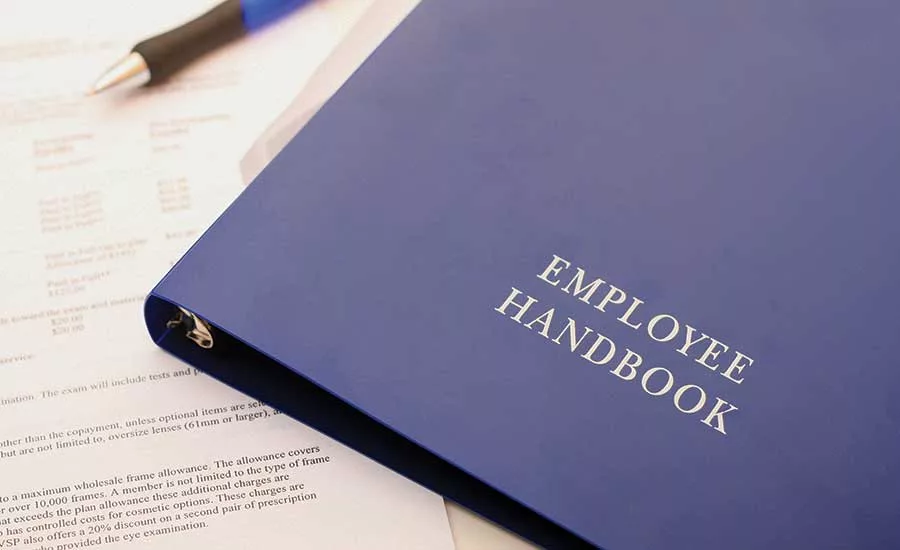
handbook-iStock-182749100
May 1, 2022

Employee handbooks have long been an essential workplace tool. Regardless of size, all employers should maintain a handbook. Handbooks often provide an employer’s history as well as its mission statement and guiding philosophy. They spell out the rules of what is expected of employees and what the employer will provide in return. They have become ubiquitous and, for the most part, non-controversial. However, with the current majority on the National Labor Relations Board (NLRB or Board) and even more so its general counsel, employee handbooks may once again become a potential source of liability for unsuspecting employers. 

The National Labor Relations Act (NLRA or Act) protects both the “union” and “concerted” activities of employees. In recent years, with union activity substantially diminished, the NLRB has focused a great deal of time and attention on issues involving what are referred to as “concerted protected activities.” The term refers to employees acting together (in concert) on matters related to their terms and conditions of employment. Employees have the right to discuss and engage in advocacy regarding workplace concerns and to act for “mutual aid or protection.” It includes not only employees acting as a group, but also a single employee speaking or acting on behalf of himself and others. Any employer interference with such concerted, protected activity is considered a violation of the rights of employees set forth in Section 7 of the NLRA. 

Historically, under the concerted activity framework, the Board has challenged employee handbook rules and policies that impinge on those employee rights. Handbook rules on confidentiality, inappropriate communications, non-disparagement, social media, media communications, civility, respectful and professional conduct, offensive language, camera prohibitions, employee loitering and access limits on off-duty employees, and similar restrictions on employees were frequently found unlawful. 

In 2017, an NLRB majority comprised of Trump appointees significantly limited the ability of the Board to micromanage handbooks. It did so in a case called The Boeing Co., involving a handbook rule restricting the use of cameras in the workplace. Prior to Boeing, the guiding principle on the legality of handbook rules was whether employees could reasonably construe the rule or policy to limit their right to engage in concerted activities. The Board used Boeing to limit review to only those rules or policies that either explicitly or as applied restricted concerted activity.

In 2019, the Trump Board further refined the new Boeing standard in a case called LA Specialty Produce. That case involved a media communications policy that prohibited employees from providing information when contacted by the media. In finding the rule lawful, the Board majority took the view that an “objectively reasonable employee who is aware of his legal rights but who also interprets work rules as they apply to the everydayness of the job” would interpret the rule as addressing situations where the media was seeking an official employer response. In other words, common sense should play a role in the analysis. 

The new general counsel, Jennifer Abruzzo, a long-time union attorney, has been actively reviewing pending Board cases to select the proper vehicle to justify a return to the former standard. She has requested that interested parties submit briefs on whether the Boeing standard should continue to apply using a pending case called Stericyle, Inc. The rule change is therefore just a matter of time. 

In accord with the effort to return to the former rule on handbook provisions, the new general counsel has also announced the intent to expand the concept of “concerted, protected activity” well beyond its traditional limits. Employee conduct that could be deemed to qualify for protection will include activity in support of social justice issues such as Black Lives Matter (BLM), Fight for $15, transgender rights, support of undocumented immigrants, and similar matters not specifically connected to their workplace. The general counsel framed it to “include employees’ political and social justice advocacy when the subject matter has a direct nexus to employees’ interests as employees.”

The Board has already taken action against two major U.S. retailers under this new expanded definition of concerted protected activity as including political advocacy. The NLRB Regional Office in Minneapolis issued an unfair labor practice complaint against a Home Depot branch for enforcing a company-wide dress code policy prohibiting workers from displaying political messages on their aprons against employees displaying BLM slogans on their aprons. Among the remedies that the NLRB is seeking is that Home Depot rescind its rule at its more than 2,000 U.S. stores. The Board issued a similar complaint against Whole Foods for prohibiting employees from wearing face masks with “Black Lives Matter” imprinted on them. Both cases remain pending.

The likely return by the NLRB to the former standard for assessing the legality of work rules – whether employees could reasonably construe the rule as limiting their right to engage in concerted activities – should prompt employers to carefully review their current handbook rules to assure they are legal. Defending against an NLRB complaint can be a costly exercise, and it could be all the more so if monetary fines for violations ever become a reality. 


KEYWORDS: employee relations legal issues in AEC NLRB (National Labor Relations Board) President Donald Trump

Share This Story

Looking for a reprint of this article?
From high-res PDFs to custom plaques, order your copy today!

Richard D. Alaniz is senior partner at Alaniz and Schraeder, a national labor and employment firm based in Houston. He has been at the forefront of labor and employment law for over thirty years, including stints with the U.S. Department of Labor and the National Labor Relations Board. He is a prolific writer on labor and employment law and conducts frequent seminars to client companies and trade associations across the country. For more information, call Alaniz at 281-833-2200.

Recommended Content

JOIN TODAY
to unlock your recommendations.

Already have an account? Sign In

  • two-roofers-in-harnesses-on-tile-roof

    How AI Is (and Isn’t) Impacting Roofing Jobs

    A new study from Microsoft shows artificial intelligence...
    Roofing News
    By: Chris Gray
  • Baker-Roofing-Company-employees-on-flat-roof-examinining-paperwork

    Exclusive: 2025’s Top 100 Roofing Contractors

    Roofing Contractor's 2025 Top 100 list reveals revenue...
    Top 100 Roofing Contractors
    By: Chris Gray
  • A before and after heat measurement comparison

    How Hot is Too Hot in the Attic?

    If the ventilation is working, how hot should the attic...
    Columns
    By: Paul Scelsi
You must login or register in order to post a comment.

Report Abusive Comment

Manage My Account
  • eMagazine Subscription
  • Sign Up for the Newsletter
  • Online Registration
  • Manage My Preferences
  • Subscription Customer Service

More Videos

Sponsored Content

Sponsored Content is a special paid section where industry companies provide high quality, objective, non-commercial content around topics of interest to the Roofing Contractor audience. All Sponsored Content is supplied by the advertising company and any opinions expressed in this article are those of the author and not necessarily reflect the views of Roofing Contractor or its parent company, BNP Media. Interested in participating in our Sponsored Content section? Contact your local rep!

close
  • A finished commercial roof, including flashings
    Sponsored byFlashCo

    It’s All in the Details – How to Avoid 4 Common Mistakes with Roofing Accessories

  • Happy mature couple using phone holding credit card making payments. Middle aged older man and woman doing ecommerce shopping on smartphone booking or buying online on mobile sitting at home table.
    Sponsored byWatercress Financial

    Meeting Modern Expectations: Why Offering Financing Is Essential for Roofers Today

  • A roofing contractor stands on a roof behind an American flag
    Sponsored byTAMKO®

    Building Roofs, Building Community: TAMKO’s Lasting Commitment to Veterans and the Military

Popular Stories

TWS Remodeling team

Private Equity Fallout Rocks Roofing; Pros Step In

Malarkey-logo-with-Charles-Collins-headshot

Malarkey Roofing Products Announces New President

roofer-safety-harness-construction.jpg

OSHA's Top 10 Most Cited Violations of 2025

Roofing Contractor Bookstore

Related Articles

  • man working

    Are Your Policies Up to Standard?

    See More
  • Legally Speaking: Manage Your Legal Exposure by Reviewing Overtime Standards

    See More
  • salaried roofing employees

    Are Your Salaried Employees at Your Roofing Company Truly Exempt?

    See More

Related Products

See More Products
  • cc2.png

    Handbook of Construction Contracting, Vol. 2

  • business.png

    How to Succeed With Your Own Construction Business

See More Products
×

Be in the forefront of the roofing industry!

Join thousands of professionals today. Shouldn’t you know what they know?

JOIN NOW!
  • RESOURCES
    • Advertise
    • Contact Us
    • Directories
    • Store
    • Want More
  • SIGN UP TODAY
    • Create Account
    • eMagazine
    • Newsletters
    • Customer Service
    • Manage Preferences
  • SERVICES
    • Marketing Services
    • Reprints
    • Market Research
    • List Rental
    • Survey/Respondent Access
  • STAY CONNECTED
    • LinkedIn
    • Facebook
    • Instagram
    • YouTube
    • X
  • PRIVACY
    • PRIVACY POLICY
    • TERMS & CONDITIONS
    • DO NOT SELL MY PERSONAL INFORMATION
    • PRIVACY REQUEST
    • ACCESSIBILITY

Copyright ©2025. All Rights Reserved BNP Media.

Design, CMS, Hosting & Web Development :: ePublishing