Coating Over the Pandemic
Since the start of the COVID-19 pandemic, there’s been a tight supply market that has many roofing contractors and facility owners considering the application of coatings and other fluid-applied materials on existing roofs in efforts to extend their service life until things get back to "normal."
This provides an opportunity for coating manufacturers to introduce their products to a wider segment of the market and to gain market share. This also provides an opportunity for roofing contractors that are interested in expanding services into the coatings market to become familiar with the latest generation of coatings.
Recent advancements in coating material technology have increased the uses for roof coatings in the commercial market. Today, coatings are manufactured as monolithic, fully adhered, flexible materials. Coatings are now used to restore existing roof systems by acting as a surfacing that shields the membrane from erosion caused by rain, snow, sleet, and hail and to reflect ultra-violet radiation. When properly applied, coatings can provide significant advantages to a roof system. Coatings have been documented to expand the service life of existing roofs, improve a building’s energy efficiency, resist degradation from chemical attack and ultra-violet radiation and eliminate the formation of small cracks associated with these degenerative conditions.
Repairing the Existing Roof System
It’s important to point out that although coatings can extend the service life of the roof system and provide repairs to specific conditions, most coatings do not provide long-term, stand-alone waterproofing protection. The waterproofing is still completed by the existing membrane.
Therefore, the performance of the roof coating will only be as good as the condition of the substrate that it is applied over. The most important criterion for long-term extension of an existing roof system is the proper completion of repairs to the existing materials. This is accomplished by reinforcing any weaknesses and improving any shortcomings in the system, such as eliminating current leaks and repairing conditions that may lead to problems in the future. If a defect that may have an adverse effect on the roof system is discovered during the coating process, it should be promptly repaired. It’s imperative that the symptom of the problem is determined and corrected. Band-aid repairs that do not address the cause of the problem do not eliminate the problem. They will reoccur, and are not cost effective overall.
Proper roof repair procedures should be completed on the entire roof system. All wet insulation should be replaced, and any deteriorated decking should be repaired and/or replaced. Application of new flashings and accessories should also be completed as required. Membrane repairs should address all deficiencies, such as a deficient seam in the membrane or flashing, openings in the membrane and/or flashings and splits at penetrations.
Proper Requirements
There are several types of coatings available on the commercial roofing market. The material formulations, uses and application methods are all different, so the roofing contractor should examine the manufacturers’ material data sheets to determine which product is suitable for their specific project. Not all coatings are acceptable or compatible on all roof surfaces. Although the coatings are manufactured with varied materials and chemical compositions, the proper application requirements are consistent. Contractors should be familiar with proper preparation and application requirements.
Weather Conditions
The ambient weather conditions play a critical role in the coating application process. Most coatings should not be applied when the ambient weather temperatures are below 40 degrees Fahrenheit. This is primarily true of waterborne coatings. Some solvent-based coatings can be applied in lower temperatures — if they are properly stored in a heated environment — prior to application. The concern in applying coatings in lower temperatures is that dew or moisture can accumulate over the surface and interfere with the bonding of the coating. Hot temperatures — over 110 degrees Fahrenheit — can also be detrimental to the coating application. Application in extreme temperatures could result in the coating curing too quickly, which contributes to streaks. Most coatings should not be applied if rain or precipitation is forecasted within 24 hours of application.
Surface Conditions
Preparation of the surface is the most critical component of the application process. Preparation requirements are contingent upon the type of surface that the coating is being applied over and the age of the applied surface. For the best results, check with the coating manufacturer to determine what the age requirements are for application on different surfaces.
The surface must be clean and free of all moisture, contaminants, debris, oils and loose particles. Surface contaminants create impediments to the coating adhesion, which result in loss of attachment or peeling of the coating. The surface can be cleaned of all contaminants by power washing, brooming, or vacuuming. Power washing is typically used to remove heavier debris or remnants from existing coatings.
On aggregate surfaced systems, the aggregate has to be fully removed prior to adhesive application. The applied substrate must then be thoroughly cleaned in the manner described above. To avoid any costly mistakes, it is recommended that the applicator clarify all preparation procedures with the material manufacturer prior to application.
If contaminants on the surface are extensive, a primer may be required prior to the coating application. The primer must be dry (fully cured) prior to the application of the coating. It is also important to note that not all primers are suitable for all coatings; some primers are incompatible with specific coatings. The coating manufacturer should be consulted prior to surface cleaning to determine what cleaning methods are acceptable and if/what primer is required.
Coatings should only be applied on roof surfaces with positive drainage. Ponded water typically reduces the service life of the coating and contributes to a reduction of the coating’s mil or film thickness, peeling and delamination. Some manufacturers have developed products that are specifically made for application in ponded areas. These types of products can be considered if there’s no other means of eliminating ponded water.
Application Methods
The initial step in the coating application process is to properly mix the coating prior to — and during — the coating application. Pigments used in the manufacturing of the coating settle during storage of the coating. Properly mixing the coating allows for uniform color and optimum reflectivity. Most manufacturers recommend the use of mechanical mixers to properly mix the coating while it is still in the pail. The mixer should have a blade that is designed for use with fibered products, not regular paint blades.
Another important criteria prior to application phase is that the contractor should use the coating in its manufactured state. In other words, do not mix solvents or water into the coating to thin it out. The coatings are manufactured with special formulations to achieve optimum performance. The addition of thinners can contribute to premature failures or shortened service life. Thinning the coating may decrease the final film thickness, leading to improper weathering.
There are two accepted methods of coating application: manual application (brush, roller, squeegee) or spray application.
Manual Application
Manual application refers to the application of the coating with a squeegee, roller, or brush. A squeegee with a notched 18-inch blade is the most common type used for coating applications. The brush should be a three or four knot roofers brush or a soft-bristled broom. If a roller is used, it should have a medium nap roller cover. The application methods with brushes and rollers are similar in that the strokes should be finished in the same direction to achieve cohesive esthetics.
In manual applications, the coating is poured directly in front of the blade or bristles of the spreading equipment and evenly and thoroughly spread throughout the area to the required thickness. The application rate should be in accordance with the material manufacturer’s latest printed specifications.
The coating material should be applied in an area slightly wider than the felt roll width. There should not be any voids in the material application over the substrate; one hundred percent coverage is required.
Spray Application
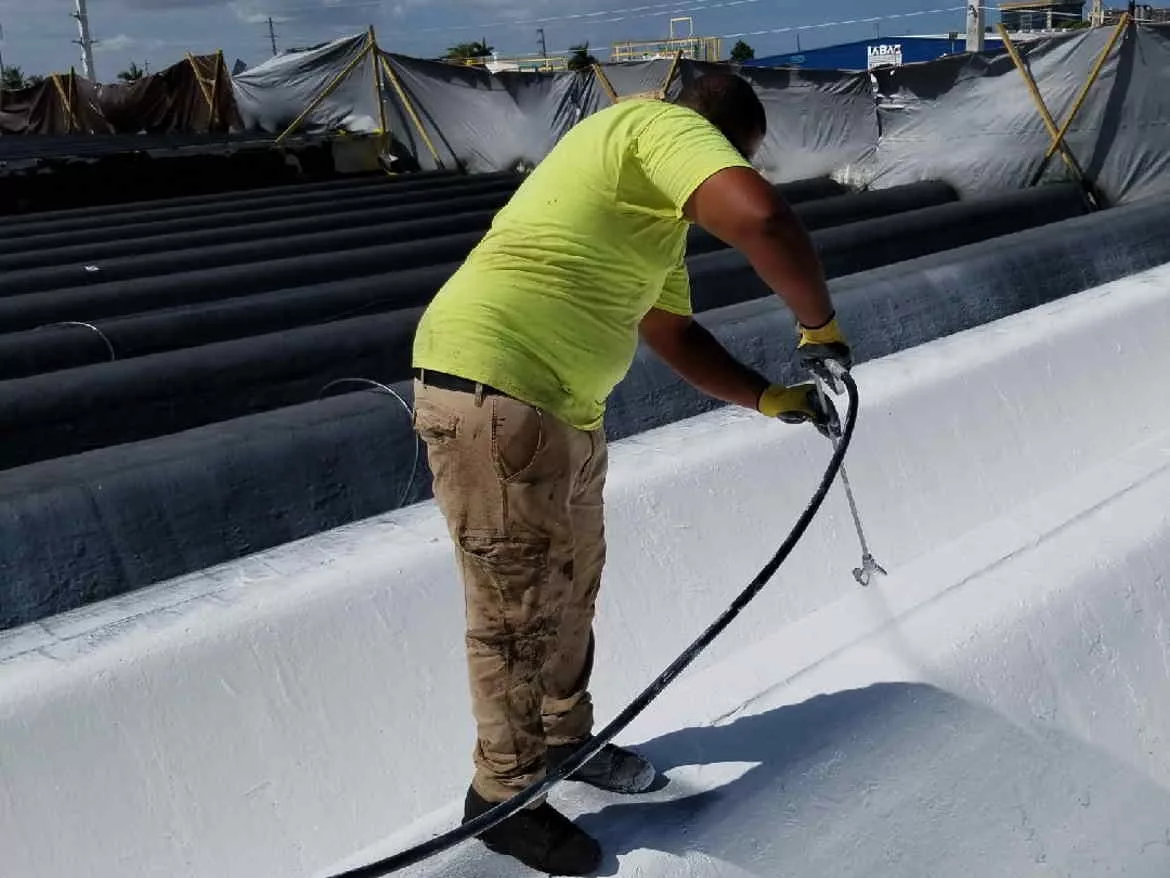
The spray equipment used can be any type that is capable of spraying the coating in an even application. The most prominent type used in roof coating applications are airless sprayers. The viscosity of the coating material, the internal diameter size of the hose and the length of the hose are important determining factors for the proper selection of the spray equipment. For guidance with the spray equipment selection process, consult the material manufacturer for the type of sprayer that provides the best performance with their materials.
Applying the coating with a mechanical spraying machine is a faster method of application. The coating is evenly applied over the substrate at the required mil coverage. The applicator should use a wet gauge to verify mil thickness. As with manual applications, the coating should be applied over the substrate at 100% coverage rate.
Coverage
All roof coatings should be applied in accordance with the manufacturer’s latest printed specifications and guidelines. The manufacturers have evaluated their products and know what their optimum performance rates are. Too much coating or too little coating will result in deficient performance and premature failure. Most coatings are typically applied at a rate of 1 to 2 gallons per square.
The coatings should be applied in a uniform and even application over the entire surface. Foot traffic over the completed coating application should be avoided until the material is fully cured. Curing depends on the ambient temperatures, with the quickest curing occurring in dry, moderate temperatures.
Looking for a reprint of this article?
From high-res PDFs to custom plaques, order your copy today!