Construction Data
Residential Remodeling Confidence Rebounds in Q4
Renovation and remodeling activity surges as contractors close 2025 on a high note, even amid data gaps from the ongoing federal shutdown.
.webp?t=1760632077&width=1080)
The Houzz Expected Business Activity Indicator related to project inquiries and new committed projects increased by eight points to 66 for Q4.
.webp?t=1760532517&width=1080)
Residential project backlogs are shorter compared with last year.
Updated Oct. 16 at 2:15 p.m.
Residential construction professionals are heading into the fourth quarter of 2025 with renewed optimism, buoyed by a sharp rebound in renovation activity and new project commitments, according to new private industry data. The recovery comes even as the federal government shutdown, which began on Oct. 1, has paused official economic data releases, leaving private sector reports to fill the information gap.
Remodeling Sector Defies Broader Construction Slowdown
While private data firm FMI Corp. forecasts residential markets face affordability challenges, with multifamily construction expected to contract 9% in 2025, the residential renovation and remodeling sector is experiencing a dramatic turnaround.
Houzz's Q4 2025 U.S. Renovation Barometer reveals the Expected Business Activity Indicator for construction businesses jumped 8 points to 66 for Q4, driven largely by a 12-point uptick in expectations for new committed projects. Both build-only remodelers and design-build firms expect improved Q4 business activity, with the indicator at 66 points each.
Even more striking, the Recent Business Activity Indicator jumped to 55 in Q3 from just 38 in Q2—a 20-point increase in project inquiries driving the surge. New committed projects also increased by 13 points, reaching 48 points.
"Construction professionals are closing the year with renewed confidence, supported by a surge in project activity in the third quarter and recent interest rate cuts," said Houzz Staff Economist Marine Sargsyan.
"Overall, remodelers remain optimistic about the market, although slightly less optimistic than they were at this time last year," said NAHB Remodelers Chair Nicole Goolsby Morrison, a remodeler from Raleigh, N.C. "The most significant headwinds they are facing include high material and labor costs, as well as economic and political uncertainty, making some of their potential customers cautious about moving forward with remodeling projects."
QUICK READ: 5 Takeaways
- Remodeling Rebounds Despite Shutdown: Private industry data shows residential remodelers entering Q4 2025 with renewed confidence, even as the federal government shutdown halts official economic reports.
- Renovation Activity Surges: The Houzz U.S. Renovation Barometer jumped sharply—an 8-point rise in expected business activity and a 20-point leap in recent inquiries—signaling stronger pipelines for remodelers and design-build firms.
- Fundamentals Fuel Demand: High home values, aging housing stock, and demographic shifts toward multigenerational living are driving steady investment in upgrades, energy efficiency, and resilience projects.
- Cost Pressures Persist: Despite rising inquiries, contractors face headwinds from high labor and materials costs, extended project timelines, and cautious consumers delaying big-ticket renovations.
- 2026 Brings New Challenges:Most firms expect homeowner hesitation to grow next year, prompting nearly 90% of remodelers to adopt new tech tools, adjust pricing strategies, and strengthen marketing efforts to stay competitive.
Strong Fundamentals Support Continued Growth
FMI's analysis identifies several factors supporting improvement spending: record-high home valuations, aging housing stock, demographic demand for multigenerational living and a continued preference for retrofitting over moving in a high-mortgage-rate environment.
Rising insurance premiums and stricter building codes in coastal and disaster-prone areas are prompting more homeowners to invest in resilience-focused exterior upgrades. The outlook for the remainder of 2025 anticipates a modest yet steady improvement in investment, with activity primarily focused on system upgrades, energy efficiency enhancements, and aging-in-place renovations. After 2026, existing home sales are projected to rebound, supporting a return to more natural and stable demand in the home improvement segment.
"The small quarter-over-quarter improvement in the RMI is consistent with flat construction spending trends and the current wait-and-see demand environment," said NAHB Chief Economist Robert Dietz. "Going forward, remodeling spending should continue to grow, supported by the aging housing stock and gains for household net worth."
RELATED: FORTIFIED Homes Gaining Momentum
However, renovation and improvement projects remain constrained by high labor, materials and borrowing costs in addition to longer project schedules due to ongoing supply chain issues for mechanical systems and finished products. Home Depot and Lowe's both reported that consumers are still deferring larger discretionary projects due to cost pressures and high interest rates. At the same time, professional contractor sales remain more stable than do-it-yourself activity.
Unlike commercial construction, where backlogs remain at 8.5 months, residential contractors are working through their pipelines much faster. The Houzz Project Backlog Indicator stands at 5.4 weeks in the beginning of Q4—5.1 weeks shorter than a year ago. Build-only remodelers report a 4.4-week backlog (down 3.9 weeks year-over-year), while design-build remodelers report a 6.3-week backlog (down 6.5 weeks year-over-year).
The shortened backlogs, combined with surging new inquiries, suggest contractors are both completing work faster and seeing renewed demand—a positive sign for the sector's velocity.
“If the housing market begins to show signs of momentum, remodeling could be poised for stronger growth into 2027,” says Chris Herbert, managing director of the Joint Center for Housing Studies of Harvard University. “However, sluggish housing starts and uncertainty in the broader economy, which are factors in predicting remodeling expenditures, are creating headwinds to larger gains in renovation and repair spending.”
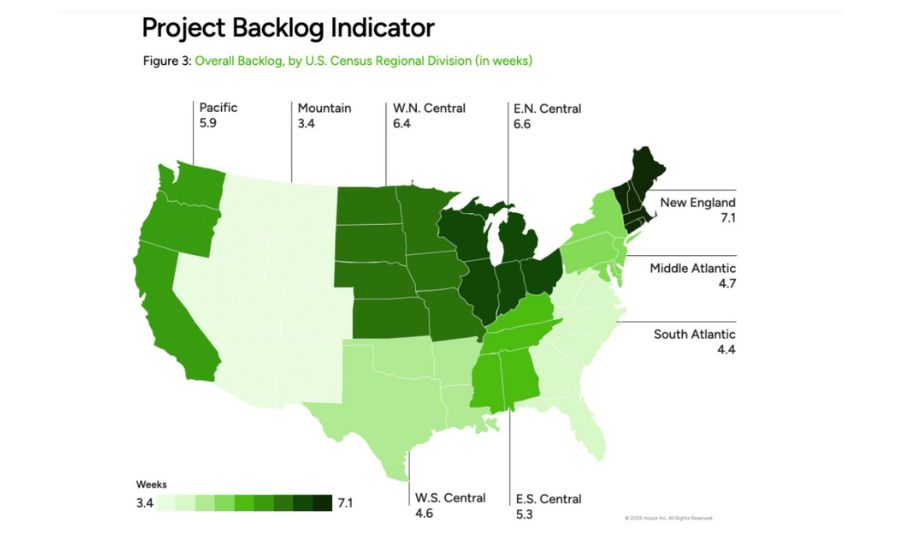 Chart: Houzz
Chart: HouzzPreparing for 2026 Headwinds
Despite current optimism, residential professionals anticipate significant challenges ahead. Nearly all pros surveyed by Houzz expect homeowners to have concerns when deciding to move forward with renovation projects in 2026 (93% construction, 96% design). The top homeowner concerns include overall project costs (74-80%), the economy/job stability (40-41%), and tariffs (31-44%).
In response, nearly 9 in 10 firms expect to make operational changes (86%). The most common strategies include adopting or upgrading technologies, particularly those with project management capabilities and AI-powered features (42-48%), placing greater emphasis on marketing and client acquisition (34-39%), and adjusting pricing structures and contract terms (32-40%) to maintain stability.
While single-family renovation shows resilience, the multifamily sector faces a starkly different reality, according to FMI. Developers continue to face elevated replacement and operating costs, including insurance and materials. At the same time, condo prices have dropped sharply in dense markets such as San Francisco, Seattle and Chicago, reflecting weaker investor demand and ongoing affordability challenges.
With vacancy rates rising and capital availability limited, new multifamily activity is expected to remain subdued through late 2025 and into 2026, with few new or renovation projects outside of affordable and mixed-use segments. NAHB projects multifamily starts will fall to around 349,000 units in 2025, with the steepest declines in the South and West, including markets like Phoenix, Austin and Atlanta, where new supply has outpaced demand.
Looking for a reprint of this article?
From high-res PDFs to custom plaques, order your copy today!

.webp?height=740&t=1781278983&width=auto "KEE(2).png")