Solar Economics
Why Solar Roofing Has Yet to Catch On With Homeowners
Principia analyst says high costs, financing challenges and installation complexity could keep integrated solar roofing a premium niche despite continued manufacturer investment
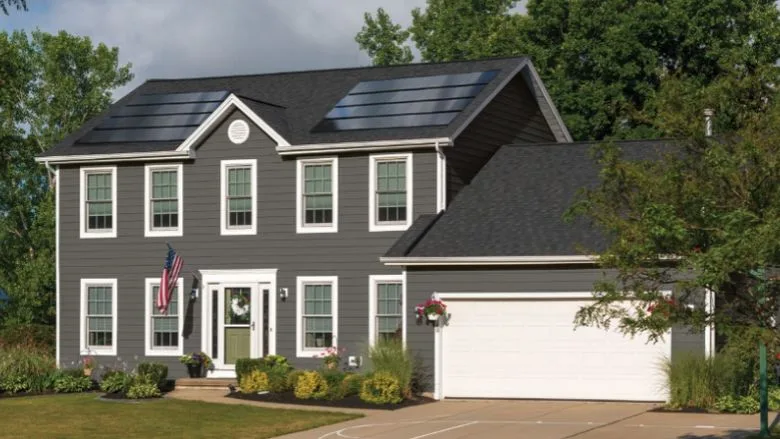
CertainTeed's Landmark PWR solar roof.
Key Takeaways
- High upfront costs and financing payments remain the biggest obstacles to broader adoption of integrated solar roofing.
- Solar shingles are most practical during roof replacement, limiting opportunities compared with traditional panels installed on suitable existing roofs.
- Principia expects solar roofing to grow as a premium niche rather than become a mainstream residential roofing product within five years.
Tesla's decision to discontinue its Solar Roof and CertainTeed's continued investment in solar shingles illustrate a challenge facing residential roofing: Homeowners may like the appearance of integrated solar roofing, but convincing them to pay for it is another matter.
Lilli Tillman Smith, industry analyst for roofing and insulation at Principia, said the manufacturers' different approaches suggest consumer interest in building-integrated photovoltaics (BIPV) remains, even as the economics limit widespread adoption.
"I think it tells us that homeowners like the idea of integrated solar roofing more than they like the economics," Tillman Smith said.
Tesla generated considerable attention by addressing one of the most common objections to conventional rooftop solar panels: appearance. Rather than mounting panels over an existing roof, the company's system incorporated electricity-generating components directly into the roofing material. But the integrated design came with substantial costs and installation challenges.
"Homeowners generally prefer a roof that looks clean and seamless rather than having large panels mounted on top," Tillman Smith said. "However, actual adoption remained very limited because the systems were expensive, difficult to install, and often harder to justify financially than a conventional roof paired with rooftop solar panels."
A Different Approach to Integrated Solar
CertainTeed's launch of its Landmark PWR Solar Roof offers a different approach to the integrated solar market as Tesla exits the category. The new product gives the roofing manufacturer an opportunity to compete in a market where homeowners continue to show interest in solar-integrated roofing, but cost and installation complexity have limited adoption.
"They're focusing on making the products easier for roofing contractors to install and positioning them as another roofing option rather than trying to completely reinvent residential solar," Tillman Smith said.
For roofing contractors, products that more closely resemble conventional roofing materials could provide a more accessible entry point into the market, although electrical work and other solar-specific requirements remain.
Todd Miller, president of Isaiah Industries and Classic Metal Roofing Systems, said Tesla's experience illustrates the importance of understanding the roofing business when developing integrated solar products.
"I feel that a mistake Tesla made with their Solar Glass roof is it took several years for them to accept the fact they were in the roofing business and happened to be selling a solar roof," Miller said. "When they were strictly approaching this as a solar product, they were missing the nuances and intricacies of residential roofing."
Miller, whose company manufactures residential metal roofing, said that approach slowed Tesla's ability to gain traction in the market.
Related: Roofing Contractors Have Three Paths Into Solar
Financing Remains the Biggest Obstacle
Although product cost remains the biggest barrier, Tillman Smith said financing can be just as important in deciding whether homeowners move forward with solar roofing.
"In some cases, the energy savings generated by the system are largely offset by the financing payment, especially in the first several years," she said.
Higher interest rates further complicate the economics by increasing financing costs and potentially extending the time required for homeowners to realize meaningful savings.
Tillman Smith said the value proposition becomes much harder when monthly energy savings roughly match the financing payment. For homeowners considering a premium integrated solar roof, that calculation can be particularly challenging compared with purchasing a conventional roof and adding rooftop solar panels.
Integrated solar roofing also faces a challenge conventional rooftop panels largely avoid: the timing of roof replacement. Most homeowners replace their roofs only once every couple of decades, creating a relatively narrow window when integrated solar makes the most economic sense. By comparison, traditional rooftop solar panels can be installed on a suitable existing roof without requiring an immediate roof replacement.
Installation requirements create another hurdle. Solar roofing combines traditional roofing work with electrical components, requiring specialized training and coordination. Although the roofing and solar industries each have extensive contractor networks, relatively few contractors are qualified to install integrated systems. Consumer familiarity is also limited. Most homeowners recognize conventional solar panels, but fewer understand solar shingles or how they differ from traditional rooftop installations.
Related: 5 Things Roofing Got from Tesla’s Solar Roofs
A Premium Market, Not a Mainstream Product
Despite those challenges, Tillman Smith expects solar roofing to grow over the next five years. She does not, however, expect it to capture a significant share of the overall residential roofing market during that period. For adoption to accelerate, manufacturers will need to lower costs, simplify installation, expand contractor training and improve system durability, serviceability and energy output. Higher utility rates could also strengthen the economic argument for integrated solar, particularly if manufacturers can demonstrate shorter payback periods.
"My view is that solar roofing will evolve into a solid premium niche within residential roofing rather than a mainstream roofing product," Tillman Smith said.
Miller also sees an opportunity to improve the economics of integrated solar by combining it with premium roofing materials such as metal, tile or slate.
"By integrating them into these higher-priced products, you effectively reduce the cost of the solar by what those roofs would have cost had the whole roof been the premium product," he said.
For example, Miller said a $50,000 solar system that replaces $15,000 worth of premium roofing materials effectively reduces the incremental cost of solar to $35,000.
He believes solar shingle manufacturers must also focus on maximizing electricity generation while maintaining the appearance homeowners want.
Looking for a reprint of this article?
From high-res PDFs to custom plaques, order your copy today!