Historic Roofing
Preserving History at North Carolina Landmark
The Mecklenburg County District Attorney’s Office remains one of Charlotte’s most recognizable civic landmarks and has a new hybrid roof system.
Key Takeaways
- Built in 1928, the Mecklenburg County Courthouse roof consisted of multiple systems—lightweight insulating concrete, metal decking, and structural concrete—each varying in age and condition.
- A key priority was not to disrupt daily operations since the building remained fully active throughout construction.
- A small, but significant, adjustment minimized fumes on-site while maintaining full system performance and warranty compliance.
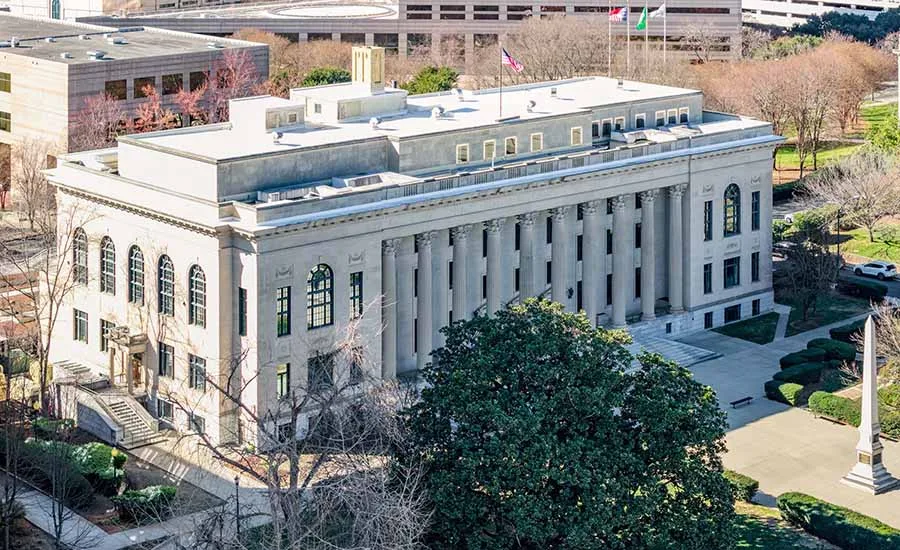
Built in 1928 as the Mecklenburg County Courthouse, this historic building now serves as the Mecklenburg County District Attorney’s Office and remains one of Charlotte’s most recognizable civic landmarks. Designed by architect Louis H. Asbury in the Neoclassical style, the property was added to the National Register of Historic Places in 1979 and designated a local historic landmark in 1983, cementing its status as a symbol of the city’s civic and architectural heritage.
When leaks began appearing across several roof sections of the Mecklenburg County District Attorney’s Office, each constructed from different materials during past renovations, the Mecklenburg County Asset and Facility Management Department sought a solution that could preserve the structure’s integrity. The building’s roof consisted of multiple systems—lightweight insulating concrete (LWIC), metal decking, and structural concrete—each varying in age and condition. Over time, some areas began to show signs of wear, and leaks became increasingly common.
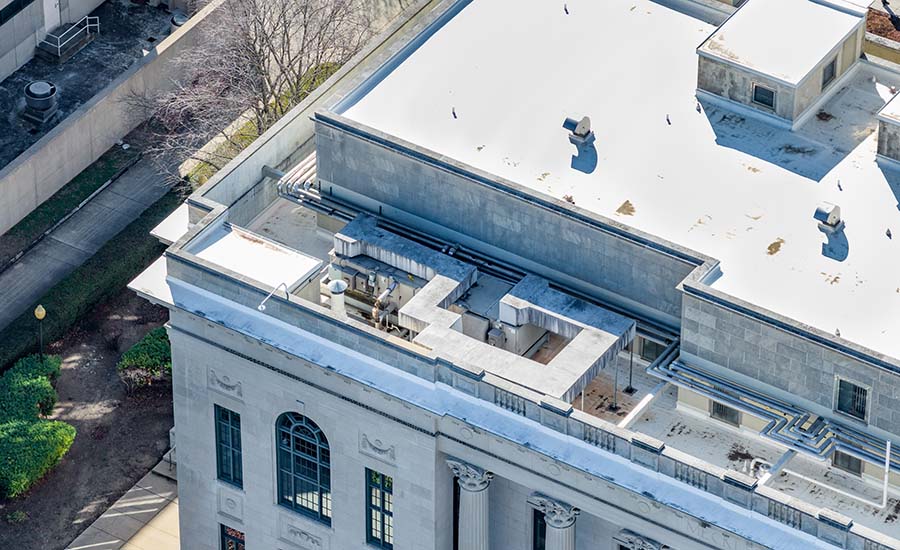
Built in 1928, the roof consisted of multiple systems—lightweight insulating concrete, metal decking, and structural concrete—each varying in age and condition.
Photo: Clear Sky Images
REI Engineers, a North Carolina-based building enclosure consulting firm with offices throughout the eastern United States specializing in roof system design, restoration, and forensic evaluation, designed the roof replacement. Interstate Roofing Co., a prominent commercial roofing contractor based in Charlotte, was awarded the contract after approval from the Board of County Commissioners (BOCC) and elected to utilize Siplast materials. A key priority was ensuring that renovations did not disrupt daily operations. Because the building remained fully active throughout construction, careful coordination, noise management, odor mitigation, and safety protocols were essential. In addition, given the District Attorney's Office's age and continuous use, odor and air monitoring services were not initially provided. REI Engineers was made aware of complaints from the building occupants about odor, and an alternative, low-VOC adhesive was then approved for use.
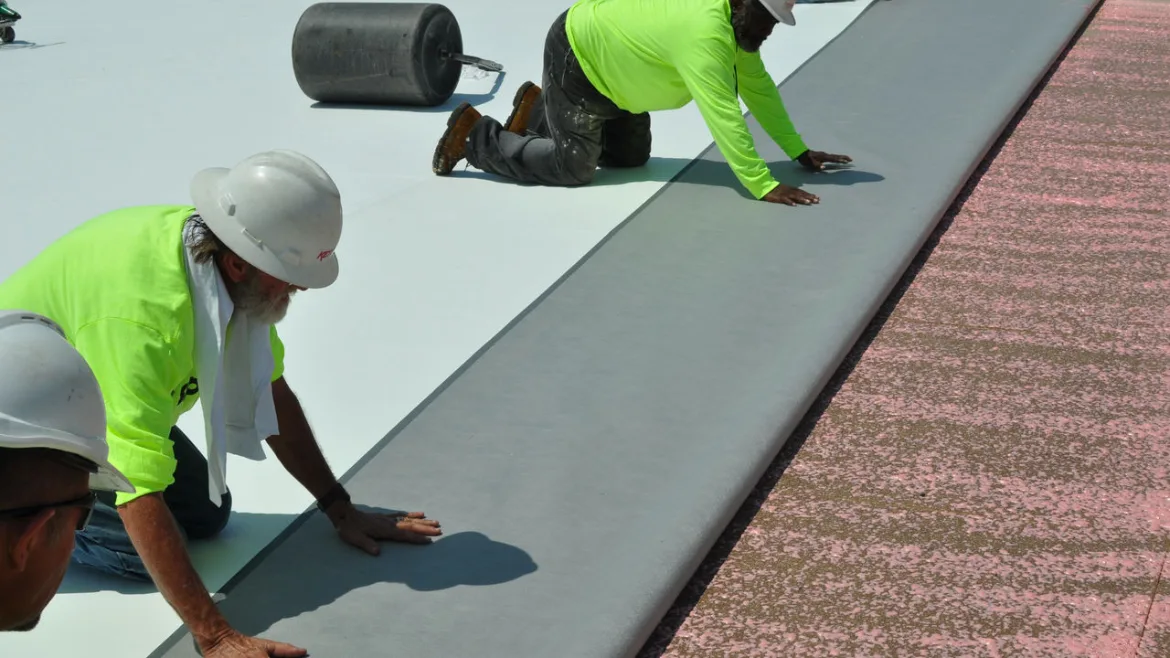
Siplast’s technical knowledge made them an ideal partner for the District Attorney’s Office roofing project. REI Engineers designed this project. Siplast provided a roof system in accordance with the design: a hybrid system combining Paratech Glass Base TG, a torch-applied SBS-modified bitumen base ply, with 80-mil Parasolo TPX Fleeceback, a high-performance TPO membrane. This system provided proven durability while accommodating the District Attorney’s Office's varied roof substrates. To help ensure a durable and visually consistent transition at flashing areas, Siplast applied its patented liquid flashing detail with the TPX roof membrane. This process involves installing the TPX fleeceback membrane upside down, welding the white cap to the field membrane so the fleece faces upward. The fleece then receives a base coat of Parapro Flashing, into which Pro Fleece Reinforcement is embedded. A topcoat is applied to complete the detail, providing a clean, reinforced, and cohesive finish.
To address complaints over odor in the occupied building, Siplast collaborated closely with REI Engineers to substitute the standard Parasolo Bonding Adhesive with LV50 Adhesive, a low-VOC option. This adjustment minimized fumes on-site while maintaining full system performance and warranty compliance, ensuring a safe and efficient installation in the active environment.
Security measures added an extra layer of complexity, as all workers underwent background checks and fingerprinting for building access. Despite these challenges, the project team completed the project efficiently and with minimal disruption to the District Attorney’s Office operations.
With its upgraded roof system, the Mecklenburg County District Attorney’s Office now benefits from a cohesive and warrantied solution designed for longevity and reduced maintenance, underscoring the value of Siplast’s commitment to innovation and partnership in complex renovation projects.
The building’s roof consisted of multiple systems—lightweight insulating concrete (LWIC), metal decking, and structural concrete—each varying in age and condition. Over time, some areas began to show signs of wear, and leaks became increasingly common.
Siplast representatives provided hands-on technical support throughout this project, assisting with product selection, detailing, and on-site troubleshooting. Their involvement helped ensure the system met both the county’s performance standards and demanding schedule. Interstate Roofing praised the collaboration, noting that Siplast’s knowledge of modified roofing systems and comprehensive approach helped simplify the installation. Their proactive, forward-thinking solutions contributed to a smoother process and a cleaner final result.
While the project did not involve a historic review board, maintaining the Mecklenburg County District Attorney’s Office's visual character was essential. The new roof system blends durability and modern waterproofing technology with minimal visual change, preserving the building’s civic identity while extending its service life.
Looking for a reprint of this article?
From high-res PDFs to custom plaques, order your copy today!