Construction Data
Construction Job Openings Surge Amid Roofing Labor Crunch
Open positions climbed to 259,000 in April as contractors nationwide struggled to find workers, despite construction employment gains in many states
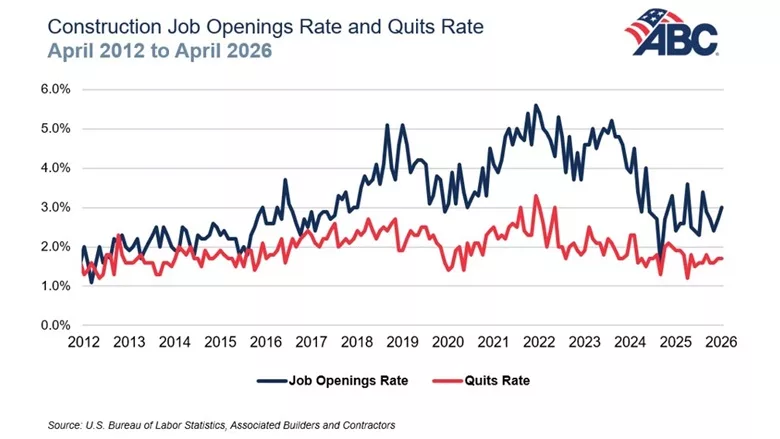
Construction employers are adding jobs across much of the country, but finding workers remains a growing challenge. The industry had 259,000 open positions at the end of April — up 25% from a year ago — highlighting a labor shortage that continues to pressure contractors, including roofing companies competing for skilled workers. Construction job openings rose by 25,000 from March and were up 52,000 compared with April 2025, reflecting continued demand for workers across the industry.
“This release of April data suggests that contractors are increasingly struggling to fill open positions,” said ABC Chief Economist Anirban Basu.
According to ABC, layoffs remained exceptionally low in April, reaching their lowest level since the first half of 2022. At the same time, industry job openings have increased by more than 25% over the past year, signaling persistent hiring challenges despite openings remaining below historic highs.
ABC attributes the labor shortage to several factors, including immigration policy changes, a declining number of undocumented workers and ongoing shortages in specialized trades. Demand for skilled workers involved in data center construction has been particularly strong.
New employment data released by the Associated General Contractors of America underscores the continued demand for construction workers. Construction employment increased in 32 states and the District of Columbia between April 2025 and April 2026, while 32 states also added jobs from March to April.
Texas added the largest number of construction jobs over the past year, gaining 18,700 positions, followed by North Carolina with 13,600 jobs and Ohio with 13,500. Louisiana posted the largest percentage increase, with construction employment rising 5.8% year over year. By contrast, California lost the most construction jobs during the period, shedding 14,500 positions, while Alaska recorded the steepest percentage decline at 5.6%.
Monthly gains were led by Florida, which added 6,000 construction jobs between March and April, followed by Texas, Massachusetts and North Carolina. New Mexico posted the largest percentage increase for the month at 4.9%. Meanwhile, New Jersey recorded the largest monthly job loss, down 1,500 positions, while Maine experienced the steepest percentage decline.
While employment growth across much of the country reflects healthy construction demand, AGC officials cautioned that future hiring could be affected by uncertainty surrounding federal infrastructure funding. The current federal surface transportation law expires Sept. 30, and industry leaders are urging Congress to renew highway and transit funding programs that support construction activity nationwide.
Related: Workforce Pell Grants Boost Trade Training
“It’s encouraging to see construction employment increasing in many parts of the country,” said Ken Simonson, AGC’s chief economist. “But many states will struggle to maintain current employment levels later this year if Congress fails to renew federal legislation to fund highway and transit construction after the current law expires on September 30.”
While contractors continue to express confidence in expanding their workforce over the next six months, as measured by ABC’s Construction Confidence Index, labor availability is expected to remain constrained in the near term.
The tightening labor market presents particular challenges for roofing contractors, who continue to compete for a limited pool of skilled workers. Demand for experienced roofers remains elevated as contractors balance new construction projects with reroofing and repair work driven by storm activity, aging building stock and ongoing investments in commercial properties.
With fewer workers available and hiring becoming more difficult, roofing companies may face higher labor costs, longer project timelines and increased pressure to invest in training, recruitment and workforce development programs. The combination of rising job openings and employment gains in many states suggests that demand for construction labor remains strong, even as contractors struggle to find enough qualified workers to meet project needs.
Looking for a reprint of this article?
From high-res PDFs to custom plaques, order your copy today!