2025 Metal Special Section
Metal Momentum
Market forces drive metal roofing in 2025 and beyond

Asphalt shingles have reigned supreme in the roofing world for decades, covering about 80% of the residential roofs in the United States due to accessibility and price point. But, a combination of climate, social, and financial market pressures is driving the growth of more resilient roof materials, with metal holding the largest share of that residential market, and experts projecting that metal roofing will grow more than 4% a year for several more years.
This growth is not the result of a single trend, but rather a confluence of market changes — including insurance incentives, the increasing severity of weather events, the rise of the FORTIFIED Roof program, new legislative and code requirements, and a surging interest in energy efficiency and sustainability.
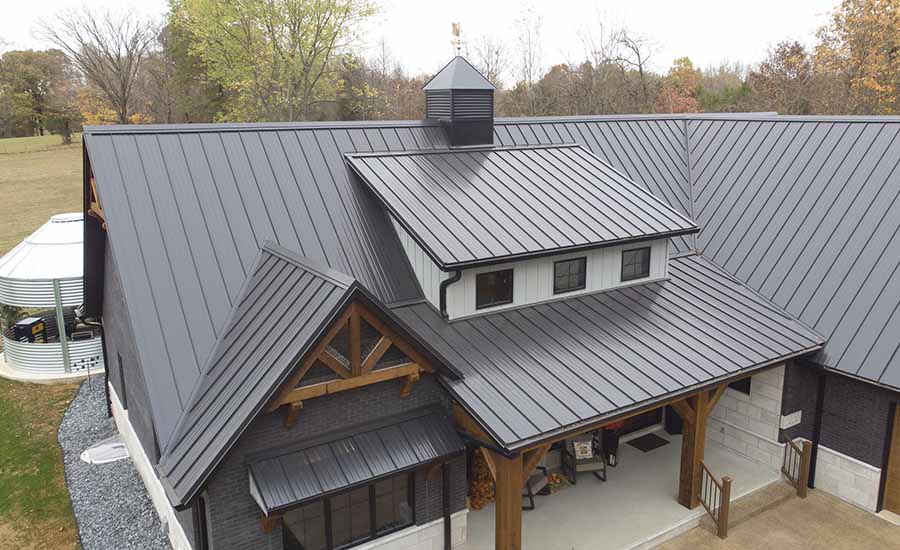
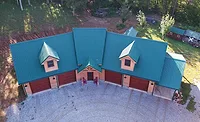
Most standard metal roofing is automatically Class 4 impact rated. To get ratings like that, property owners have to pay a premium for specialty shingles with added features.
Photo: Central States
Severe Weather and Natural Disasters: Shaping Roofing Choices
Extreme weather events and the damage they cause are the top drivers for the increased demand for more resilient roofing. The U.S. is experiencing a larger number of severe events, the degree of severity is greater, and the events are more costly than in previous years.
The U.S. has seen nearly six times more billion-dollar severe storms in the last 20 years compared to the 20 years before that. The annual costs of these storms have increased from $2.5 billion a year to a whopping $15.4 billion a year. Some Midwest states have seen more than 100% increases in severe hail events, and hail risk models indicate more than 12 million properties are now at high risk for hail damage in the U.S. at an estimated replacement cost of $190 billion.
When faced with these extreme weather events — whether coastal hurricanes, southeast winds, or Midwest hailstorms — metal roofing becomes appealing to property owners and insurers. Most standard metal roofing is automatically Class 4 impact rated. To get ratings like that, property owners have to pay a premium for specialty shingles with added features and higher price tags.
Metal roofs can withstand winds of more than 140 mph, while asphalt shingles are typically warranted for 110-130 mph. Real-world applications during recent Florida hurricanes have revealed whole neighborhoods where metal roofs remained intact while nearly all other shingle roofs experienced significant damage.
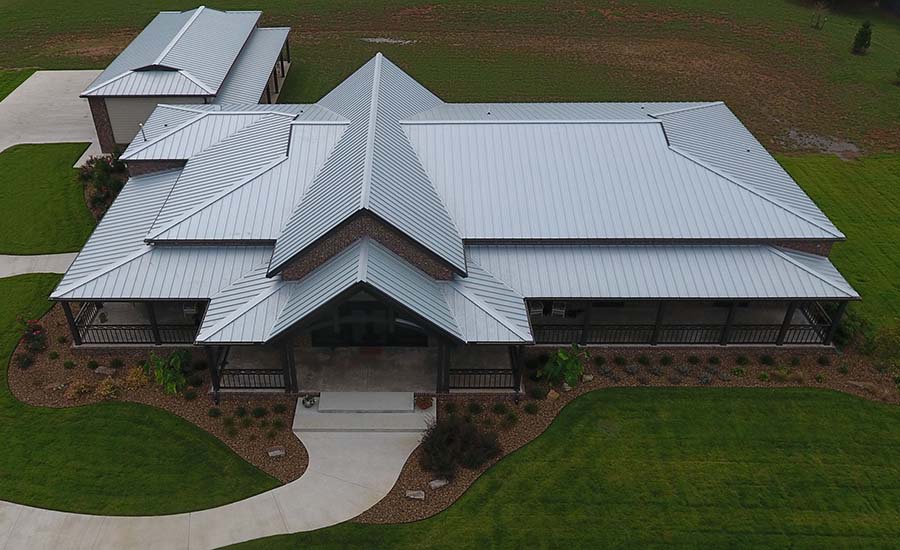
More resilient homes have the potential to reduce the amount of state and federal funding needed for disaster recovery, incentivizing governments to push more resilient building products.
Photo: Central States
Wildfire Mitigation: Recent Disasters Bring Metal to the Forefront
As a Class A-rated, non-combustible material, metal roofing has always been a great choice for areas prone to wildfires, but the last two years have brought the issue into the national conversation and driven demand and acceptance for metal building products in unprecedented ways.
The Los Angeles wildfires of 2025 destroyed more than 16,000 structures and created at least $30 billion in damage. Photos from this disaster and other wildfire-ravaged areas in the last several years show metal-roofed homes still standing in the middle of burned debris from the rest of the neighborhood. These images have clearly had an impact on how metal roofs are viewed in these areas, and multiple states are currently engaged in legislative debates about changing building codes to require more wildfire mitigation efforts. In the meantime, the Federal Emergency Management Agency (FEMA) has recommended that homeowners in fire-prone areas consider replacing their wood shake or asphalt roofs with more fire-resistant materials, like metal.
Insurance Incentives: Paving the Way for Metal Roofing Adoption
If extreme weather is the engine creating the demand for more durable roofing, insurance companies are the driver. More than a quarter of the money insurers paid out to cover residential claims in 2024 was related to roof repair or replacement. Insurers are looking for building products that present less risk by offering higher performance against increasingly common extreme weather events.
Insurance research into the resilience of asphalt shingles has produced things like the Impact-Resistant Shingle Performance Rating, which shows a lack of performance against impact — even for specialty asphalt shingles designed to withstand these types of impacts — and has raised questions about whether asphalt is the best choice for resilient roofs.
Research by groups like the Insurance Institute for Business and Home Safety (IBHS), funded by the major insurance consortia, is actively looking at the resilience of a variety of roofing types.
“The expectations of most American homeowners about the lifespan of their asphalt shingle roof — supported by decades-long product warranties — are not matched by the efficacy of the product,” the IBHS Strategy 2026 report details. “IBHS research has exposed the vulnerabilities of asphalt shingles, including the impact of aging, but manufacturers have not developed a lasting solution.”
The report continues, saying, “It is probable that asphalt shingles have not improved because consumers keep buying the products without knowing or demanding better, with insurers footing the bill 30% of the time. Only through detailed, science-based guidance can consumer expectations for the performance of asphalt shingles and other building components be reset.”
These research efforts by the largest insurers in the country will undoubtedly impact the demand for more resilient products, metal included. The more convinced insurers are of the performance of one material over another, the greater the incentives will be to encourage property owners to switch to these more resilient alternatives. Depending on insurer and state, those incentives can currently range from 5% to 55% off the insurance premium.
Additionally, a growing list of states is providing state funding to property owners to incentivize resilient roofs, including grants of $8,000 to $10,000 for installation and updates, which can quickly make higher-performing and higher-cost roof materials more in line with asphalt shingle costs.
The FORTIFIED Roof Program: Raising the Bar for Resilience
The FORTIFIED Roof program, developed by IBHS, represents a major advancement in promoting resilient roofing standards. This voluntary program certifies roofs that meet stringent performance criteria for resisting wind, water, and impact damage. Metal roofing systems are among the materials that qualify for FORTIFIED Roof certification due to their durability and engineering when installed according to the FORTIFIED standards.
What started as a program in a few coastal states with moderate adoption has grown to active status in all 50 U.S. states, with more than 80,000 homes being certified with the FORTIFIED designation.
Participation in the FORTIFIED Roof program brings tangible benefits. Certified roofs may qualify for additional insurance discounts, increase property value, and qualify for significant state grants. For example, Alabama and Louisiana both offer $10,000 grants to help cover the costs of upgrading to FORTIFIED standards.
In the last two years, FORTIFIED has grown into states like Oklahoma, Minnesota, and Kentucky as the program’s popularity has expanded beyond high wind performance, and additional focus has been added to fortify homes against the threat of hail.
The incentives are based on the real-world performance of more resilient roof systems. In Alabama, after Hurricane Sally, it was reported that homes with FORTIFIED roofs had 55% to 74% fewer insurance claims and 14% to 40% less severe losses compared to non-FORTIFIED homes.
Building Codes, Legislation, and Sustainability: Why Contractors Will Need to Expand into Metal
As severe weather drives insurance companies to explore and incentivize more resilient roofing options, state and federal legislation and building codes are likely to follow to promote healthy insurance markets where major insurers don’t execute a mass exodus due to unmitigated claims, as Florida experienced several years ago. More resilient homes have the potential to reduce the amount of state and federal funding needed for disaster recovery, further incentivizing governments to push more resilient building products.
Add to that the incentives and requirements for sustainable, carbon-neutral, energy-efficient, alternative energy buildings being pushed by states. Metal is considered the “solar-ready” roof for how easily solar can be incorporated into the system without compromising the integrity of the roof. Metal is one of the only materials with a real-world lifecycle that outlasts the solar panel system installed on it.
Metal roofing is largely comprised of recycled material, is nearly 100% recyclable at the end of its life, and qualifies as a “cool roof” the majority of the time based on its innate properties, both reducing heat islands and heating and cooling costs for the building’s inhabitants.
With so many incentives and this much momentum, property owners are responding with an increased demand for alternative, resilient roof options, and for most of the country, metal is a logical option due to its availability, longevity, performance, and price point. Property owners are asking for metal as an option when requesting quotes, and experts expect that to continue.
Contractors who want to succeed in this changing market will need to make sure they are knowledgeable and experienced in selling, quoting, and installing higher-performing roof systems to meet this demand.

Looking for a reprint of this article?
From high-res PDFs to custom plaques, order your copy today!