Guest Essay
HD Polyiso Cover Boards: High-Density for Superior Roof Protection
Advantages for maximizing roof protection and performance
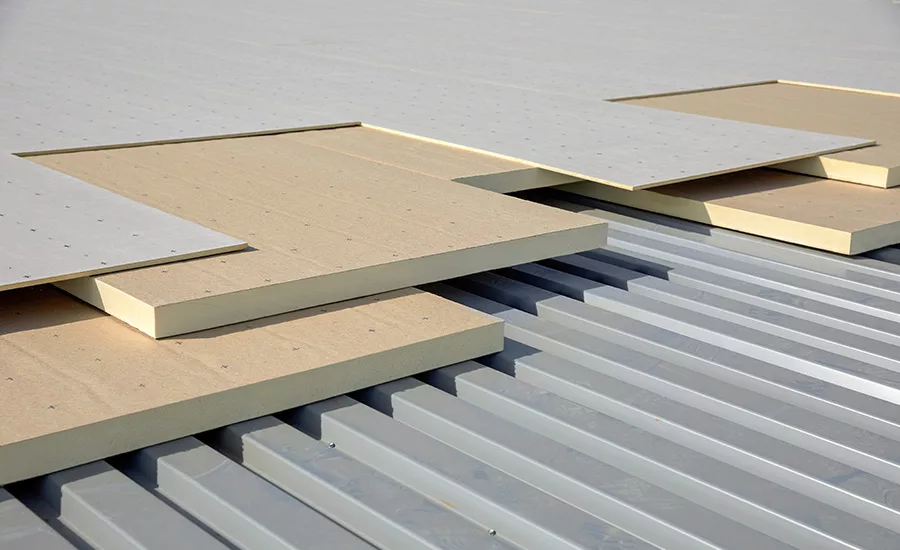
PIMA President Justin Koscher says high-density polyiso cover boards enhance roof durability, thermal performance and installation efficiency. Lighter than gypsum, HD polyiso cover boards offer higher R-values, moisture resistance, and streamlined installation — reducing labor and materials.
— Image courtesy of PIMA
A roof assembly does more than protect against weather; it also addresses thermal efficiency and durability, and for projects that aim for high sustainability, roofs can help lower a project’s carbon footprint.
The National Roofing Contractors Association recommends incorporating a roof cover or protection board in all low-slope membrane roof systems to achieve a high-performance and durable roof assembly.
What is a Cover Board?
A cover board is a thin, protective substrate typically installed between low-slope roof systems' insulation and membrane layers. Cover boards are often specified for roofs likely to be subjected to consistent service traffic, extreme weather events (such as hail or high winds) or those with renewable energy systems such as rooftop solar systems.
Engineered with high compressive strength, cover boards bolster a roof's overall resilience and improve its wind uplift performance.
In the past, traditional gypsum cover boards were the go-to solution. However, roofing contractors are increasingly switching to high-density polyisocyanurate cover boards, which offer the compressive strength to meet project targets and contribute to the roof assembly’s thermal performance. The polyiso foam core provides higher R-values in a lighter-weight profile.
Compressive Strength Enhances Durability
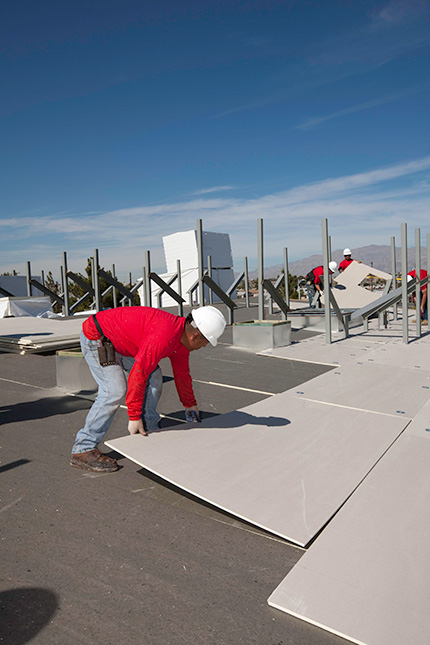
Designed with high compressive strength, cover boards improve a roof's overall resilience and wind uplift performance.
These products provide the compressive strengths necessary for various specifications and roof assembly types. HD polyiso cover boards are an excellent choice for installation over flat stock and/or tapered insulation, forming roof assemblies that can withstand the impact of roof traffic and help meet specific hail approval requirements.
In the design phase, professionals should evaluate the expected range of loads—such as equipment, people, wind, or hail — that a roof assembly will experience.
“Traditionally, contractors have installed gypsum boards for its familiarity and very high-compressive values,” Mary Schenker, senior product manager of Insulation at GAF, explains. “But in hindsight, many of those roof assemblies are unlikely to experience extreme loading demands and end up being overengineered. This causes building teams to miss out on the other benefits that alternative cover board options have to offer and which can actually enhance in-service performance.”
Comparing apples to apples, gypsum and HD polyiso cover boards can each meet extreme weather criteria, including Severe Hail classification requirements.
However, HD polyiso cover boards have higher R-values and enable greater installation efficiency, making them a more valuable choice for contractors and their projects.
R-value and Leaner Roof Assemblies
Regarding thermal resistance, HD polyiso cover boards outperform gypsum alternatives. A half-inch-thick HD polyiso cover board has an R-value of 2.5, whereas a gypsum cover board of similar thickness offers a negligible R-value (typically R-0.5).
If a roof assembly is designed to achieve a thermal performance of R-30, HD polyiso cover board can add R-2.5 to that value, thus reducing the additional insulation required in the assembly. Conversely, if gypsum is specified, the roof assembly will need more insulation beneath the cover board to meet the desired thermal performance.
“HD polyiso cover boards also enable roofing contractors to build leaner systems,” Schenker says. “Because there is less insulation required below the protection board, they can thin their roof assembly by at least a half inch, which can be especially beneficial in projects where the roof assembly is limited to a certain thickness as a result of existing rooftop conditions,” she adds.
In addition to enhancing thermal performance, HD polyiso cover boards are typically manufactured with coated glass facers (CGF), further improving the moisture resistance of polyiso’s closed-cell foam core. The facer also provides a surface that effectively allows membrane adhesives and other products to be applied, enhancing compatibility with various roofing materials and installation practices. Moisture resistance and system compatibility are crucial factors when designing and installing a roofing system.
Lighter Boards Promote Installation Efficiency
In addition to their performance benefits, HD polyiso cover boards offer exceptional installation efficiency due to their lightweight nature. A single polyiso panel typically weighs about 66-80% lighter than similar gypsum products.
The weight reduction simplifies rooftop bundle staging with shorter crane time for hoisting and easier handling and installation of individual boards. In fact, HD polyiso cover boards can cut staging time by almost 70% compared to gypsum boards.
Lighter cover boards also reduce workers' risk of injury, as the panels are easier to maneuver on the job site. Unlike gypsum boards, HD polyiso cover boards can be easily cut without requiring specialized tools and produce virtually no dust during installation.
Composite HD Polyiso Board Streamline Installation
Contractors can further streamline installation using composite HD polyiso boards, which are pre-adhered to the roof insulation boards. In a conventional roof system, multiple layers are required: the base layer of insulation is mechanically fastened to the deck, followed by one or more layers of insulation, depending on the assembly's R-value, and finally, a cover board adhered or fastened on top.
With composite HD polyiso boards, the installation of one layer is completely eliminated, as the insulation is already adhered to the cover board.
“With composite HD polyiso boards, roofing contractors can install fewer individual layers of materials, which saves on adhesives and reduces the number of boards that need to be lifted onto the roof and installed,” Schenker says.
“In construction, where time is money, such a streamlined installation process allows a contractor’s team to complete a project faster,” she adds.
Having it All: Durability and Efficiency
As roofing systems continue to evolve in response to growing demands for projects that are sustainable, energy-efficient and provide long-term durability, HD polyiso cover boards are proving to be a superior solution.
Their combination of suitable impact resistance for most roof systems, higher R-value, moisture resistance and ease of installation offers roofing contractors an efficient and versatile option for their projects.
A special thanks to PIMA member Mary Schenker of GAF for contributing their expert insights to this article.
For more information, visit polyiso.org.
Looking for a reprint of this article?
From high-res PDFs to custom plaques, order your copy today!