Are Blanket Safety Rules for Roofers a Good Idea?
Controls implemented to reduce hazards must not only be feasible, they also can’t create a greater threat
Throughout my career, I’ve observed many industry trends, both positive and negative. Recently, I’ve noticed a concerning trend among general contractors taking a blanket, one-size-fits-all approach to controlling health, safety, and compliance concerns on their projects.
While this may seem like a good idea to ensure compliance with OSHA and EPA regulations, this approach has the opposite effect: it creates greater hazards for several contractors.
To understand what drives this extreme approach to control jobsite safety and health, one must understand the “controlling contractor” role. OSHA has different classifications for contractors on a project, depending on their role in a safety or health violation, and they are all cited for non-compliance accordingly.
A controlling contractor is the contractor of record who has legal care, custody, and control of the project. A controlling contractor is legally responsible for everything on the site during their contractual ownership of the project.
A creating contractor is a contractor who creates a hazard.
An exposing contractor is a contractor who may not have created a hazard but is exposing their workers to a hazard.
Due to the multi-employer worksite clause, all these categories of contractors will be held liable for an injury, and all are subject to OSHA citations for violations or exposure to a hazard.
For this reason, general contractors receive the duplicate citations that their subcontractors receive when they violate safety or health regulations. On commercial projects, hundreds of workers are frequently between multiple contractors on-site at any given time.
The likelihood of a worker violating a safety or health rule is very high, given the dynamic and dangerous nature of the construction industry and the number of workers on site. However, when this happens, the general contractor often receives these citations, which can add up quickly, given their exposure to the number of on-site contractors.
To try and control the number of violations and citations they receive, more and more general contractors are taking very aggressive and extreme measures, such as blanket, one-size-fits-all PPE rules.
As an industrial hygienist and occupational and environmental health and safety professional, I find this very concerning, as many of these policies have created a greater hazard for several of my clients’ employees. The number one rule in my profession is “Do not create a greater hazard,” so anything we implement as a control measure must first be weighed against two considerations:
- Is the control measure safe and effective?
- Does the control measure create a greater hazard?
Suppose we answer “no” to question No. 1. In that case, we stop and re-evaluate and do not need to proceed to question No. 2. If we answer “yes” to question No. 1, we proceed to question No. 2.
If the answer to question No. 2 is “yes,” we are not legally allowed to implement the control measure according to OSHA’s Greater Hazard Clause, which is established by Section 501(a) of the Occupational Safety and Health Act of 1970, also known as the General Duty Clause.
I want to share a couple of case studies that directly impact roofing contractors and the solutions I brought to the table to appease (and educate) the general contractors and their safety managers. These contractors were simply not educated on all the tenets of our profession, based on the “Hierarchy of Safety and Controls,” which have dictated our profession since 1950.
(There are 18 disciplines in the fields of IH/OEHS and most safety managers are only educated on the “safety” component, i.e., “slips, trips, falls,” and not the higher-level governing principles and regulatory drivers).
Case Study 1
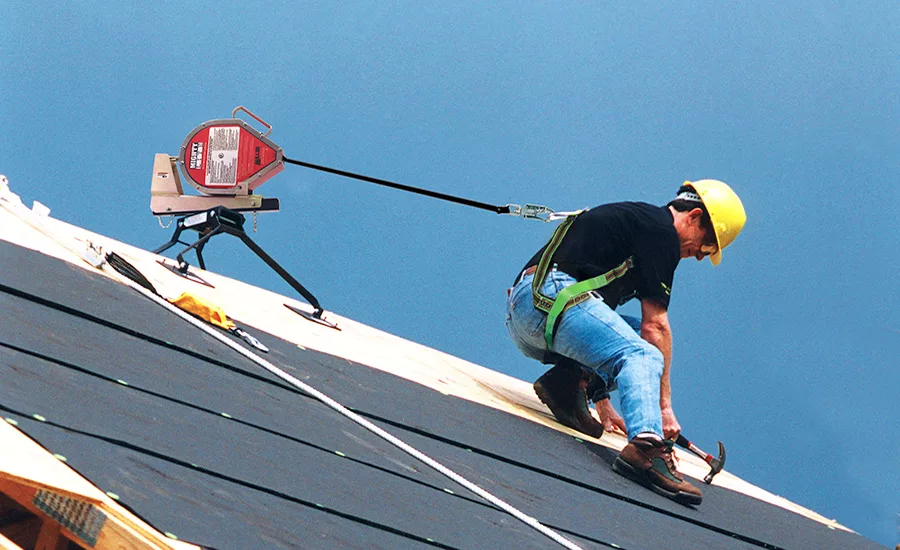
General Contractor implements a “no ropes” policy for roofers in response to not having their ropes adjusted to prevent a worker from contacting the ground in the event of a fall.
While requiring self-retracting lifelines (SRLs) may only seem a reasonable response, this approach created a more significant hazard for my roofing contractor for the following reasons:
The workers must attach to a lifeline before stepping off the ladder to move across the roof to the next anchor point. This cannot be done with an SRL, as the connector cannot be pulled down from the ridge point anchor to the ladder. This left workers with no choice but to walk across the roof without fall protection to their anchor point. If OSHA observed a worker walking across a roof without fall protection, they would cite the subcontractor for being on the roof without fall protection. The GC argued that we should install an SRL anchor by the ladder at the roof edge. This was not an acceptable response, as connecting to an anchor below the worker’s feet is not legal. If the worker attached at that point and moved to the upper roof elevation to the next anchor point, they would be connected to an anchor below their feet, exposing them to a swing radius hazard in which a fall could result in contact with the ground due to too much wire cable being extended.
- The other issue this policy created concerns OSHA’s “feasibility” exception. It is not feasible for a worker doing roofing work on a steep-slope roof to use an SRL, as this system does not allow them to utilize the cable for fall prevention when moving up and down the roof during their work. On steep slope-roofs, workers need to utilize their rope for mobility reasons, moving up and down the roof as they use it for stability, ascending and descending the steep roof. This is not possible with the wire cable on an SRL.
When I brought these more significant hazard and infeasibility issues to the GC, they created an exemption form for specific trades that would be negatively impacted by this new policy to allow them to do their work in the safest manner possible.
Case Study 2
General Contractor implements a “steel-toed work boot” policy for all trades on their projects.
This policy was created in response to foot injuries on the GC’s projects. While this is a reasonable response for workers on the ground, it created new hazards for roofers.
- Roofers wear special safety shoes with specially designed soles, creating an excellent grip for roofing work. This is an engineering control measure to prevent falls. A steel-toed boot does not have the necessary grip workers need on a roof to help prevent falls. On the contrary, these boots are heavy, clunky, and not as grip-protective for roofers, which can lead to fall hazards.
- On steep-slope roofs, workers bend and flex their feet all day. The steel component covering the toes of these boots will cut into the foot's metatarsal joints, creating ergonomic foot/joint injuries. For this reason, roofers would need to take frequent work-rest cycles to alleviate the pressure on their feet and prevent injuries. This would slow the work activities, negatively impacting production schedules.
These issues were pointed out to the GC, who initially resisted. I provided court cases in which the “Greater Hazard” clause was used and documentation of where this clause was addressed in OSHA’s language, Section 501(a) of the Occupational Safety and Health Act of Congress. This clause is known as the General Duty Clause, which states that employers must provide a workplace free of all known hazards and anything that could become a hazard.
A thorough understating of the regulatory requirements and applications of the regulations to each trade is essential to help keep our employees and subcontractors safe and healthy on our projects, despite what a GC may mandate as a control measure.
In conclusion, any control measure (including PPE) that we attempt to implement to reduce hazards must be feasible and cannot create a greater hazard.
Looking for a reprint of this article?
From high-res PDFs to custom plaques, order your copy today!