Web Exclusive: Green Building Solutions: Recycling Vinyl Roofing Systems
For more than 10 years, the European vinyl roofing manufacturers have been blazing the trail toward a robust post-consumer vinyl roof recycling infrastructure. And now, riding on the notable success of vinyl roof material reclamation pilot projects and the incorporation of new equipment for material processing, their North American counterparts are poised to bring post-consumer vinyl roof recycling into the mainstream.

For more than 10 years, the European vinyl roofing manufacturers have been blazing the trail toward a robust post-consumer vinyl roof recycling infrastructure. And now, riding on the notable success of vinyl roof material reclamation pilot projects and the incorporation of new equipment for material processing, their North American counterparts are poised to bring post-consumer vinyl roof recycling into the mainstream.
Because thermoplastic single-ply vinyl membrane can be heated and re-formed repeatedly over its lifespan, it has long been an industry practice to recover production trimmings and scrap, and to recycle the material into new membranes. Well-run and properly equipped production plants are capable of converting virtually all of the raw vinyl roof material and components of one membrane into another installed roof system or other applications.
Traditionally, post-industrial recycled products have included accessories such as roofing walkway pads, commercial-grade flooring, and concrete expansion joints. In addition, scrap from the production of roof membranes can be reintroduced as a raw material into a subsequent membrane manufacturing process. Some roofing manufacturers collect their customers' vinyl scrap, as well as the general-purpose scrap of other vinyl fabricators, for reuse in production of new vinyl roof membranes.
Building on this track record, the member manufacturers of the Chemical Fabrics and Film Association (CFFA) Vinyl Roofing Division have initiated a feasibility study to evaluate strategies for making post-consumer recycling of vinyl roofing products viable on a broad scale, as has been done in Europe for many years. Skyrocketing raw material costs, higher landfill tipping fees, and legislation to restrict disposal of construction materials[1] - as well as an architectural community that demands the lightest environmental footprint that can be achieved - are all leading toward the mainstreaming of post-consumer vinyl roof product recycling.
 European Initiatives
Vinyl roofs have been in use for more than 40 years in Europe, and roofing manufacturers there have been recycling retired vinyl roofs into other useful products since 1994. That was the year a consortium of companies funded the construction and operation of a facility in Germany to reclaim the growing volume of vinyl roof membranes at the end of their service lives and return them to the original manufacturers. Typically incorporated into the backside of the sheet where potential color variations are not a factor, the recovered material can comprise 5 percent to 15 percent by weight of the finished vinyl roofing product. Some field reports have indicated that even after more than 10 years of second life, the vinyl membranes made with recycled post-consumer material are performing the same as membranes produced from virgin raw vinyl materials.
Today, ROOFCOLLECT, a European Single Ply Waterproofing Association (ESWA) program, coordinates the recovery and processing of post-consumer vinyl roofing membranes. In conjunction with the European Commission, ESWA sets annual targets for post-consumer vinyl roof recycling; in 2006, 4.4 million pounds of vinyl roofing membrane were recycled due to its efforts.
ESWA is now working with the recycler Interseroh to establish a pan-European collection system that would facilitate vinyl membrane recycling in closer proximity to the jobsite. ESWA is also investigating strategies for incorporating higher percentages of recycled material into finished membranes.
 Testing Cases at Home
In the United States, post-consumer recycling of vinyl roof membranes began in 1999. Working in tandem with a vinyl membrane manufacturer, a Massachusetts recycling company produced a highway cold patching material with a percentage of old vinyl roofing membranes and other recovered plastics. Since then, post-consumer recycling of vinyl roof membranes has occurred on a limited basis. More often than not, the savings in disposal fees and the value of the salvaged vinyl materials have generally exceeded the cost of the additional labor, shipping, and grinding fees. In general, the total net costs are dependent on total roofing square footage, the distance that the old roof must be shipped to be processed, and the avoidance of landfill tipping fees.
In 2005, those tasked with re-roofing Boston's Marriott Long Wharf hotel recognized that several logistical efficiencies made the job an ideal recycling test case. The consultant, contractor, and roofing manufacturer identified two factors working in favor of a successful vinyl roof membrane recycling scenario. Foremost, the hotel was close to the roofing manufacturer's production facility, which meant below-average shipping costs for transport of the vinyl roofing material. Furthermore, project management identified a local recycler with an established program for handling thermal insulation, which meant minimal incremental freight charges as a percentage of overall salvage costs and experienced handling and processing of the old vinyl roofing membrane.
Other system components recycled included the gravel ballast, the metal flashings, and the extruded polystyrene insulation. In the end, 95 percent of the existing materials of the roof assembly, by weight, were recycled. The vinyl membrane was returned to the manufacturer for use in other membrane products. The contractor estimated a savings of 25 percent versus the traditional disposal costs, even with the additional handling required.
A more typical recycling scenario faced those working on the University of Iowa's Carver-Hawkeye Arena. In April of 2006, the project's building team was also committed to incorporate a vinyl membrane recycling strategy into its roof replacement project; however, there was no local insulation recycling program to help defray the shipping costs, and the manufacturer was much further away from the jobsite. Nonetheless, university officials found this approach a cost-effective choice compared to tipping fees at a landfill, and it was more environmentally friendly.
The aged roof was rolled up on site in Iowa City. It was then sent to Cedar Rapids to be ground down to a smaller size. With the volume reduced for more affordable shipping, the vinyl material was finally sent to the manufacturer to take the place of virgin post-industrial vinyl in the production of a roofing walkway membrane. Smart scheduling of the project allowed some of the walkway material produced from the recycled vinyl roof membrane to be also used on the new roof.
 Recycling Durable Building Products
Many end users and plastic recyclers recognize that the plastics used in durable goods are often more valuable than those found in packaging. But mainstreaming recovery of these plastics is complicated by a number of unique challenges. Such challenges include a much wider range of different and incompatible plastics in the market; a less developed plastics collection infrastructure; more varied end products; lower overall volumes of these plastic materials, particularly on an individual grade basis; and a much wider range of attached foreign materials such as metal, rubber, foams, and fabrics.[2]
A sustainable plastic materials recycling strategy requires high-quality reclamation during teardown, reprocessing efficiency and a ready customer base for the recycled plastic product. With this in mind, the CFFA feasibility study on post-consumer vinyl roof recycling is looking at ways to address the following issues on a large scale.
 Reclamation
Any long-term approach to reclaiming old vinyl roof membranes will need to address the training of roofing contractors in the logistics of tearing down the roof system for recycling instead of landfill disposal. Recycling requires more handling, since the contractor must separate the vinyl membrane from other waste materials and prepare it for shipping off the site.
When preparing and storing the vinyl membrane for transport to the recycler, old membranes must be cut into strips of prescribed widths and lengths and tightly rolled and tack welded before leaving the jobsite. As part of the planning process, roofing contractors need to pre-order Gaylord boxes and pallets from the vinyl membrane manufacturer based on the surface area of the roof, the membrane thickness, and the existing assembly construction. Scrap membrane and trimmings from the new vinyl roof membrane installation can be added to the Gaylord for recycling as well.
When delivering product to the company that is providing size reduction and grinding services, the vinyl membrane should be clean of foreign materials like stone ballast and metal fasteners.
Processing
Many processors can grind reclaimed roofing materials, but for vinyl roofs to be reduced in size to chunks or powder, equipment is needed that can remove unwanted components such as felt backing material and the reinforcing polyester matrix.
Until recently, felt-backed vinyl roof membranes could not be reprocessed and had to be sent to the landfill. Newer equipment can separate the felt, allowing the sheet to be recycled with ease. The equipment can also extract the encapsulated scrim reinforcement from the polymer matrix. This means that the felt backing and scrim can also be reused as fibrous filler when, for example, fabricating concrete blocks for landscaping.
The ultimate success of roof recycling - as in the case with all recycling - depends on the will of the participants in the process. Developing a customer base and collection infrastructure as well as encouraging market desire for sustainable building construction is necessary to a viable roof recycling program. Such a program will enhance the already significant life cycle of the durable, highly engineered, light-colored vinyl roofing membranes that have for the last 40 years been cooling and protecting buildings in all climates around the world.
For more information on how to take advantage of vinyl recycling programs, visit www.vinylroofs.org.
Notes
1 For example, Title 11 of Chicago's municipal code governing utilities and environmental protection mandates recycling minimums for certain jobs, below which fines are levied for the percentage below the minimum.
2 Biddle, Dr. Michael B.; Dinger, Peter; Fisher, Dr. Michael M.; ÒAn Overview of Recycling Plastics from Durable Goods: Challenges and Opportunities,' presentation before IdentiPlast II, Brussels, Belgium; April 1999.
Strips of the old Carver-Hawkeye roof are rolled up and readied for transport off site.
For more than 10 years, the European vinyl roofing manufacturers have been blazing the trail toward a robust post-consumer vinyl roof recycling infrastructure. And now, riding on the notable success of vinyl roof material reclamation pilot projects and the incorporation of new equipment for material processing, their North American counterparts are poised to bring post-consumer vinyl roof recycling into the mainstream.
Because thermoplastic single-ply vinyl membrane can be heated and re-formed repeatedly over its lifespan, it has long been an industry practice to recover production trimmings and scrap, and to recycle the material into new membranes. Well-run and properly equipped production plants are capable of converting virtually all of the raw vinyl roof material and components of one membrane into another installed roof system or other applications.
Traditionally, post-industrial recycled products have included accessories such as roofing walkway pads, commercial-grade flooring, and concrete expansion joints. In addition, scrap from the production of roof membranes can be reintroduced as a raw material into a subsequent membrane manufacturing process. Some roofing manufacturers collect their customers' vinyl scrap, as well as the general-purpose scrap of other vinyl fabricators, for reuse in production of new vinyl roof membranes.
Building on this track record, the member manufacturers of the Chemical Fabrics and Film Association (CFFA) Vinyl Roofing Division have initiated a feasibility study to evaluate strategies for making post-consumer recycling of vinyl roofing products viable on a broad scale, as has been done in Europe for many years. Skyrocketing raw material costs, higher landfill tipping fees, and legislation to restrict disposal of construction materials[1] - as well as an architectural community that demands the lightest environmental footprint that can be achieved - are all leading toward the mainstreaming of post-consumer vinyl roof product recycling.
The University of Iowa’s building team recycled the aged roof of the Carver-Hawkeye Arena into roofi ng walkway membrane. All photos courtesy of Chemical Fabrics and Film Association (CFFA).
Vinyl roofs have been in use for more than 40 years in Europe, and roofing manufacturers there have been recycling retired vinyl roofs into other useful products since 1994. That was the year a consortium of companies funded the construction and operation of a facility in Germany to reclaim the growing volume of vinyl roof membranes at the end of their service lives and return them to the original manufacturers. Typically incorporated into the backside of the sheet where potential color variations are not a factor, the recovered material can comprise 5 percent to 15 percent by weight of the finished vinyl roofing product. Some field reports have indicated that even after more than 10 years of second life, the vinyl membranes made with recycled post-consumer material are performing the same as membranes produced from virgin raw vinyl materials.
Today, ROOFCOLLECT, a European Single Ply Waterproofing Association (ESWA) program, coordinates the recovery and processing of post-consumer vinyl roofing membranes. In conjunction with the European Commission, ESWA sets annual targets for post-consumer vinyl roof recycling; in 2006, 4.4 million pounds of vinyl roofing membrane were recycled due to its efforts.
ESWA is now working with the recycler Interseroh to establish a pan-European collection system that would facilitate vinyl membrane recycling in closer proximity to the jobsite. ESWA is also investigating strategies for incorporating higher percentages of recycled material into finished membranes.
In re-roofi ng Marriott’s Long Wharf hotel, 95 percent of the existing materials of the roof assembly were recycled.
In the United States, post-consumer recycling of vinyl roof membranes began in 1999. Working in tandem with a vinyl membrane manufacturer, a Massachusetts recycling company produced a highway cold patching material with a percentage of old vinyl roofing membranes and other recovered plastics. Since then, post-consumer recycling of vinyl roof membranes has occurred on a limited basis. More often than not, the savings in disposal fees and the value of the salvaged vinyl materials have generally exceeded the cost of the additional labor, shipping, and grinding fees. In general, the total net costs are dependent on total roofing square footage, the distance that the old roof must be shipped to be processed, and the avoidance of landfill tipping fees.
In 2005, those tasked with re-roofing Boston's Marriott Long Wharf hotel recognized that several logistical efficiencies made the job an ideal recycling test case. The consultant, contractor, and roofing manufacturer identified two factors working in favor of a successful vinyl roof membrane recycling scenario. Foremost, the hotel was close to the roofing manufacturer's production facility, which meant below-average shipping costs for transport of the vinyl roofing material. Furthermore, project management identified a local recycler with an established program for handling thermal insulation, which meant minimal incremental freight charges as a percentage of overall salvage costs and experienced handling and processing of the old vinyl roofing membrane.
Other system components recycled included the gravel ballast, the metal flashings, and the extruded polystyrene insulation. In the end, 95 percent of the existing materials of the roof assembly, by weight, were recycled. The vinyl membrane was returned to the manufacturer for use in other membrane products. The contractor estimated a savings of 25 percent versus the traditional disposal costs, even with the additional handling required.
A more typical recycling scenario faced those working on the University of Iowa's Carver-Hawkeye Arena. In April of 2006, the project's building team was also committed to incorporate a vinyl membrane recycling strategy into its roof replacement project; however, there was no local insulation recycling program to help defray the shipping costs, and the manufacturer was much further away from the jobsite. Nonetheless, university officials found this approach a cost-effective choice compared to tipping fees at a landfill, and it was more environmentally friendly.
The aged roof was rolled up on site in Iowa City. It was then sent to Cedar Rapids to be ground down to a smaller size. With the volume reduced for more affordable shipping, the vinyl material was finally sent to the manufacturer to take the place of virgin post-industrial vinyl in the production of a roofing walkway membrane. Smart scheduling of the project allowed some of the walkway material produced from the recycled vinyl roof membrane to be also used on the new roof.
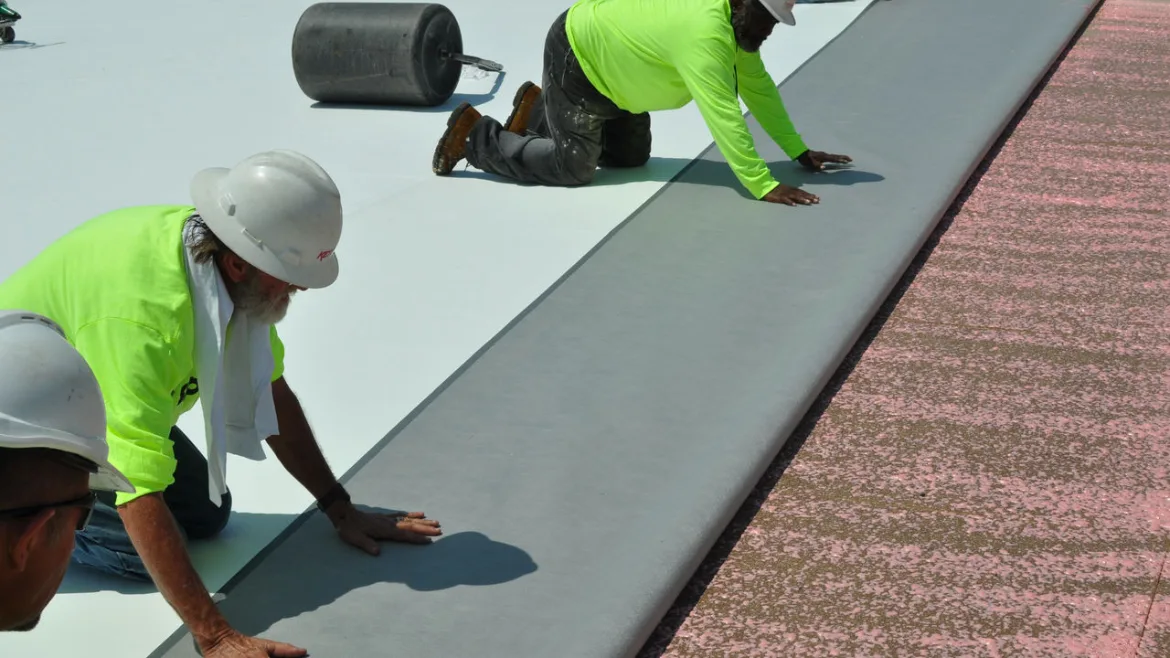
The retired membranes are cut into strips of prescribed width and rolled up for easy removal.
Many end users and plastic recyclers recognize that the plastics used in durable goods are often more valuable than those found in packaging. But mainstreaming recovery of these plastics is complicated by a number of unique challenges. Such challenges include a much wider range of different and incompatible plastics in the market; a less developed plastics collection infrastructure; more varied end products; lower overall volumes of these plastic materials, particularly on an individual grade basis; and a much wider range of attached foreign materials such as metal, rubber, foams, and fabrics.[2]
A sustainable plastic materials recycling strategy requires high-quality reclamation during teardown, reprocessing efficiency and a ready customer base for the recycled plastic product. With this in mind, the CFFA feasibility study on post-consumer vinyl roof recycling is looking at ways to address the following issues on a large scale.
Initial prep, such as vacuuming stone ballast, ensures that a clean product is sent to the recycler.
Any long-term approach to reclaiming old vinyl roof membranes will need to address the training of roofing contractors in the logistics of tearing down the roof system for recycling instead of landfill disposal. Recycling requires more handling, since the contractor must separate the vinyl membrane from other waste materials and prepare it for shipping off the site.
When preparing and storing the vinyl membrane for transport to the recycler, old membranes must be cut into strips of prescribed widths and lengths and tightly rolled and tack welded before leaving the jobsite. As part of the planning process, roofing contractors need to pre-order Gaylord boxes and pallets from the vinyl membrane manufacturer based on the surface area of the roof, the membrane thickness, and the existing assembly construction. Scrap membrane and trimmings from the new vinyl roof membrane installation can be added to the Gaylord for recycling as well.
When delivering product to the company that is providing size reduction and grinding services, the vinyl membrane should be clean of foreign materials like stone ballast and metal fasteners.
Processing
Many processors can grind reclaimed roofing materials, but for vinyl roofs to be reduced in size to chunks or powder, equipment is needed that can remove unwanted components such as felt backing material and the reinforcing polyester matrix.
Until recently, felt-backed vinyl roof membranes could not be reprocessed and had to be sent to the landfill. Newer equipment can separate the felt, allowing the sheet to be recycled with ease. The equipment can also extract the encapsulated scrim reinforcement from the polymer matrix. This means that the felt backing and scrim can also be reused as fibrous filler when, for example, fabricating concrete blocks for landscaping.
The ultimate success of roof recycling - as in the case with all recycling - depends on the will of the participants in the process. Developing a customer base and collection infrastructure as well as encouraging market desire for sustainable building construction is necessary to a viable roof recycling program. Such a program will enhance the already significant life cycle of the durable, highly engineered, light-colored vinyl roofing membranes that have for the last 40 years been cooling and protecting buildings in all climates around the world.
For more information on how to take advantage of vinyl recycling programs, visit www.vinylroofs.org.
Notes
1 For example, Title 11 of Chicago's municipal code governing utilities and environmental protection mandates recycling minimums for certain jobs, below which fines are levied for the percentage below the minimum.
2 Biddle, Dr. Michael B.; Dinger, Peter; Fisher, Dr. Michael M.; ÒAn Overview of Recycling Plastics from Durable Goods: Challenges and Opportunities,' presentation before IdentiPlast II, Brussels, Belgium; April 1999.
Looking for a reprint of this article?
From high-res PDFs to custom plaques, order your copy today!