Roofing Safety
Roofing Industry Lacks First Step Safety Standards
Recent fatal incidents show roofers are walking onto unknown roofs without defined safety protocols, often with deadly consequences.
A roofing construction fatality in 2022 underscores a critical blind spot in the industry’s safety protocols.
An estimator walked onto a metal roof for a routine inspection of a commercial building in Georgia. During the roof evaluation, the worker stepped on a skylight roofing panel and fell 34 feet to his death.
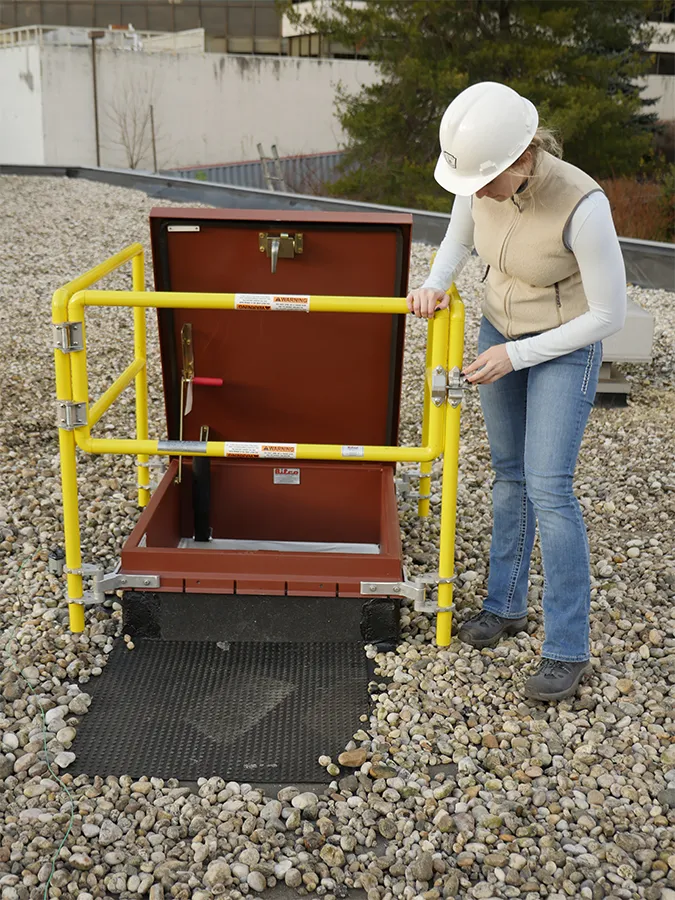
BILCO’s LadderUP safety post adds a critical safety component for access through roof hatches.
Photo courtesy of BILCO
The incident is not uncommon. A little more than a year later, a roofing project manager died while performing a post-purchase inspection of a commercial warehouse in Kentucky. The man stepped onto the skylight and fell 25 feet to his death. According to the Occupational Safety and Health Administration, falls are the leading cause of death in construction. Data from the Bureau of Labor Statistics finds that roofing is among the top three most fatal occupations in the U.S.
While safety procedures for roofing contractors are well-established — but not always followed — an overlooked safety aspect fails to address estimators, project managers and service or maintenance teams who are the first ones to access the roof. They are walking on unproven, unknown roofs at their peril.
An industry objective should be to develop protocols and find solutions to prevent these hazardous situations. They are preventable, but they also require more attention from all members of the roofing community.
Risky First Steps
Many safety practices miss an important step. The most dangerous moment isn’t always during construction. Frequently, first access and initial steps on an unknown roof present the most risk.
Currently, there is no defined protocol for pre-inspection and hazard identification. Unverified roofs and camouflaged skylights pose uncertainty for first access workers.
A primary industry flaw assumes that “it’s just an estimate or service work” and that initial tasks can be accomplished quickly with no real safety threat. The reality, however, is that it’s high-risk work with zero controls.
The industry has adapted an over-reliance on speed, habits and assumptions, and has not leveraged technology or pre-planning measures that can dramatically reduce the risk for workers who are making initial assessments.
Attitude Shift
A shift in mindset and process will help curb potential first-step hazards. Every roofing business, employee and customer should treat every unknown roof as hazardous.
Due diligence beforehand is a crucial step. Drones, for instance, are terrific tools for early inspection. They provide high-resolution photos and videos that can zoom in on problem areas and reach angles or crevices that might challenge a roofing contractor. Drones can also help with steep pitches, multiple layers and architectural features that create hard-to-inspect elements.
Drones are also far safer — crews remain grounded — and work quickly, efficiently and accurately, providing data that determines the precise scope of work that may be required. As drones become more widely used, they are also affordable. Drone assessment costs for most residential properties are $400 or less, while commercial building assessments can range between $400 and $1,200.
Satellite imagery or Google Earth can also help identify safety issues. Interior inspections can pinpoint issues with ceilings and structures, and discussions with property owners can also reveal information that imagery might not display.
Roof access should be the last step, not the first, and should only be granted after risks are identified and controls are in place.
Protocols for estimators and service teams should be developed that have the same rigor as construction crews, with defined access procedures, hazard identification steps and fall protection requirements.
Missed Opportunities
Tools are available for work crews to assess safety before stepping onto the roof. Drones, Google Map, satellite imagery and even artificial intelligence can be utilized to guarantee safety.
Overall, the industry has been reactive instead of proactive in using all available resources to ensure safety.
A wide range of personal protective equipment can also make roof inspections safer. They include helmets, non-slip shoes with traction soles, gloves and fall protection gear connected to lifelines.
Advances are also being made in technology for workers when they reach the roof. A Seattle business, Zuper, has developed AI-powered, voice activated glasses that let teams capture photos, videos and voice notes hands-free. All captured data syncs automatically with the Zuper platform in real time.
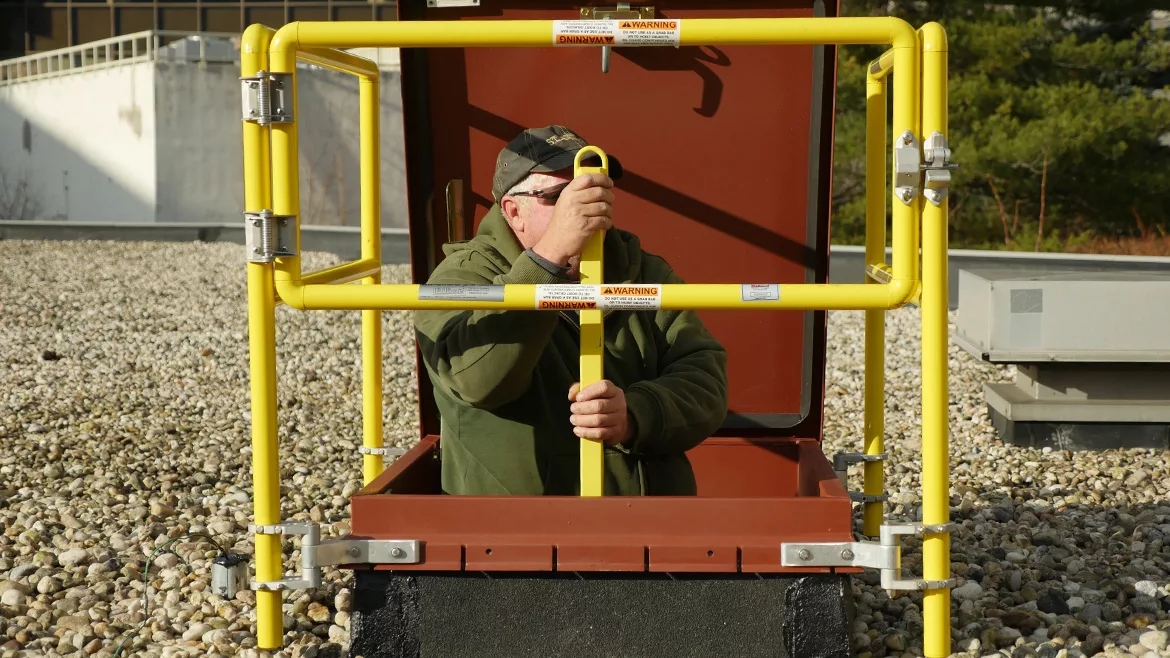
The deadly situation with the Georgia estimator pinpoints another safety flaw that could have been addressed prior to stepping on the roof. Skylights, roof hatches and other roof protrusions should always be guarded by fall protection equipment. BILCO manufactures the Bil-Guard® 2.0 safety railing system, which provides a permanent means of fall protection for roof hatch openings. The Bil-Guard® 2.0 system meets and exceeds fall protection requirements, and a self-closing and latching gate ensures that the opening is protected at all times.
Hatches should be kept closed at all times and warning lines 15 feet from the edge of the skylight also add safety. Netting should also be installed. Those safety measures should be in place before any individual accesses the roof.
BILCO’s LadderUP® safety post adds a critical safety component for access through roof hatches, access doors and manholes. The telescoping post permanently mounts on the top of two rungs of any fixed ladder, providing a positive hand-hold and enabling the user to enter or exit an opening an upright and balanced position.
The industry does not lack the tools to ensure inspection safety. Established protocols and commitment to utilizing new technologies vary and can lead to putting workers at risk.
Safety Goals
The overarching objective of a safety program should be to protect every phase of roofing work, not just when production starts.
The issue is not compliance. It’s about changing how industry thinks, evolves, embraces technology and addresses the gap in established safety protocols. Failure to adopt standards centered around initial roof assessments will lead to losing more workers in preventable situations.
The roofing industry has mastered protection on the job but is failing to protect workers who take the first step onto it. Course correction in that mentality is essential.
Looking for a reprint of this article?
From high-res PDFs to custom plaques, order your copy today!