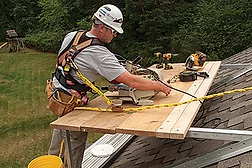
Most state civil judiciary legally consider roofing within the “inherently dangerous” occupation category. When you consider the steep pitches, heights to grade, surface traction conditions, material handling tasks, bulk material weights, environmental factors of wind and weather and the perpetual force gravity on the worker’s center of mass, it is no wonder that falls from or through roofs cause numerous injuries and deaths every year.
In 2001, backed by the National Academy of Sciences research report, Occupational Safety and Health Administration (OSHA) Assistant Secretary Charles Jeffress stated to Congress that implementation of the recently passed Ergonomics Standard would prevent over 460,000 serious workplace injures and save the nation’s employers $9 billion each year.
Roof hatches are frequently used to provide safe and convenient access to and from rooftop areas in commercial buildings. These products allow service personnel to gain access to the roof for maintenance and facilitate the installation or removal of large pieces of equipment into or out of a building.
Every year in the United States, chemical and thermal burns account for an estimated 700,000 emergency room visits, with more than 45,000 patients requiring extended hospitalizations for treatment such as skin grafts.
Prefabricated roof curbs have been in use since the roof has been utilized for something other than keeping weather out. And in this one sentence lie the benefits and the detriments we face in the roof curb business everyday. The primary function of the curb is to keep weather out while supporting/flashing the equipment on it.
All successful roof projects require that the installers adhere to proper application methods. Improper workmanship contributes to a decrease in the roof systems service life. All types of roof systems - both steep-slope and low-slope applications - are prone to potential workmanship errors. In the case of steep-slope shingle applications, there are a number of common mistakes that should be avoided to ensure a long service life. A successful roofing project and satisfied client can be achieved if these common mistakes can be avoided in the field.
Decades ago, a foreman instructed me in my roofing duties by simply stating, "Keep your feet under you and your ass behind you." I've had worse advice since then.
It's a clear July morning with temperatures in the high 80s - a perfect day to lay 20 or 30 square of shingles. It's a little humid, but the winds out of the south give you just enough relief as you begin to sweat.