Technical Details: TPO and the Environment
Thermoplastic olefins (TPOs) are a blend of
thermoplastics and elastomers. The chemical formulation consists of a
thermoplastic base - polypropylene (PP) or polyethylene (PE) - and an
elastomeric base - the ethylene-propylene rubber polymer of ethylene propylene
diene terpolymer rubber (EPDM).

Thermoplastic olefins (TPOs) are a blend of thermoplastics and elastomers. The chemical formulation consists of a thermoplastic base - polypropylene (PP) or polyethylene (PE) - and an elastomeric base - the ethylene-propylene rubber polymer of ethylene propylene diene terpolymer rubber (EPDM). A typical formulation for polypropylene-based thermoplastic olefins is approximately 70 percent ethylene-propylene rubber and approximately 30 percent polypropylene.
TPOs are produced with polymers that provide a combination of the best attributes from EPDM and thermoplastic membranes. The thermoplastic polymer provides strong properties and the inherent ability to heat weld the seams. The elastic rubber polymer provides significant weathering capacities and inherent flexibility. This combination produces a membrane that has the ultraviolet and heat resistance of EPDM and has PVC’s capacity to heat weld the seams.
 Thermoplastic olefins have inherent chemical
resistance properties and can endure most animal fats, vegetable oils,
microbial attack and some acids. They are inorganic materials that do not
contain oils or compounds that would support biological growth and this lowers
the possibility of algae or fungus attack. The material contains more than
twice the polymer and less than half the filler of EPDM, which makes it
chemically resistant to the same types of materials as EPDM. The low filler
content ensures very low water transmission and enhances long-term performance.
Thermoplastic olefins do not have the same chemical resistance abilities as
CSPE and some PVCs.
Thermoplastic olefins have inherent chemical
resistance properties and can endure most animal fats, vegetable oils,
microbial attack and some acids. They are inorganic materials that do not
contain oils or compounds that would support biological growth and this lowers
the possibility of algae or fungus attack. The material contains more than
twice the polymer and less than half the filler of EPDM, which makes it
chemically resistant to the same types of materials as EPDM. The low filler
content ensures very low water transmission and enhances long-term performance.
Thermoplastic olefins do not have the same chemical resistance abilities as
CSPE and some PVCs.
Thermoplastic olefins were introduced to the U.S. roofing market in the early 1990s and, as with all developing technologies - such as PVC - there were initial problems. The original membranes were manufactured without reinforcements based on the rationale that the inherent stability of the sheet eliminated the need for any reinforcing fabrics. While it has been proven that thermoplastic membranes have a high degree of stability and a very low shrinkage factor, there is also a high degree of elongation when the material is heated. The heating of the membrane created two initial problems. The first problem was that membrane installed in the winter months became severely wrinkled in the summer months when the material heated up. The second problem was that the membrane would become wrinkled during the welding of the seams due to the high temperature of the material at these areas.
The addition of the fabric reinforcement has curtailed a number of these problems. The current TPO membranes are reinforced with glass fiber or polyester mats that provide a number of physical benefits. The benefits include high tensile strength, high puncture and tear resistance, excellent dimensional stability and minimal shrinkage. In comparison to EPDM membranes, reinforced thermoplastic olefin membranes provide up to 40 percent greater tear strength and as much as three times greater breaking strength. The flexibility of the membrane allows for significant structural movement without splitting or cracking. Industry research indicates that polyester reinforcements provide higher tensile strength than glass fiber reinforcement.
 Fire Resistance and Environmental
Compliance
Fire Resistance and Environmental
Compliance
One of the primary benefits of thermoplastic olefins is that they can be environmentally friendly and fully recyclable materials. If the membrane sheet is properly formulated, it will not pose any environmental hazards and is well suited for landfill disposal, recycling or incineration. There are no environmental concerns with the base polymers and all of the raw materials and base additives are non-hazardous. Furthermore, all of the material components have been on the market for a number of years and there is no expectation of unknown hazards. There are no noxious fumes during installation and no migratory plasticizers that can leach out and into the local water supply. Since all of the components used are in the form of granules or powders, there is no chance of contamination of the environment from accidental spillage.
This differs from PVC and PVC-related thermoplastics that use the base polymer of chloride as the primary fire retardant chemical. The chloride content in PVC provides substantial fire resistance through the inherent low flammability of the membrane sheet. However, chloride is not environmentally friendly.
Thermoplastic olefins do not contain chloride, which also means that they do not have inherent fire resistance capabilities. This is not a concern on ballasted applications because the gravel layer provides the necessary fire protection for the system. This is not the case for thermoplastic olefin membranes used in unprotected or exposed membrane applications, such as on mechanically attached or fully adhered systems, which require fire retardants. Therefore, to meet the stringent standards required to achieve Underwriters Laboratories (UL) Class A Fire Resistance Listing, specially blended fire retardant chemicals must be added during the compounding process. The selection of the chemical additives is critical from a standpoint of fire resistance and environmental compliance.
For instance, it is reported that some manufacturers have added halogenic materials such as bromine compounds and antimony trioxide to the base polymers to increase the fire resistance capacity of the membrane sheet and to comply with UL requirements. These chemicals could have two adverse effects on the system:
1. These chemicals could have negative effects on the UV resistance and thermal stability of the membrane sheets, decreasing the service life of the system.
2. They could reduce the chances of recycling or incinerating the membrane at the end of its service life, due the environmental concerns of these chemicals.
From an environmental perspective, it is recommended that non-halogenated materials, such as mineral hydrate, be used as flame retardants. It has also been found that polypropylene-based membranes using bromine flame retardants have substantially lower ultraviolet resistance than the membranes that use mineral hydrate flame retardants.
A properly formulated thermoplastic olefin membrane (with non-halogenic fire retardants) does not require landfill disposal at the end of its service life. These materials can be recycled or incinerated. Most manufacturers currently recycle waste produced during manufacturing for use in other materials. Waste produced in the field during the application process can be saved by the contractor and supplied to the manufacturer for similar recycling. Most manufacturers are currently evaluating means of recycling the membrane once it has reached the end of the service life. At this time, most of this research is being conducted in Europe, which is significantly further ahead in environmental regulations and product development than the United States.
Incineration of the membrane can also be conducted. This is possible because the combustion byproducts extracted during incineration are only water and carbon dioxide. Studies have indicated that the inorganic additives of the membrane do not volatize during the incineration process, so there is no germane air pollution. Thermoplastic olefins produce less toxic agents and environmental pollution during incineration than typical residential refuse. During incineration, the material is transformed into a form of slag, which can be deposited in a landfill with no adverse environmental effects.
Thermoplastic olefins (TPOs) are a blend of thermoplastics and elastomers. The chemical formulation consists of a thermoplastic base - polypropylene (PP) or polyethylene (PE) - and an elastomeric base - the ethylene-propylene rubber polymer of ethylene propylene diene terpolymer rubber (EPDM). A typical formulation for polypropylene-based thermoplastic olefins is approximately 70 percent ethylene-propylene rubber and approximately 30 percent polypropylene.
TPOs are produced with polymers that provide a combination of the best attributes from EPDM and thermoplastic membranes. The thermoplastic polymer provides strong properties and the inherent ability to heat weld the seams. The elastic rubber polymer provides significant weathering capacities and inherent flexibility. This combination produces a membrane that has the ultraviolet and heat resistance of EPDM and has PVC’s capacity to heat weld the seams.
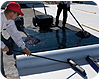
Photo courtesy of Firestone Building Products.
Thermoplastic olefins were introduced to the U.S. roofing market in the early 1990s and, as with all developing technologies - such as PVC - there were initial problems. The original membranes were manufactured without reinforcements based on the rationale that the inherent stability of the sheet eliminated the need for any reinforcing fabrics. While it has been proven that thermoplastic membranes have a high degree of stability and a very low shrinkage factor, there is also a high degree of elongation when the material is heated. The heating of the membrane created two initial problems. The first problem was that membrane installed in the winter months became severely wrinkled in the summer months when the material heated up. The second problem was that the membrane would become wrinkled during the welding of the seams due to the high temperature of the material at these areas.
The addition of the fabric reinforcement has curtailed a number of these problems. The current TPO membranes are reinforced with glass fiber or polyester mats that provide a number of physical benefits. The benefits include high tensile strength, high puncture and tear resistance, excellent dimensional stability and minimal shrinkage. In comparison to EPDM membranes, reinforced thermoplastic olefin membranes provide up to 40 percent greater tear strength and as much as three times greater breaking strength. The flexibility of the membrane allows for significant structural movement without splitting or cracking. Industry research indicates that polyester reinforcements provide higher tensile strength than glass fiber reinforcement.
One of the primary benefits of thermoplastic olefins is that they can be environmentally friendly and fully recyclable materials. If the membrane sheet is properly formulated, it will not pose any environmental hazards and is well suited for landfill disposal, recycling or incineration. There are no environmental concerns with the base polymers and all of the raw materials and base additives are non-hazardous. Furthermore, all of the material components have been on the market for a number of years and there is no expectation of unknown hazards. There are no noxious fumes during installation and no migratory plasticizers that can leach out and into the local water supply. Since all of the components used are in the form of granules or powders, there is no chance of contamination of the environment from accidental spillage.
This differs from PVC and PVC-related thermoplastics that use the base polymer of chloride as the primary fire retardant chemical. The chloride content in PVC provides substantial fire resistance through the inherent low flammability of the membrane sheet. However, chloride is not environmentally friendly.
Thermoplastic olefins do not contain chloride, which also means that they do not have inherent fire resistance capabilities. This is not a concern on ballasted applications because the gravel layer provides the necessary fire protection for the system. This is not the case for thermoplastic olefin membranes used in unprotected or exposed membrane applications, such as on mechanically attached or fully adhered systems, which require fire retardants. Therefore, to meet the stringent standards required to achieve Underwriters Laboratories (UL) Class A Fire Resistance Listing, specially blended fire retardant chemicals must be added during the compounding process. The selection of the chemical additives is critical from a standpoint of fire resistance and environmental compliance.
For instance, it is reported that some manufacturers have added halogenic materials such as bromine compounds and antimony trioxide to the base polymers to increase the fire resistance capacity of the membrane sheet and to comply with UL requirements. These chemicals could have two adverse effects on the system:
1. These chemicals could have negative effects on the UV resistance and thermal stability of the membrane sheets, decreasing the service life of the system.
2. They could reduce the chances of recycling or incinerating the membrane at the end of its service life, due the environmental concerns of these chemicals.
From an environmental perspective, it is recommended that non-halogenated materials, such as mineral hydrate, be used as flame retardants. It has also been found that polypropylene-based membranes using bromine flame retardants have substantially lower ultraviolet resistance than the membranes that use mineral hydrate flame retardants.
A properly formulated thermoplastic olefin membrane (with non-halogenic fire retardants) does not require landfill disposal at the end of its service life. These materials can be recycled or incinerated. Most manufacturers currently recycle waste produced during manufacturing for use in other materials. Waste produced in the field during the application process can be saved by the contractor and supplied to the manufacturer for similar recycling. Most manufacturers are currently evaluating means of recycling the membrane once it has reached the end of the service life. At this time, most of this research is being conducted in Europe, which is significantly further ahead in environmental regulations and product development than the United States.
Incineration of the membrane can also be conducted. This is possible because the combustion byproducts extracted during incineration are only water and carbon dioxide. Studies have indicated that the inorganic additives of the membrane do not volatize during the incineration process, so there is no germane air pollution. Thermoplastic olefins produce less toxic agents and environmental pollution during incineration than typical residential refuse. During incineration, the material is transformed into a form of slag, which can be deposited in a landfill with no adverse environmental effects.
Looking for a reprint of this article?
From high-res PDFs to custom plaques, order your copy today!
.webp?height=740&t=1781278983&width=auto "KEE(2).png")