Measuring Up: Why You Can't Make Money Charging $25 an Hour
Many small contractors mistake wages with what they should charge a customer for their services. Since many contractors start out moonlighting and doing side jobs, such logic is understandable. Unfortunately, side work is just that, side work, and the part-time contractor is probably earning most of his or her livable income through regular employment.

 Many small contractors mistake wages with what they should charge a customer for their services. Since many contractors start out moonlighting and doing side jobs, such logic is understandable. Unfortunately, side work is just that, side work, and the part-time contractor is probably earning most of his or her livable income through regular employment. Plus, I suspect many part timers are taking cash and not paying taxes on their part-time work.
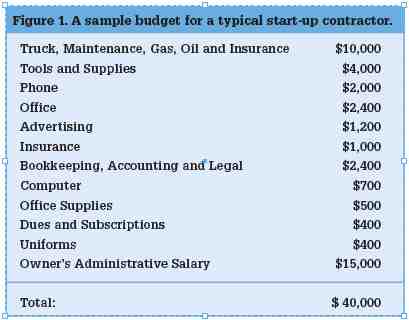
So let’s develop a simple budget for a small start-up contractor. The costs shown in Figure 1 are purely fictitious and have been put together just to use for our example. While your numbers may vary, you can determine similar costs. Take your checkbook and other records and estimate your costs. If you do not know, guess. An educated guess is better than no budget. Also, note we have not included retirement compensation, hospitalization or other owner benefits in the above example. We have included a $15,000 cost for owner’s administrative salary, which covers non-field activities such as estimating time, billing, etc. It is important to build this owner non-field time into the budget. If not, a small contractor ends up doing all of these chores for nothing and working for his customer for free.
The next question is what do we have to charge per hour to turn a profit. Remember, we need to recoup the $40,000 overhead cost before any profit exists. It is also important to note that we budgeted $10,000 for truck expenses. Many contractors make the mistake of not adequately budgeting to replace their equipment costs and they end up with worn out, run down equipment because they cannot afford to replace what they currently own.
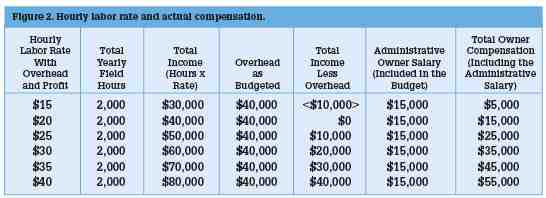
Let’s look at what these numbers mean in actual compensation. In our example shown in Figure 2, we are assuming the owner would work 2,000 hours per year in the field (40 hours a week, 50 weeks per year).
I realize the math can get somewhat confusing, but basically we are taking our hourly rate and multiplying it by the number of field hours produced and then subtracting our $40,000 overhead. We have already built a non-field owner salary of $15,000 into our budget, so we have to add this $15,000 administrative salary to the total income less overhead to arrive at total owner compensation. As you can see in our example above, $25 per hour equates to $25,000 a year, which is barely a livable salary.
One might argue that our budget is too high. OK, let’s take $10,000 less for our budget. At $25 per hour, we are still only making $35,000 a year, up from the $25,000 as shown in our example above. Is it really worth owning a business for $35,000 a year? All the headaches, hassles and other day-to-day stress is just not worth the hassle.
Maybe you will generate more income but there certainly is more financial strain as you add people. You may need more tools, you have to sell more jobs, you have to do payroll, and maybe you need another truck. An owner and another person might make a living at $25 per hour as long as they control overhead, the owner continues to work in the field and you stay as productive as you once were. But why not do this at $35 or $40 an hour, not $25 and have a real business and not just a job? And remember, if you go to three or four employees, soon you will no longer be able to work in the field and production will slow as well as overhead will increase. So I stick by my statement; it is very difficult if not impossible to make such a low hourly rate work.
Again, I know what you are thinking: “There is no way I can sell my work that high.” We have lots of contractors who charge $40 and above for their services. Maybe the reason you cannot sell higher than you do is right between your own ears. Or maybe it is because you have not taken the time to make a budget and do not want to overcharge your customers? Or maybe, because you do cheap work, you attract cheap customers. Possibly you need to find a different customer base.
Many small contractors make less money than if they had a job. So why would they put themselves through being self-employed? Some do it because they prefer to work by themselves, be small and make a good living for a select customer base. Cheers and hip, hip, hurray for those folks. Free enterprise is a wonderful thing.
I have, however, found there is another group of one- or two-person contractors who stay small because the owner wants to take cash, cannot work for someone else, won’t pass a drug test, and the list goes on. These are the folks who cheat the system and make it difficult on everyone.
In closing, I want to make it clear. I am all for the small contractor. In fact, I doubt you have ever read one of my columns that promotes bigness or growth. Most of the contractors that go broke do so because they grow too fast and are too cheap. So staying small is a great idea, I just think you should be paid what you deserve.
Monroe Porter
Figure 1. A sample budget for a typical start-up contractor.
So let’s develop a simple budget for a small start-up contractor. The costs shown in Figure 1 are purely fictitious and have been put together just to use for our example. While your numbers may vary, you can determine similar costs. Take your checkbook and other records and estimate your costs. If you do not know, guess. An educated guess is better than no budget. Also, note we have not included retirement compensation, hospitalization or other owner benefits in the above example. We have included a $15,000 cost for owner’s administrative salary, which covers non-field activities such as estimating time, billing, etc. It is important to build this owner non-field time into the budget. If not, a small contractor ends up doing all of these chores for nothing and working for his customer for free.
The next question is what do we have to charge per hour to turn a profit. Remember, we need to recoup the $40,000 overhead cost before any profit exists. It is also important to note that we budgeted $10,000 for truck expenses. Many contractors make the mistake of not adequately budgeting to replace their equipment costs and they end up with worn out, run down equipment because they cannot afford to replace what they currently own.
Let’s look at what these numbers mean in actual compensation. In our example shown in Figure 2, we are assuming the owner would work 2,000 hours per year in the field (40 hours a week, 50 weeks per year).
I realize the math can get somewhat confusing, but basically we are taking our hourly rate and multiplying it by the number of field hours produced and then subtracting our $40,000 overhead. We have already built a non-field owner salary of $15,000 into our budget, so we have to add this $15,000 administrative salary to the total income less overhead to arrive at total owner compensation. As you can see in our example above, $25 per hour equates to $25,000 a year, which is barely a livable salary.
One might argue that our budget is too high. OK, let’s take $10,000 less for our budget. At $25 per hour, we are still only making $35,000 a year, up from the $25,000 as shown in our example above. Is it really worth owning a business for $35,000 a year? All the headaches, hassles and other day-to-day stress is just not worth the hassle.
Figure 2. Hourly labor rate and actual compensation.
Employees
I know what you are thinking: “We are not just a one-man band. We have employees and more volume and that will make us profitable.” Suppose at $25 per hour you employ another person and have 2,000 more hours. This will generate another $50,000 in revenue, so now your $25,000 (from the above chart) return at $25 per hour plus our $50,000 turns into $75,000 income. Wait a minute - you are going to have to pay that person and with payroll taxes and insurance that person is going to cost you at least $15 per hour or $30,000 a year. In reality, $20 per hour is more likely and that equates to $40,000 yearly. And of course, if you are paying workers compensation, the hourly rate will probably have to go much higher. So all of this $50,000 in sales is not profit and there is a good chance this new employee will not work as fast as you.Maybe you will generate more income but there certainly is more financial strain as you add people. You may need more tools, you have to sell more jobs, you have to do payroll, and maybe you need another truck. An owner and another person might make a living at $25 per hour as long as they control overhead, the owner continues to work in the field and you stay as productive as you once were. But why not do this at $35 or $40 an hour, not $25 and have a real business and not just a job? And remember, if you go to three or four employees, soon you will no longer be able to work in the field and production will slow as well as overhead will increase. So I stick by my statement; it is very difficult if not impossible to make such a low hourly rate work.
Again, I know what you are thinking: “There is no way I can sell my work that high.” We have lots of contractors who charge $40 and above for their services. Maybe the reason you cannot sell higher than you do is right between your own ears. Or maybe it is because you have not taken the time to make a budget and do not want to overcharge your customers? Or maybe, because you do cheap work, you attract cheap customers. Possibly you need to find a different customer base.
Many small contractors make less money than if they had a job. So why would they put themselves through being self-employed? Some do it because they prefer to work by themselves, be small and make a good living for a select customer base. Cheers and hip, hip, hurray for those folks. Free enterprise is a wonderful thing.
I have, however, found there is another group of one- or two-person contractors who stay small because the owner wants to take cash, cannot work for someone else, won’t pass a drug test, and the list goes on. These are the folks who cheat the system and make it difficult on everyone.
In closing, I want to make it clear. I am all for the small contractor. In fact, I doubt you have ever read one of my columns that promotes bigness or growth. Most of the contractors that go broke do so because they grow too fast and are too cheap. So staying small is a great idea, I just think you should be paid what you deserve.
Looking for a reprint of this article?
From high-res PDFs to custom plaques, order your copy today!