Attic Ventilation: The Five Most Frequently Asked Questions
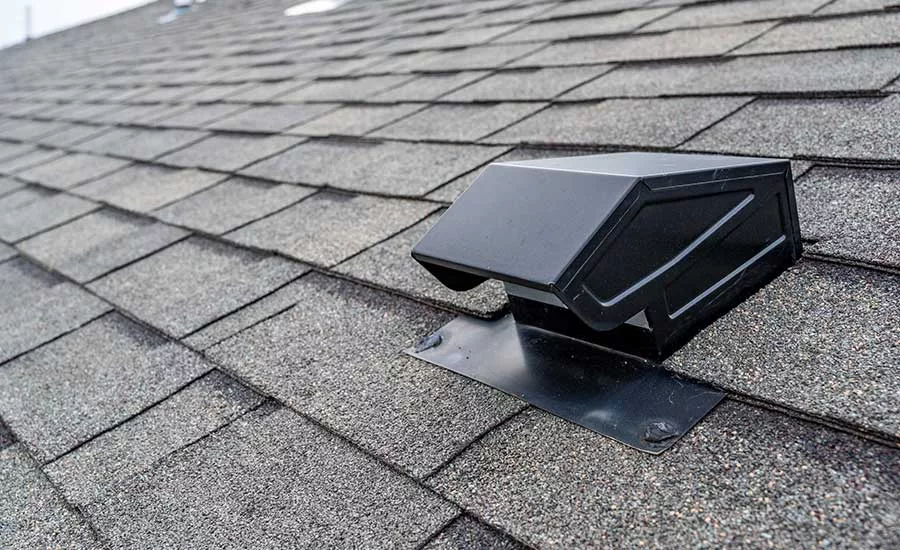
Steven White/iStock/Getty Images Plus via Getty Images
It's never been more important for contractors to be "up to speed" on the ins and outs of correct attic ventilation.
I guess it is safe to say that there are few individuals in this industry who totally understand what's on the minds of America's roofing contractors. Since AirVent started testing Attic Ventilation: Ask the Expert™ in March 1998, we have gone to every major market in the United States with over 240 seminars nationwide. We have welcomed over 8,000 attendees and have personally visited with countless roofing contractors, remodelers, builders, architects, designers, inspectors and a few writers. Perhaps even more astonishing is the 85 percent rate of return we get from our detailed questionnaires left on the tables of each seminar.
We thought you would find it helpful to hear answers to the five most frequently asked questions about attic ventilation.
1. Can I use ridge vents without intake vents?
Using a ridge vent without adequate intake venting raises a number of potential problems. First, it's important to understand that ventilation is a system of intake and exhaust. Without intake vents, the ridge vent may act as an intake vent and an exhaust vent. When that happens, the ridge vent can pull air in through one section of the vent in order to feed another section of the vent.
Imagine a large tree that is blocking one side of the house. The side open to the wind will have a lower static pressure than the side blocked from the wind. Low pressure pulls air out of the vent. The question is: where is it going to get the air it's trying to pull? Air flows from the nearest path of least resistance. If there is no soffit venting, the ridge vent has no option but to pull air from the other side of the ridge vent. Now, there is a potential weather infiltration problem.
Assuming that there is no infiltration issue, another possible consequence of a ridge vent without intake is a negatively pressurized attic. The effect here is the same as with a power fan without intake - air is going to be pulled from somewhere, so now, the only place to pull air from is out of the living space. That could be conditioned air that is very expensive to condition. The bottom line is that if you do not know where the air is coming from to feed an exhaust vent, it is probably coming from the wrong place.
2. How do I ventilate a roof with multiple ridge heights?
A "regular" at each seminar, we get this question almost more than any other. Our answer is that for multiple ridgelines, ridge vents are best because they are independent of wind direction. The basic rule for ridge heights states that all ridges can be vented whether they run parallel or at angles to each other. If, however, the ridges are more than 3 feet apart in height, one should only ventilate the higher one.
Here's why: Recall how an externally baffled ridge vents works - as the wind passes over the baffle, it creates low static pressure, drawing air from the attic. The faster the wind moves over the baffle, the greater the pressure it creates, drawing more air from the attic. Typically, wind moves faster at higher elevations, therefore, the higher ridge will be exposed to higher wind speeds. If the wind speed difference is adequate, the pressure at the higher ridge may be enough to pull air through the lower ridge vent.
If the ridgelines are more than 3 feet apart in height, we recommend that you separate the attics with a piece of plywood or poly sheeting to create two distinct attics. Once this is done, you can ventilate both ridgelines with exhaust vents and balance them with intake vents.
3. Is it possible to have too much intake ventilation?
We explain to seminar attendees that it's nearly impossible. For example, if there is more intake net free area installed than exhaust net free area, the excess intake venting will become exhaust on the leeward side of the house. This is because the intake vents on the windward side will have pressurized the attic. As a result, the intake vents on the leeward side will work with the exhaust vents to release the air. In general, it's more likely that houses will have too little intake than too much.
4. How do I ventilate cathedral ceilings?
For starters, the ventilation system must be balanced with high vents for exhaust and low vents for intake. For intake, we recommend that every rafter bay be ventilated. In addition to this, a major concern is the air space between the insulation and the roof deck. We recommend a minimum 1 1/2-inch air space in all cathedral/vaulted or compact roof systems. These values come from calculation, design and experience. The calculation is fluid dynamics and the design is based on rafter depths and insulation requirements. Experience shows that anything less can cause problems.
One thing to watch for in cathedral ceilings is insulation "slumping down" and blocking off the air space that was originally designed for ventilation. We always recommend that you use insulation baffles for the entire length, even with fiberglass batt insulation. Thirty to 35 feet is the maximum length of rafter that one should use with the 1 1/2-inch air space. When rafter runs get longer than this, we recommend looking at 2- or 3-inch air spaces.
To support this, we find helpful the recent investigations of the Cold Regions Research and Engineering Laboratory in New Hampshire. They found that various roof slopes, roof systems R-value, inlet area and rafter lengths define what the requirements should be for most attic air spaces. The research shows that in some cases (high roof R-value and steep slope), even for long rafter runs, the 1- to 1 1/2-inch rule applies; however, for longer rafter runs, they recommend providing air spaces of 2 to 3 inches.
5. Can I place roof louvers low on the roof for intake ventilation when getting intake at the soffit is not possible or practical?
This is potentially a problem that could lead to weather infiltration and could short-circuit the proper airflow of the ventilation system. Here's why:
Weather Infiltration: An exhaust vent placed low on the roof could lead to weather infiltration because the vent is not designed to be an intake vent. If the exhaust vent is pulling in air, it can eventually pull in rain, snow, dust and dirt. Furthermore, an exhaust vent low on the roof will receive an increased amount of watershed from higher points on the roof that it's not designed to handle.
Short-circuiting: Proper airflow travels from low at the soffit/undereave to high near the peak of the roof. Placing an exhaust vent low on the roof interrupts this airflow because air will always follow the path of least resistance. Depending on if intake vents are in place in the soffit, the path of least resistance may be between the exhaust vents low on the roof to the exhaust vents high on the roof; or between the soffit vents and the exhaust vents low on the roof. Either way, part of the roof deck is not being properly ventilated.
"Going Back to School"
With construction codes, practices and products changing so frequently, our seminar attendees tell us that it really helps "going back to school." With windows and doors more airtight, insulation levels increasing dramatically over the past 20 years, and the use of house wraps and vapor retarders now commonplace, it's never been more important for contractors to be "up to speed" on the ins and outs of correct attic ventilation.
Looking for a reprint of this article?
From high-res PDFs to custom plaques, order your copy today!

.webp?height=740&t=1781278983&width=auto "KEE(2).png")