BUR Rebounds From Exaggerated Death Report
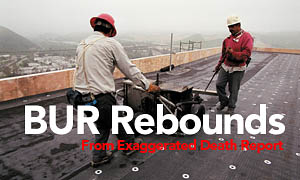
Much like Mark Twain did years ago, built-up roofing (BUR) can complain that the report of its death was an exaggeration. The roofing system, composed of three or four layers of roofing felts embedded in a bitumen, is enjoying a revival despite threats from other systems over the last few decades.
Annual market surveys by the National Roofing Contractors Association show that BUR has held a 20 percent or more share of U.S. low-slope roofing sales over the past several years, adding to the 50 billion square feet of BUR in service.
Experienced contractors with a heavy stake in BUR continue to thrive. “The average age, experience and asset levels of BUR contractors and their roofers are substantially more than the average of single-ply roofing system contractors,” said Scott Wagner, a third-generation contractor from M.G. Wagner Co. Inc., in Yakima, Wash. “I’ve got BUR roofers who’ve been doing this for 25 years.”
Wagner is among a number of contractors who point to the durability of BURs as a prime reason for their continued popularity. “I can show BURs that my company put up over 25 years ago that are still going strong, and lots of BUR squares that have performed great in our cold climate. We had a major snowstorm in 1996-97. BUR showed it can take as much punishment as any other kind of roof.”
Wagner is not alone in pointing out that the redundancy of plies plays a major role in tolerating thermal shock, by giving cohesive strength and minimizing the effects of cracking from expansion and contraction of the material.
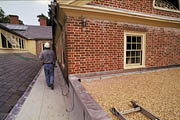
Contractors Attest to Durability
Another contractor, Gary Ramsburg of Roof Engineering Corp., Norfolk, Va., said, “We’re just now replacing built-up roofs that we put on 31 to 32 years ago.”“I have some built-up roofs that are approaching 20 years old,” said Harry Bruton, Bruton-Gomez, Corpus Christi, Texas. “In my experience I’ve never had a product failure, even under our severe heat, as well as frequent high winds.”
“We install built-up systems as well as single-plies and metal roof systems,” said Malcolm Nunn Jr., Roof Systems of Virginia, in Richmond. “Built-up roofs hold up much better in high traffic industrial environments than other systems.”
Larry Scroggins of Hankins Roofing, Kansas City, Mo., who applies most types of low-slope roofing systems, said, “We feel that the four-ply gravel-surfaced built-up roof system offers our clients the best return for their investment, on the basis of cost per year of service. One reason is that BUR is repairable in its later years. It gives plenty of warning to the building owner before it goes out. Owners have time to budget repair or reroofing costs and nurse the roof through until they’ve got the money.”
“In our firm’s 40-year history, we haven’t once been in the courthouse with any BUR failures,” said Gary Wilson of HEC Roofing in Dallas.
These reactions represent a significant turnaround from a few years ago, when the lower initial costs of some other roofing systems attracted owners. But today many major companies, especially those in high-tech areas, are realizing that even a quarter of a million dollars for a roof is minimal, compared with the potential cost of damage to the work that’s going on beneath that roof.
Century-old Technology Goes High-tech
These owners recognize that today’s BURs — descendants of a technology developed in the 19th century — are themselves “high-tech,” because they’re based on state-of-the-art research and development that will assure proven, long-term, leak-free performance. BUR materials and application procedures are continually upgraded. Improved guidelines include National Bureau of Standards NBS #55 on tensile properties for adhered systems and the NRCA document, “Quality Control in the Application of Built-Up Roofing.”
As for materials, “Built-up systems took a nose dive years ago when they were using organic felts,” said Ramsburg. Introduction of the two-ply coated organic felt system in the mid-1960s seemed like a reasonable way to save labor costs. But, recalled Ramsburg, “The rag content started disappearing from the felts and was replaced by paper. But then you had the advent of fiberglass felts, some of which have worn like iron. We have a fiberglass-felt BUR on the Colonial Williamsburg [Va.] Inn that is 11 years into a 20-year warranty, and other than debris from a tree it looks like new.”
Low-fuming Asphalt Overcomes BUR Objections
Another deterrent to BUR use had been objections of building owners and occupants to smoke and fumes from heated asphalt, the weatherproofing bitumen usually used to adhere reinforcing plies to each other and to substrates. Today, development of low-fuming asphalts has overcome these objections. The asphalts, such as TruLo®, TruMelt® and PermaMop® (from Owens Corning), contain a polymer additive that when heated to the surface creates a skim layer on the kettle that traps the fumes and odor inside – without affecting the asphalt or disrupting kettle operation.“Low-fuming asphalt enables contractors to get the advantages of BUR — redundancy of the multiple-ply effect, toughness of the membrane system, ease of repair and modification — without the smell,” said Ray Corbin of the Better Understanding of Roofing Systems Institute.
Reducing the fumes — as well as innovations in workable packaging — also boosts worker morale. “Workers sense, ‘The bosses recognize we’re out here busting our tail and they’re trying to make things a little better for us,’” Wagner said.
In addition, “There’s a significant amount of garbage generated from a conventional carton of a ton of asphalt. With TruMelt there’s zero garbage,” Wagner said. “It comes in the nice pre-made cartons, so the crew doesn’t have to split kegs and peel a wrapper. They can just put these 60-pound cartons in the kettle.”
Low Fuming Restores BUR to Applications
Low fuming has put BUR back into the running for applications that for a while were seemingly ruled out, for example, reroofing of occupied mid-rise schools, hospitals and apartment, cooperative or condominium buildings.School officials also find useful the protection afforded by BUR’s redundancy against the foot traffic of trespassing students. Atop high-rise buildings, the same thickness and stiffness of the BUR membrane enable it to distribute wind loads to help resist uplift.
BUR provides a durable, easily maintained choice on low-rise, large-area, limited access structures such as shopping malls. An experienced contractor can install three plies of Type IV BUR glass felt and a gravel surface for initial costs competitive with single-ply.
Asphalt Choice is Key
Contractors quoted above agree that choice of asphalt is a key factor in the durability their BURs have achieved. Most of their BUR work is with asphalt that has been developed to meet and exceed American Society for Testing and Materials (ASTM) standards, with softening points in the top range of the specifications to minimize the risk of slippage and reduce “fallback.” The asphalt is made with high-flash-point raw materials to provide added safety. It has a wide spread between equiviscous temperature (EVT) and flash point to support application, adhesion and waterproofing. It is tested against standards twice, at a plant laboratory and at one of the few technological laboratories certified by the American Association of State Highway Testing Officials.Wilson said HEC has used asphalt meeting these standards and its predecessor products on “probably 98 percent” of its jobs. He said HEC recently received a commendation letter from the manufacturer of its roof systems pointing out that since 1987, HEC “installed 13.8 million square feet of the manufacturer’s roofing systems without a single workmanship-related problem.”
Ramsburg, whose firm has also used the high quality asphalt and its predecessors for close to 50 years, observed that it “doesn’t dirty the kettles like other asphalt does. It just holds up better.”
Another user, Bruton, warned against asphalt that doesn’t stand up well in the 100-degree-plus temperatures in southeast Texas. That “is the frothing of the asphalt when you heat it, and the coking [settling of solid materials to the bottom] of the kettle. You’ll have to chop the coke out of your flues so that the kettle heats properly.” Users of low-fuming asphalt like TruMelt find that it eliminates this coking and frothing.
Adhere to Best Installation, Maintenance Practices
For all the improvements in BUR materials, contractors are quick to point out the need to adhere to best installation and maintenance practices. The field on a built-up roof is usually not the cause of failures if properly installed. More often, the causes are poor details at transitions, base and perimeter flashings, curbs and penetrations. Apply extra asphalt to provide waterproof sealing around flashings and other vulnerable areas.Ramsburg emphasized, “Make sure the kettle operator is following NRCA and manufacturer guidelines for the proper kettle temperature in heating the asphalt. If it’s too cold, it goes down too thick. If it’s too hot, it goes down too thin. Also, make sure you’ve got good adhesion when you’re brooming in felts, so that you don’t leave pockets with no asphalt.”
Contractors also advise that all layers, laps, sealants and fasteners at seams, as well as seals into the roof drains and scuppers, should be completed for the area being worked on by the end of the working day.
Tom Potteiger of Potteiger-Raintree Inc. in Glen Rock, Pa., said, “The most important thing in installation is to minimize traffic over a new roof to prevent displacing the asphalt when it is still in a liquid state.” Potteiger advised waiting longer in the summer than in the rest of the year because of the longer time needed for asphalt to set in the heat. The rule of thumb is to wait 45 minutes after application on a hot day without a cool breeze.
In discussing the longevity of his firm’s BURs, Bruton cautioned, “That doesn’t mean they held up without maintenance, any more than your car would go 100,000 miles without changing your oil.”
Suggest that building owners follow steps listed in NRCA’s Handbook of Roof Knowledge to ensure a roof is properly maintained:
Keep all job records and specifications on file.
Clear debris from the roof.
Unclog roof drains.
Make a thorough inspection twice a year, checking: the integrity of all flashings; how quickly water drains from a roof after a storm; and the condition of the membrane. If the inspector spots a problem or potential problem, the owner should contact you immediately.
Keep people off the roof. If the roof contains equipment that must be serviced, walkways should be part of the original design.
And, don’t forget common sense. “Any kind of roof can get beaten up if you try,” Wagner cautioned. “In our 1996-97 snowstorm, BURs and single-plies both suffered damage, but it wasn’t because of the roofs. It was because of what was exerted on them. If a guy started chipping ice with a snow shovel, it didn’t matter what kind of roof it was. He made a hole in it.”
Mark Twain lived 13 years after his exaggerated obituary. Following these successful contractors’ suggestions for materials selection, installation and maintenance should enable your built-up roofs – and the system type itself – to last a lot longer than that.
Looking for a reprint of this article?
From high-res PDFs to custom plaques, order your copy today!