Insulation Cover Boards: When and Why We Use Them
Roof designers and contractors should be aware of when and why we use coverboards.
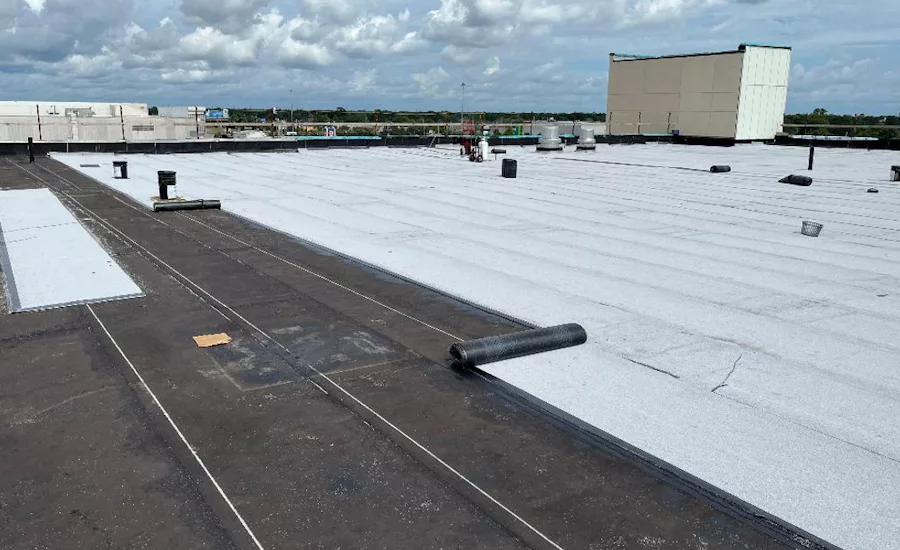
Photo courtesy of Polyglass.
Coverboards - or double-layered insulation - have been a requirement for long-term built-up roof warranties for a number of years. The use of double-layered insulation in single-ply applications has not occurred as frequently, generating some discussion regarding the validity of their use. Roof designers and contractors should be aware of when and why we use coverboards and of their advantages and disadvantages so they can better serve their customers.
Advantages of Cover Boards
The primary advantage of double-layered insulation is that it provides a smoother top surface for the application of the membrane. Single-layered insulation often conforms to irregularities in the substrate creating an uneven, warped surface. Studies have indicated that warping of insulation is reduced in double-layered applications because proper adhesion between insulation boards is easier to achieve than it is between the insulation and substrate. This is also true because the joints of the top layer of insulation are offset from the joints of the bottom layer to form an almost continuous plane. This is an important characteristic in adhered membrane systems because membrane adhesion is more successful over flat, stable surfaces.
Double-layered insulation is also more preferable over metal decks, which account for the majority of roof substrates in the United States. Applying a cover board over mechanically attached insulation offers three distinct advantages. First, it reduces the shank length of the fastener by as much as one-half of the total insulation thickness. The fastener is only required to penetrate through the bottom layer of the insulation. The cover board is adhered using hot asphalt or a specially formulated adhesive that is applied over the top surface of the bottom layer of insulation.
Second, the cover board serves to insulate the fastener eliminating energy loss and possible thermal bridging at fasteners and insulation joints. Thermal bridging contributes to condensation, which could occur where sub-freezing outdoor temperatures are met with rising heat circulated from the warmer interior spaces. Off-setting insulation joints between the two layers of insulation blocks vertical paths of upward moving water vapor that could condensate at the cold side of the membrane and contribute to the formation of membrane ridges.
A third major advantage of cover boards is that they eliminate protrusions to the membrane surface from backed-out fasteners created by thermal contraction stress. This is a common source of membrane openings in single-ply membrane systems and these openings are sources of moisture infiltration. The installation of cover boards prevents the need for continual membrane repair throughout the service life of the system.
Disadvantages of Cover Boards
The one disadvantage of double-layered insulation - other than the additional cost of the system - is that there exists a slight possibility that condensation could form between the layers of insulation. This phenomenon can occur if the upward migrating water vapor is impeded by the asphalt/adhesive layers used to adhere the insulation boards. The adhesive film could act as a vapor barrier if its temperature in cold weather falls below the dew-point temperature. The roof designer can determine if condensation would be a threat to the system by completing a simple calculation based on assumed interior and exterior relative humidity and outside temperatures.
Types of Cover Boards
It is imperative to consult with the membrane manufacturer to determine approved cover boards prior to designing or installing. Manufacturers of all types of roof membrane allow the use of cover boards in their systems. There are four common types of insulation that can be used as cover boards in conventional low-slope membrane roof systems: fiberboard, perlite, Dens-Deck and isocyanurate composite boards.Fiberboard
Fiberboard insulation is an organic insulating board that is composed of wood or bayasse (cane) fibers. A finished board can be left plain or it can be impregnated with asphalt, which makes it more moisture-resistant. The fiberboard can also be coated with asphalt, which not only provides additional resistance to moisture, but it also improves its bonding characteristics. If moisture enters into the insulation it changes its dimensions, which is a serious disadvantage. To avoid the extrusion of moisture into the insulation, it is normally required that a vapor barrier be installed between the interior of the building and the insulation. This is especially true of buildings with high moisture conditions.
One advantage of fiberboard insulation is that it performs well when it is mechanically fastened to the deck. This is an important characteristic when considering the large number of metal decks in use today that require mechanical attachment of insulation. It is also advantageous in that its compressive and laminar strengths are good.
Fiberboard insulation is manufactured in standard boards that measure 2 feet by 4 feet. It is available in thicknesses of 1/2 inch to 3 inches, with 1/2-inch increments in between. The thermal resistance at a 2-inch thickness is an R-value of 5.26. It is commonly used as a top layer over polyisocyanurate insulation.
Perlite
Perlite is also a fibrous insulation board that contains both inorganic and organic materials. The inorganic materials are expanded silicaceous volcanic glass, which is added to organic wood fibers and bonded with asphaltic binders. Perlite also changes dimensions when it becomes wet. It has excellent fire resistance capabilities and is manufactured in sizes similar to fiberboard.
Dens-Deck
Dens-Deck is a non-structural glass mat applied over a silicone-treated gypsum core panel. The material is noncombustible for high fire resistance and is water-resistant. Dens-Deck provides an excellent substrate for all types of conventional low-slope roofing membranes, particularly in fully adhered assemblies. The material is durable and provides superior impact and puncture resistance. The boards are manufactured in standard sizes of 4 feet by 8 feet and an average thickness of 3/8 inch.
Composite Boards
Composite boards utilizing polyisocyanurate as the base insulation are also common. These boards are offered for the combination of properties that they can provide in certain situations. For instance, the high R-value of polyisocyanurate can be provided in applications where a bottom layer of isocyanurate is applied to the substrate and a composite board of isocyanurate with perlite or wood fiber is used. The top layer of the composite board will then serve as a suitable substrate for the membrane application in adhered membrane systems.
Cover Board Installation Procedures
Cover boards can be fully adhered or mechanically fastened to the existing substrate. Mechanical attachment should be completed in accordance with FM wind uplift requirements. Fully adhered cover boards should be applied in accordance with proper roofing procedures. Cover boards should be set over the bottom layer of insulation.
The cover board should be secured to the bottom layer of insulation in a full and even application of hot asphalt (applied at a rate of 30 pounds per square) or specially formulated adhesive (applied at a rate of 2 gallons per square).
The insulation board joints should be butted and aligned in both directions with the end joints staggered by maximum dimensions possible in relation to joints on the bottom layer of insulation. Make sure that the board ends and sides touch all along their length. Minor gaps in boards should be filled with roof adhesive. The joints of the insulation boards in the top layer should be vertically staggered and offset from the joints of the insulation boards in the bottom layer. The edges of the insulation boards should be square, flush and have moderate contact with the edges of the adjacent insulation boards. End joints between boards should be staggered.
No more insulation should be laid at any one time than can be protected by roofing in case of sudden weather changes. The roof insulation must be kept dry at all times. No insulation, once wet, should be used in the roofing system. If insulation boards, cant strips or tapered edge strips can be lifted or moved by hand without board breakage, they are not attached well enough.
The roof designer and contractor can be of benefit to their clients if they know when to apply cover boards, the types of materials suitable to the project, and proper installation procedures. They should evaluate the benefits in comparison to cost factors, particularly in single-ply applications. Proper cover board installation can be advantageous to the long-term success of a roof system and add to the contractor's bottom line.
Looking for a reprint of this article?
From high-res PDFs to custom plaques, order your copy today!
.webp?height=740&t=1781278983&width=auto "KEE(2).png")