Modified Bitumen
What are the differences between SBS and APP modifiers?
SBS (Styrene-Butadiene-Styrene) “rubber” modifier additive is combined with a premium asphalt flux to provide an asphalt-blended coating that has elongation and recovery properties, better able to deal with the stresses created by wind, temperature fluctuation and normal roof-top expansion and contraction. While these products are typically applied with hot-asphalt, they also can be heat-welded or applied with cold adhesive.APP (Atactic Polypropolyene) “plastic” modifier additive is combined with the asphalt to provide a tougher, better weathering asphalt coating that can be heat welded or applied with cold adhesive. The APP blend is more plastomeric than the elastomeric SBS blend, so it will not have the recovery properties associated with the SBS products. The strength of APP products is their ability to be heat welded (torch applied), although more recently they have been “cold applied” in some specifications.
APP products are designed to be heat welded. They use a blend of modifiers that allows for a broader range of temperature when heat welding, making them more user friendly. Both APP and SBS products can be heat welded. It is important that the SBS product is designed for heat welding with additional coating asphalt on the back and a burn-off sheet.
What is the concern with “phased construction” of a modified bitumen system?
Modified bitumen systems are natural for a “phased” application since they come as two distinct waterproof layers — the base, consisting of one or more layers, and the cap. This allows the roofing contractor to finish the entire base layer(s) without having to worry about tracking over a completed section. Unfortunately, any time that the base layer remains exposed, dirt and debris are allowed to accumulate, which in turn may cause blistering sometime in the future.
Recognizing this danger, most manufacturers limit the time the base layer(s) can remain exposed to the elements to five days. Any longer open time will need the consent of the manufacturer and its required cleaning procedure prior to application of the cap. Always check with the product’s manufacturer for recommendations.
What are the pros and cons of hot- vs. cold-applied modified bitumen systems?
Some owners have turned to cold-applied modified bitumen systems when hot kettles or the odor of hot asphalt poses a concern. School systems are a good example, particularly now that many districts are offering year-round schooling. The staging of an asphalt kettle for hot-applied systems can be a safety concern around children and the odor may be an irritant to some people. In some cases, the roofing contractor may elect to use cold-applied adhesives instead of a heat-welded or hot-asphalt application in these situations. The finished membrane has the same basic waterproofing whether it was installed with hot asphalt or cold adhesive. There can be some concerns until the “cold” applied adhesive finally sets up, which could take as much as 30 days depending upon the conditions at the time. Additionally, there may be concern about the odor and solvent content of cold-applied adhesive.
One method to continue to use hot asphalt is to stage the kettle in a restricted area away from children and to use either a filter, an after-burner, low-fuming asphalt or some other odor control during installation. For example, one fume recovery system eliminates odor, fume and particulates at the kettle. Filters aren’t needed with this method as the gases pass through a thermal converter where they mix with fresh air and are superheated, eliminating 99 percent of the odor and fume. The use of low-fuming asphalt also helps to eliminate some odor and fume at the point of application.
Do modified bitumen membrane systems handle abuse?
Gravel-surfaced built-up roofing systems have been known for the damage resistance provided by their four-ply construction and gravel surface. Modified bitumen products also have demonstrated similar performance. Recently, hybrid modified bitumen systems, comprised of two-to-three plies of BUR and a modified bitumen cap sheet, also have provided good damage resistance due to their multi-ply construction, the strength of the modified bitumen sheet, and the damage protection provided by the granular surface. In addition, walk pads or a sacrificial layer of the modified bitumen product can be used in high traffic areas such as the walking area from the access hatch to and around the high-maintenance equipment. Regardless of which is used, the owner should limit traffic on the completed roof.Where are metal-surfaced modified bitumen cap sheets used and why?
A metal-surfaced modified bitumen cap sheet is usually an aluminum- or copper-faced membrane that generally incorporates a woven fiberglass reinforcement, which is coated with a blend of SBS and a premium asphalt. This special cap sheet can be used as a flashing material, usually in areas that are in view. Its woven fiberglass mat provides the membrane with superior tensile properties, dimensional stability, tear and puncture resistance. Additionally, premium SBS modified blend provides the membrane with excellent weathering characteristics. The metal surface, usually embossed, provides solar energy reflectance. It reduces the heat to the roof membrane and to the building it covers, and offers excellent U.L. ratings. For one- or two-story construction, it helps to reduce air conditioning costs.Why hot-air weld the lap instead of torching?
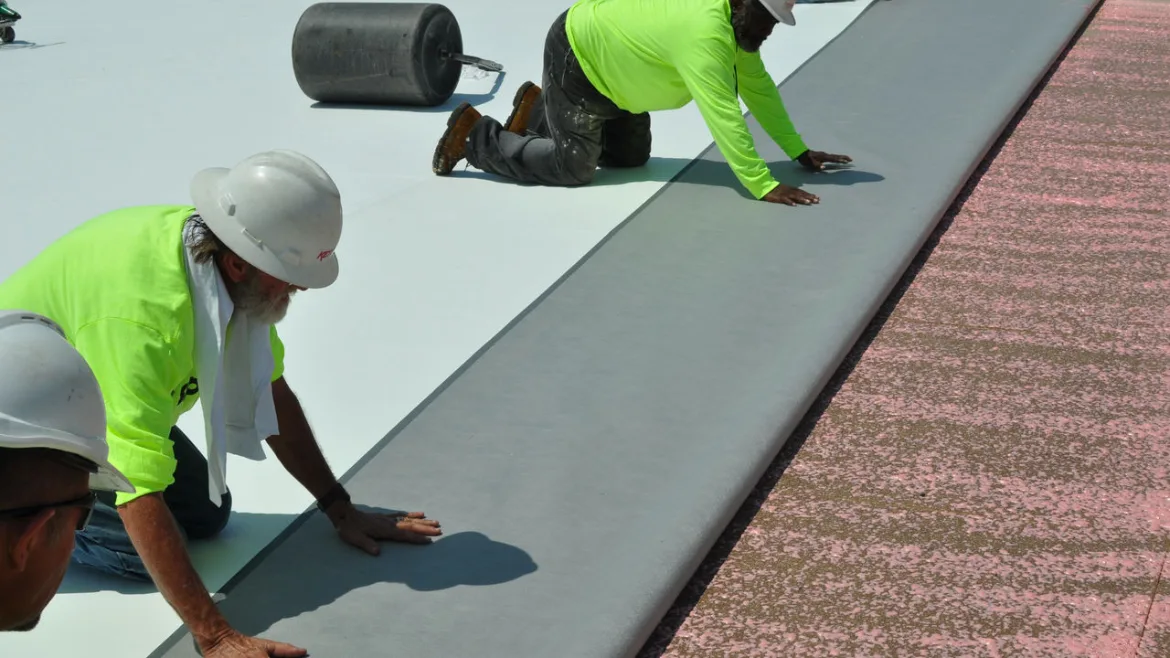
When torching the lap is desired but there is a concern about an open flame, hot-air welding is often used. The equipment is very similar to that used with thermoplastic single-ply membranes but travels at about one half of the speed and utilizes a wider orifice to accommodate the modified bitumen laps.An experienced mechanic can make a good weld using either the motorized hot-air heat welder for laps or the hand-held hot-air gun, used for smaller, detail work. Motorized hot-air welders come with adjustable weights, variable speed control and digital temperature control systems to maintain consistent welding temperatures, regardless of the ambient temperature or voltage fluctuations.
When utilizing a motorized hot-air welder, it’s important to check the lap for proper sealing at the startup and periodically afterwards. The lap should be rechecked as the job conditions dictate. To verify a proper weld, 100 percent of each lap should be examined.
Looking for a reprint of this article?
From high-res PDFs to custom plaques, order your copy today!