Workforce
Construction Quits Surge as Labor Market Tightens
Construction quits hit 198,000 in September as job openings rose and labor shortages returned.
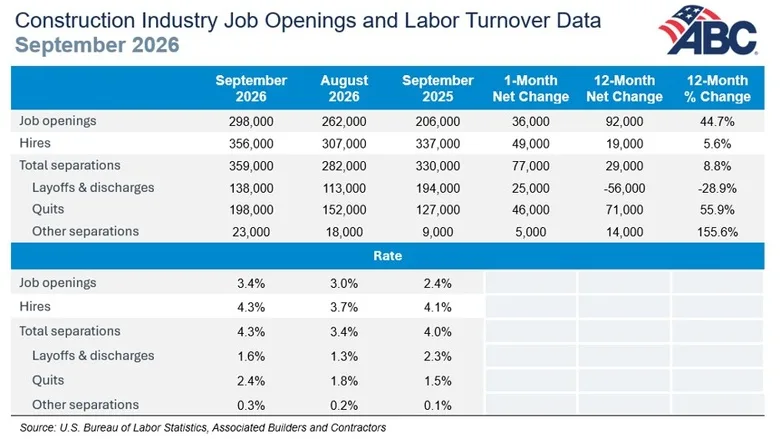
Construction labor pressures intensified in September as nearly 200,000 workers quit their jobs and industry job openings climbed, according to an Associated Builders and Contractors analysis of federal employment data.
The construction industry had 298,000 job openings on the final day of September, according to data from the U.S. Bureau of Labor Statistics' Job Openings and Labor Turnover Survey. That represented an increase of 36,000 openings from August and 92,000 from September 2025.
JOLTS defines a job opening as an unfilled position for which an employer is actively recruiting.
Worker Quits Reach Three-Year High
One of the strongest signs of renewed labor pressure came from the number of workers voluntarily leaving their jobs. Construction quits reached 198,000 in September, the industry's highest monthly total since the first half of 2023.
"Nearly 200,000 construction workers quit their jobs in September," said ABC Chief Economist Anirban Basu. "That's the most in any month since the first half of 2023 and a strong indication that the industry's labor supply is once again tightening."
Basu said contractors also appear increasingly reluctant to let workers go as finding replacements becomes more difficult. Construction layoffs declined by 56,000 compared with the same period last year, while the industry's layoff rate remained below levels recorded in any month prior to 2020.
Labor Costs Add to Contractor Pressures
A tighter labor market could create additional challenges for wall and ceiling contractors already competing for skilled craftworkers, including drywall installers, finishers, plasterers, ceiling installers and cold-formed steel framing crews.
Renewed worker shortages could also put additional upward pressure on wages at a time when contractors continue to contend with elevated material prices, financing costs and tight project margins.
"Reemerging worker shortages will put upward pressure on labor costs, a dynamic that will exacerbate the effects of high borrowing costs and ongoing materials price escalation," Basu said.
The combination could become increasingly important as contractors prepare their bids and workforce plans for 2027.
Margin Concerns Heading Into 2027
More than one in four contractors expect their profit margins to decline during the next six months, according to ABC's Construction Confidence Index. Basu said that percentage could increase if labor shortages continue to intensify into early 2027.
For specialty contractors, the September numbers underscore a familiar challenge: maintaining enough skilled workers to meet project schedules while keeping labor costs from eroding margins. With job openings increasing and more workers willing to leave their current positions, employee recruitment and retention could again become a significant concern heading into the new year.
Looking for a reprint of this article?
From high-res PDFs to custom plaques, order your copy today!