Mission Critical
Data Centers Push Contractor Backlog Higher
ABC says one in six contractors now has data center work as backlog rebounds to 8.5 months.
Data centers continue to emerge as one of the construction industry’s most important sources of work, with a new Associated Builders and Contractors survey finding that roughly one in six of its contractor members is currently under contract for a data center project.
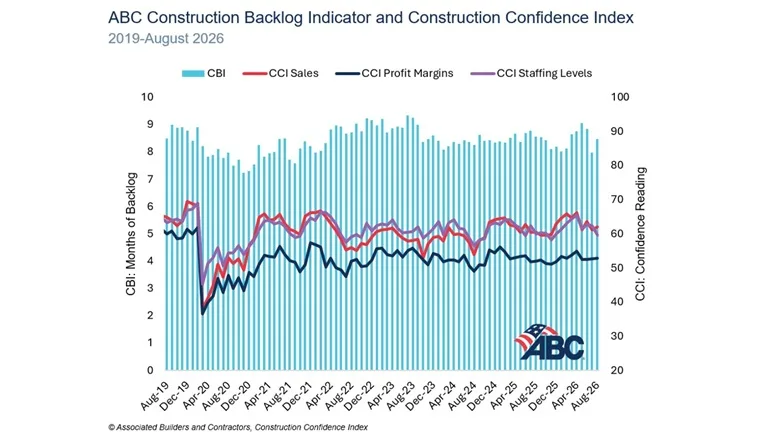
ABC reported Sept. 15 that its Construction Backlog Indicator increased to 8.5 months in August, up half a month from July and unchanged from August 2025. The results are based on an ABC member survey conducted Aug. 20 through Sept. 4.
But the headline behind the headline may be the growing influence of mission-critical construction.
Contractors performing data center work reported 9.9 months of backlog compared with 8.3 months among contractors without data center projects. ABC Chief Economist Anirban Basu said the narrowing gap between the two groups appears to reflect more contractors entering the data center market rather than any broader weakening in the sector.
“Data centers continue to keep contractors busy even as activity softens in other segments,” Basu said.
Approximately one in six ABC members is now under contract to perform data center work, the highest proportion recorded by the association.
Data Centers Become a Construction Engine
The findings reinforce a trend Walls & Ceilings has been following throughout 2026: construction opportunity remains strong, but growth has become increasingly concentrated in select markets.
In W&C’s four-part “State of the Industry: Midyear 2026” series, data centers emerged alongside power, health care and institutional construction as important sources of opportunity as traditional commercial markets softened. The series also cautioned that access to the strongest markets increasingly depends on a contractor’s scale, geography, labor capacity, specialization and financial resources.
More recently, W&C examined the rapid expansion of mission-critical construction in “How Data Centers Are Reshaping Construction,” including the implications for steel framing, drywall, insulation, ceilings, fire protection and other specialty trades. The publication has also examined major projects, such as Walbridge’s work on a massive Michigan data center, where interior contractors face demanding coordination, sequencing, airtightness and tolerance requirements.
For wall and ceiling contractors, that makes the data center boom more than a macroeconomic story. These facilities can create significant demand for cold-formed steel framing, gypsum assemblies, shaft walls, insulation, firestopping, acoustical treatments and other specialty systems while requiring unusually tight coordination with mechanical, electrical and plumbing trades.
AGC Sees the Same Shift
The Associated General Contractors of America is seeing a similar concentration of construction activity.
AGC reported Sept. 1 that overall construction spending declined 0.5 percent from June to July and 3.8 percent from a year earlier. Yet data center construction surged 57.2 percent year over year. According to AGC Chief Economist Ken Simonson, data centers, power projects and highway construction are essentially supporting the market while many other construction categories struggle.
AGC estimates data center construction spending had already reached a seasonally adjusted annual rate of $59.3 billion in May, representing approximately 8 percent of private nonresidential construction spending. Fifty-seven percent of contractors surveyed for AGC’s 2026 outlook expected the available dollar value of data center work to increase this year.
That growth, however, is creating another challenge: finding enough workers.
An AGC-NCCER workforce survey released in September found that 28 percent of respondents had worked on a data center during the previous 12 months. Among those contractors, 58 percent said data center construction had increased competition for skilled workers, while 49 percent reported greater wage pressure. Thirty-seven percent identified the availability of workers or subcontractors as their biggest obstacle to pursuing or delivering data center projects.
Backlog Improves, Labor Concerns Return
ABC’s August numbers suggest that labor pressure is also beginning to show up more broadly.
Only the largest contractors experienced a backlog decline during August. Compared with a year earlier, backlog improvement was concentrated among contractors with less than $30 million in annual revenue.
ABC’s Construction Confidence Index readings for sales and profit margins also increased during August, although expectations for staffing declined. All three measures remained above 50, indicating contractors generally expect growth during the next six months.
Still, 12.3 percent of contractors said they expect to reduce staffing during that period, the largest share since December. Basu also noted a sharp increase in contractors voluntarily citing labor shortages as a concern.
AGC reported a similar contradiction in the market. Construction firms added 22,000 jobs in August while construction unemployment fell to a record-low 3.1 percent. Nonresidential specialty trade contractors alone added 7,800 workers during the month and 86,000 over the previous year. Yet firms continue struggling to find qualified workers, particularly as data centers, advanced manufacturing and power projects compete for available craft labor.
The question heading into 2027 may be less about whether data centers will continue generating work and more about how many specialty contractors have the people, expertise and capacity to pursue it.
Looking for a reprint of this article?
From high-res PDFs to custom plaques, order your copy today!