Sustainability News
Testing Rooftop Coatings at World Cup 2026
EnKoat’s World Cup partnership highlights cooling technology developed to help roofing contractors.
Key Takeaways
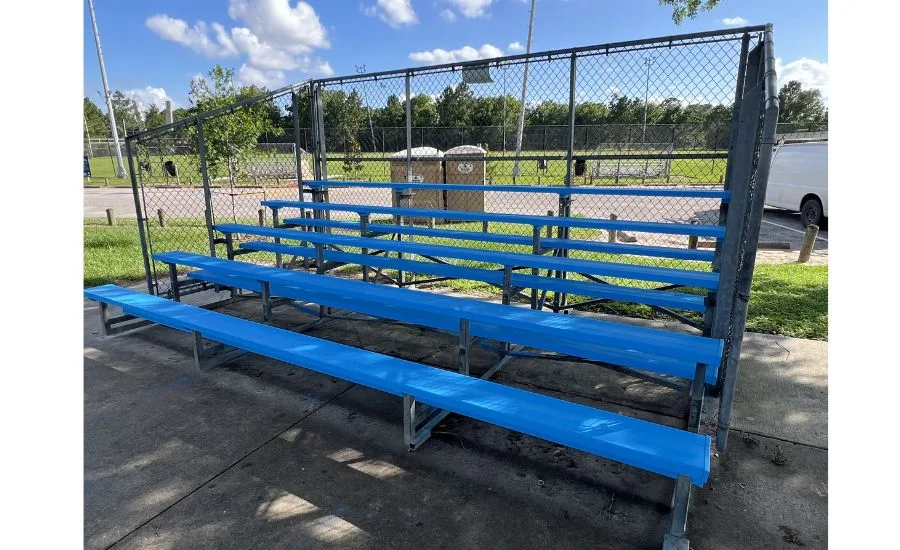
- EnKoat, developed by two Arizona State University graduates and applied by roofing contractors, showcased their product metal bleachers at the FIFA Houston Fan Festival.
- Officials said it dropped temperatures by 40 degrees for the FIFA World Cup 2026 event.
- EnKoat developers will maximize the moment to demonstrate a real solution to a real global problem at the World Cup.
The 2026 FIFA World Cup is turning out to be a proving ground for more than just soccer’s elite. During festivities in Houston, thousands of soccer fans tried out metal bleachers coated with a specialized cooling paint designed for rooftops.
The results were better than expected and further validation of years of hard work, according to the developers of EnKoat, a roofing product designed to actually cool surfaces as the climate gets warmer.
“We've been taking 25 F off Arizona rooftops for years,” said Aashay Arora, co-developer of EnKoat. “The question was whether we could do the same at the human scale, on the surfaces fans actually sit on.”
Officials said the metal cooled 40 degrees despite heat indexes well above 175 F.
EnKoat is composed of materials that act as an ice pack, freezing at night and cooling during the day. It’s now applied on a million square feet of roofing around the country and is distributed by Gulfeagle Supply, SRS Distribution and ABC Supply Co.
Selected by the FIFA Sustainability Committee of Houston, which is affiliated with the host city and FIFA's sustainability program, EnKoat was among a pool of climate-tech companies selected to feature its thermal management coating at the Houston fan park and innovation corridor. The open-air space in the fan park is a fan gathering spot in direct sunlight throughout the course of the tournament.
Five sets of bleacher seating in the fan park were coated and at the Sustainability Committee's request, tinted the topcoat blue, to stay in line World Cup branding.
The idea started by recognizing that big infrastructure like roofs, wall and HVAC systems receive much of the focus on battling heat. But fan and athlete heat exposure at outdoor venues is its own discrete problem, and it's getting worse. When the FIFA Sustainability Committee in Houston put out the call for climate tech innovations to feature at the fan park, it seemed like a natural fit.
The Sustainability Committee invited proposals from a number of climate tech companies in an open-call format.
“They liked the deployment story and the validation chain (NREL, ASU, peer-reviewed data), and selected us along with a handful of other innovations to showcase,” Arora said. “The logistics were straightforward once we were in and the committee has been a great partner."
Arora said they relished the opportunity to demonstrate that the same thermal management approach matters at the human scale on surfaces fans actually touch.
"For a spinout from Arizona State University that started in an advanced materials lab, having our coating selected by the FIFA Sustainability Committee and featured at the Houston fan park is genuinely surreal,” he explained.
Bolstered by the success at the World Cup, it could be just the beginning.
“You can't air condition an open-air stadium or a fan park. But you can rethink the surfaces themselves, and that's a category of solution that hasn't really existed at this scale before," Arora said. “Climate-driven heat exposure at outdoor venues isn't going away after the World Cup ends.. “If this helps shape how host cities and venue operators think about fan and athlete safety going forward, that's the legacy that matters."
Looking for a reprint of this article?
From high-res PDFs to custom plaques, order your copy today!