Supply Chain
How The Home Depot Turned Its Supply Chain Into a Competitive Advantage
What Home Depot's massive logistics network means for contractors, delivery speed, and jobsite performance
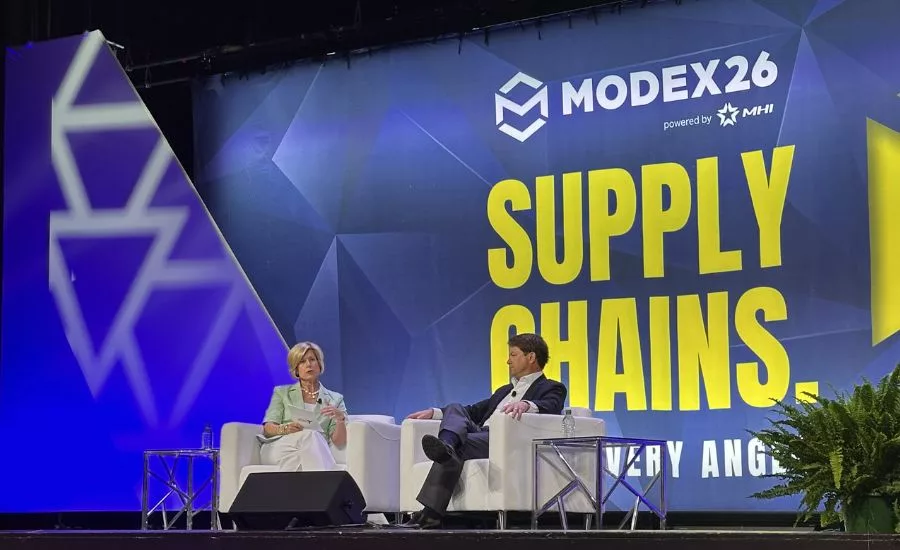
Richard McPhail, executive vice president and CFO of The Home Depot, joined Katie Kirkpatrick, president and CEO of the Metro Atlanta Chamber, for a keynote conversation on supply chain strategy at Modex 2026 in Atlanta.
Key Takeaways
- Jobsite delivery is the new normal: Distribution is shifting toward direct-to-roof drops, bulk staging, and scheduled deliveries built around your workflow.
- Precision beats speed: Same-day is expected — but hitting the right delivery window matters more than just getting it there fast.
- Material risk is your risk: Know where your shingles and components come from. Tariffs and disruptions can hit pricing and availability fast.
- Strong supplier relationships are a safety net: When supply tightens, long-term relationships with distributors and carriers can keep your jobs moving.
ATLANTA -- Two decades ago, a senior leader at The Home Depot said the supply chain would never be a competitive advantage for the company. Richard McPhail, EVP and Chief Financial Officer, opened his Modex 2026 keynote in Atlanta by saying the exact opposite is now true.
Today, Home Depot’s supply chain is what McPhail calls “a strategic weapon” — an approximately $25 billion e-commerce operation backed by hundreds of distribution facilities, same-day delivery capability, and a contractor-focused network spanning thousands of delivery branches. For contractors who depend on Home Depot for material supply to their job sites, understanding how the company thinks about logistics, disruption, and technology can inform how you run your own operation.
Read on for the key takeaways from McPhail’s conversation at Modex.
From Vendor-to-Store to Jobsite Delivery
In 2007–2008, roughly 90% of Home Depot’s product moved directly from vendor to store — an inefficient model that wouldn’t scale. The company’s supply chain transformation began with “rapid deployment centers” designed to streamline store replenishment, but that was just the starting point.
The real pivot came in 2015, when leadership recognized that delivery — not just product selection — would be the defining competitive differentiator. That insight launched a multi-billion dollar buildout still unfolding today:
- 17 flatbed distribution centers, each roughly 1 million square feet, rail-served and capable of staging 32 flatbeds simultaneously — built specifically to serve professional contractors and jobsites.
- 20 direct fulfillment centers supporting homedepot.com, the 6th largest e-commerce business in the United States.
- 160 market delivery operations for same-day appliance and bulky item flow.
- 1,250+ customer delivery branches through the acquisitions of SRS and GMS, serving specialty trades including roofing, drywall, pool, and landscape contractors.
- A pending HVAC distribution deal that will add approximately 50 more locations.
- HD Supply’s ~100 distribution points, focused on multifamily property management.
The acquisitions behind those numbers have been deliberate. SRS Distribution brought specialty trade supplies across roofing, pool, and landscape. GMS — Gypsum Management and Supply — added drywall and interior construction materials. Together, SRS and GMS added more than 1,250 customer delivery branches to the network. A newly signed agreement to distribute HVAC equipment will add approximately 50 more locations. HD Supply, acquired in 2020, rounds out the network with about 100 distribution points serving multifamily property managers — its black-and-yellow trucks a familiar sight in markets across the country.
For contractors, this matters directly: the infrastructure being built is explicitly designed around your workflow — scheduled deliveries to jobsites, bulk material staging, and specialty trade supply — not just consumer convenience.
"Over half of our sales go to the professional contractor," McPhail said. "Serving that customer with reliability and speed is critical."
Related: Tinker, Turner Discuss The Home Depot/GMS Acquisition
Lessons Learned: What Every Supply Chain Leader Needs to Hear
McPhail shared four hard-won lessons from Home Depot’s transformation that apply well beyond retail:
- Start with the customer problem, not the solution. “Wouldn’t it be cool if we could build X?” is the wrong question. Before any supply chain project gets greenlit, the team must be able to answer: What are we trying to sell? How are we going to sell it? Who is the customer? McPhail was direct: “Clarity of language and alignment are probably the most important things.”
- Build in flexibility from day one. COVID tested every assumption Home Depot had made. The company grew by $47 billion in three years, largely through e-commerce, and then had to rapidly re-engineer product flow paths when demand retreated. The distribution centers it had built — and the IT systems supporting them — needed to be adaptable. “Make sure that when you build platforms, you build in flexibility.”
- Customer expectations for speed will always outpace your projections. In 2015, two-day delivery felt like a gold standard. Today, same-day is expected — and the conversation is now about hours and minutes. Home Depot’s stores, once viewed by analysts as liabilities, are now the hubs of last-mile delivery.
- Build sales productivity before cost productivity. “Nothing happens until you sell something,” McPhail warned against approving projects based solely on cost savings. If it doesn’t help you sell more, the cost efficiency will likely disappoint.
Tariffs, Disruption, and the 10% Rule
Home Depot has been pushing supplier diversification for more than a decade — and recent tariff volatility has significantly accelerated the effort. The company is now on a stated path to ensure that no single country accounts for more than 10% of its total purchases.
With slightly over 50% of products already sourced domestically, with $164.5 billion in sales, the remaining import volume remains enormous. Managing it requires a capability that McPhail highlighted as a genuine competitive advantage: SKU-level visibility into country of origin, product cost, and supply chain cost for every item they sell.
“When you have periods of volatility, you can push a button and know immediately what your position is, then begin to work the problem," he said. "Not everyone has that.”
For contractors sourcing specialty materials — particularly in categories like roofing, HVAC, or imported fixtures — this is a model worth considering at your own scale. Knowing your cost exposure by supplier origin isn’t just a finance exercise; it’s a risk management tool.
On managing disruption more broadly, McPhail was straightforward: you can’t predict everything, but you can model outcomes and have contingency plans ready. He credited strong long-term relationships with transportation and carrier partners as a key buffer. “If you have long-term relationships with your supplier community, sometimes that helps you get through tough times. There’s some reciprocity.”
Robotics, Automation, and AI — What’s Actually Moving the Needle
McPhail broke down Home Depot’s technology bets into three distinct categories:
- Robotics: In million-square-foot fulfillment centers, associates were walking hundreds of yards per pick and performing repetitive heavy lifting. Robotics reduces physical strain, improves safety, and frees workers to apply judgment rather than just labor. “We have a mindset of safety first — robotics lets our folks use their brain more than their back.”
- Automation: Home Depot is piloting vertical storage and retrieval systems that allow facilities to use cubic space more effectively — going up instead of out. In an environment where real estate and footprint costs are high, this is becoming table stakes.
AI: McPhail described AI as the layer that will power everything else, and highlighted two specific applications most relevant to contractor service:
- Ship-from-best-location logic: At $200+ billion in e-commerce, the decision of whether to fulfill an order from a store or a DC — and which one — has a massive cost and speed impact. AI balances that math in real time. Critically, this also accounts for contractor-specific preferences: a pro might not want a delivery at the jobsite today — they might want it in four days, in a specific time window.
- Delivery routing: AI-optimized routing is increasingly a baseline requirement. It creates speed, reduces cost, and enables tighter delivery windows. For contractors managing crews on-site, tighter delivery windows mean less idle time waiting on materials.
What Separates Winning Supply Chains Over the Next Five Years
McPhail closed with a direct answer to the question every supply chain leader at Modex was asking: who wins?
His answer had two pillars:
Agility — not just in systems and infrastructure, but in thinking. Customer expectations for speed are compressing faster than anyone is predicting. “We’re talking about minutes instead of hours. Supply chain transformation is hard work, and a lot of it doesn’t get turned on with the flip of a switch.” The leaders who are thinking three to five years ahead and building the capabilities now will be the ones who can execute when expectations shift.
People and partnerships — with carrier partners, supplier partners, and most importantly, the people inside your own buildings and trucks. McPhail pointed to Home Depot’s Associate Commitment Index as a key performance metric: not a score on a dashboard, but a genuine signal of whether associates feel they’re part of a team. “Supply chain is always going to be driven by human talent.”
His final message to supply chain professionals was to stop thinking of themselves as function leaders and start thinking like general managers. “You impact everything. The more you understand the total picture — who the customer is, how the supply chain supports the business — the more valuable your company will be.”
He closed with a grounding reminder that no amount of AI hype changes the fundamentals: “Supply chain is not going to go away. Until we get teleportation — which I don’t think is happening — we have to move things around. And we have to fix our homes. Those two things are never going away.”
This story has been updated to correct annual sales and digital platform sales.
Looking for a reprint of this article?
From high-res PDFs to custom plaques, order your copy today!