IRE 2026
Roofing Leaders Size Up 2026 at IRE Keynote Panel
Industry experts break tradition to share data-driven insights, challenges, and cautious optimism shaping the roofing market in 2026
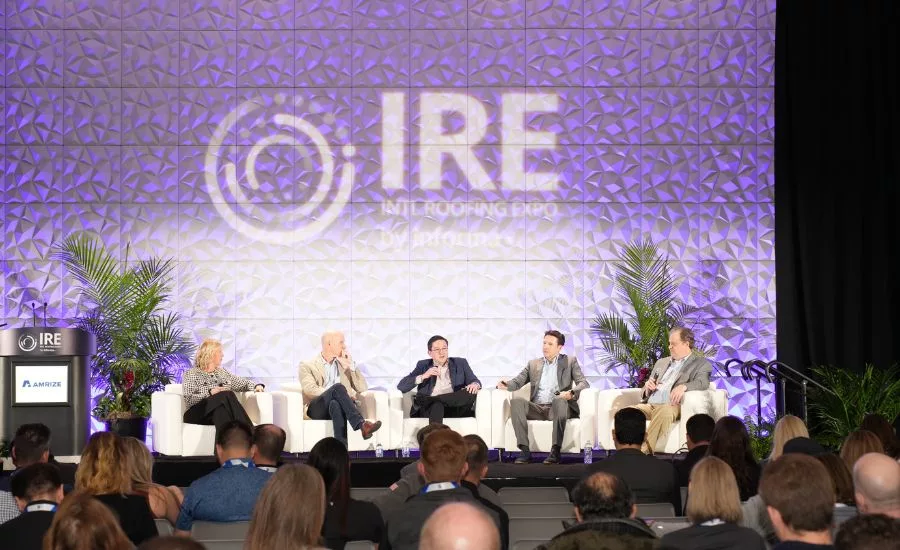
Breaking with tradition at the roofing industry’s biggest annual gathering, show organizers replaced the customary keynote address with a candid, data-driven panel discussion examining where the industry stands — and where it’s headed — in 2026.
Featuring Roofing Contractor (RC) Legal Insights Expert Trent Cotney and National Roofing Contractors Association CEO McKay Daniels, the session paired real-world perspective with fresh survey data to deliver a frank, yet often optimistic, assessment of an industry navigating uneven markets, ongoing labor challenges, and renewed opportunity.
RC Group Publisher Jill Bloom explained that presenting RC’s 2026 State of the Roofing Industry Report on the industry’s biggest stage was a unique first, but in line with the publication’s overall purpose.
“Sharing this information with the industry is part of our mission as a publication,” Bloom said. “I think that I can speak on behalf of all of us (on stage) that we all want you to walk away with a better understanding of what factors can help determine your success as roofing contractors or industry professionals in the year ahead.”
RC Editor-in-Chief Art Aisner helped set the stage by asking each expert to sum up the prior year in just a few words. Cotney chose Transformative and Uneven.
“It was a year where roofing moved out of a volume-driven environment and into one that rewards operational discipline,” Cotney explained. “Demand still exists, but it’s uneven by market and sector, and contractors are being forced to pay closer attention to labor, backlog quality, and cash flow than they have in years.”
Daniels called the industry segmented, but resilient.
“It depends, in part, on the type of work someone did, where they did it, and how professional they were in their operations,” he said. “The industry was navigating headwinds and contractors were on the front line of it...but their resilience, pragmatism, and expertise carried them through.”
A Data-Driven Conversation
The keynote panel, held before a packed house at the International Roofing Expo (IRE), marked the first time Roofing Contractor unveiled its annual State of the Industry findings live on stage. Bloom and Aisner were joined by Cotney, Daniels, and Mitch Henderson, co-CEO of BNP Media and MyCLEARInsights Hub, which partnered on the research.
Henderson emphasized that this year’s survey was designed to provide a clearer, more independent snapshot of the market. In addition to RC’s contractor database, the survey reached beyond its traditional audience to validate the findings. Nearly 200 contractors completed the survey, and the results showed strong alignment across samples.
“That consistency gives us confidence in the data,” Henderson noted, as he provided context for the numbers that would guide much of the discussion.
Industry Sentiment: Cautious Optimism Returns
One of the first audience polls asked attendees how they felt about the year ahead. The results mirrored what panelists said they were already hearing in the field: most contractors expect 2026 to be better than 2025.
While many agreed that 2025 felt more difficult — even for companies that posted solid revenue — Cotney characterized the past year as a “course correction” following the post-COVID surge. Daniels agreed, describing a sense that contractors have adapted to uncertainty and are now better equipped to operate within it.
“People have learned how to live in the chaos,” Cotney said. “That adaptability is one of this industry’s greatest strengths.”
Survey results showed more than half of respondents anticipating at least some growth in 2026, with optimism increasing further when contractors looked three years out. Panelists noted that the room itself appeared even more bullish than the broader survey audience, underscoring the energy that often accompanies IRE.
One of the clearest trends discussed was the growing optimism on the commercial side of the business, particularly in low-slope roofing. Cotney pointed to data center construction as a major driver skewing commercial outlooks upward, but he cautioned against viewing it as the only opportunity.
“Data centers are significant, but they’re not the whole story,” he said. “There’s new construction coming, retrofit work, and even international opportunities depending on where contractors are located.”
On the residential side, panelists noted renewed confidence tied to technology adoption. Contractors embracing automation, AI-driven estimating, and sales tools are seeing faster close rates and improved efficiency — advantages that are beginning to separate high performers from the rest of the market.
Product Mix Continues to Evolve
Survey data showed steep-slope roofing and shingles still dominate contractor revenue, followed closely by single-ply systems. However, both Cotney and Daniels emphasized the steady rise of metal roofing and coatings.
“Metal roofing has been exponential during my time in the industry,” Daniels said, adding that coatings have undergone a similar transformation. What was once dismissed by some contractors is now a core offering for many, particularly as building owners seek cost-effective ways to extend roof life amid high interest rates and inflation.
Cotney said technological improvements have lowered barriers to entry, making it easier for contractors to diversify their offerings and meet customer demand without overextending their operations.
“The contractors who are winning are the ones who can offer what the customer wants — and explain it clearly,” he said.
Inflation, Materials, and Managing Risk
When the discussion turned to challenges, the economy topped the list — a notable shift from pre-COVID surveys, when it rarely cracked the top five concerns. Panelists cited persistent uncertainty, government policy, tariffs, and labor shortages as interconnected pressures weighing on contractor decision-making.
Material prices, while no longer rising at pandemic-era rates, remain significantly higher than pre-COVID levels. Cotney urged contractors to protect themselves contractually, particularly as tariffs work their way through the supply chain.
“Have a price acceleration provision in your contract,” he advised. “You can’t absorb that risk alone.”
He also stressed the importance of proactive communication with customers, framing contracts as a safeguard rather than a starting point. “You lead with customer service,” Cotney said. “The contract is the trench you fall back into when customer service fails.”
Audience polling revealed that subcontract labor continues to play a major role across both residential and commercial roofing, with many contractors relying on subs for more than half their workload. While that model has helped meet demand, it also introduces regulatory and compliance risks — even for contractors who self-perform.
Daniels and Cotney both warned that labor challenges are deeply tied to broader government policy and immigration issues, underscoring the importance of staying informed and proactive.
As the session wrapped, panelists returned to a central theme: preparedness. While optimism is returning, uncertainty remains part of the operating environment. Contractors who invest in systems, diversify their offerings, manage risk, and stay disciplined operationally will be best positioned to succeed in 2026 and beyond.
“The resilience of this industry is real,” Daniels said. “But resilience works best when it’s paired with professionalism and planning.”
Looking for a reprint of this article?
From high-res PDFs to custom plaques, order your copy today!