Workforce Development
Construction Faces 349K Worker Gap in 2026 as Spending Grows
ABC projects labor demand rising to 456,000 workers in 2027 as construction spending rebounds and retirements accelerate
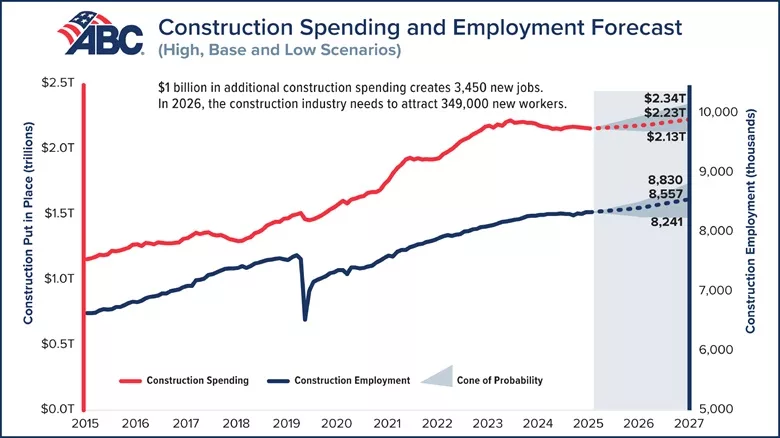
ABC’s model analyzes the historical relationship between inflation-adjusted construction spending and construction employment, using data from the U.S. Census Bureau and the U.S. Bureau of Labor Statistics. It estimates that every $1 billion increase in construction spending generates demand for approximately 3,450 additional workers. The model also accounts for current job openings, unemployment levels and projected retirements within the industry.
“If current forecasts hold, the construction industry will need to add 349,000 workers in 2026 just to keep labor supply and demand in balance,” said ABC Chief Economist Anirban Basu. “If it fails to do so, labor shortages—already severe in some regions and occupations—will intensify, driving labor costs even higher.”
Basu noted that workforce needs are lower than in recent years due to modest spending growth projections for 2026 and 2027. Much of the demand for new workers next year will stem from retirements rather than increased construction activity, despite continued growth in artificial intelligence–related infrastructure projects.
However, Basu cautioned that labor needs could exceed projections if spending forecasts prove too conservative. Factors such as declining financing costs or improved policy certainty could accelerate construction activity. He added that hiring remains strong in some areas, with nonresidential specialty trade contractors adding 95,000 jobs since August 2024.
Related: Roofing’s Future: Attracting Gen Z to the Trades
ABC President and CEO Michael Bellaman emphasized that multiple macroeconomic forces are shaping workforce challenges, including an aging workforce, immigration enforcement, high material costs, tariffs, office vacancies and rapidly advancing technology. “Despite these challenges, the industry continues to face an urgent need for skilled workers to build and rebuild America’s infrastructure,” Bellaman said.
Basu also pointed to persistent shortages in specialized trades and regions. Demand for electricians with precision wiring skills has surged due to rapid data center construction, even as nearly one-fifth of electricians are over age 55. Labor shortages remain particularly acute in areas hosting large industrial projects, such as semiconductor manufacturing facilities.
Immigration policy adds further uncertainty. While the full impact on the workforce is unclear, data show a sharp decline in undocumented worker inflows in 2025, alongside an increase in voluntary deportations.
Bellaman said the slight easing of labor shortages offers valuable lessons, including the need for a market-based worker visa system, expanded reskilling and upskilling initiatives, and broader adoption of ABC’s workforce development strategy. This approach combines industry-led training with government-registered apprenticeship programs.
“The construction industry does not have to fall off the workforce shortage cliff,” Bellaman said. “But avoiding that outcome will require decisive action now to strengthen the talent pipeline and reinforce construction as a career of choice in today’s competitive job market.”
Looking for a reprint of this article?
From high-res PDFs to custom plaques, order your copy today!

.webp?height=740&t=1781278983&width=auto "KEE(2).png")