Coatings
Scientists Create Cool Roof Coating That Harvests Water from the Air
Coating reflects 97% of sun's rays and can gather 13 fluid ounces of water per 10.8 square feet daily
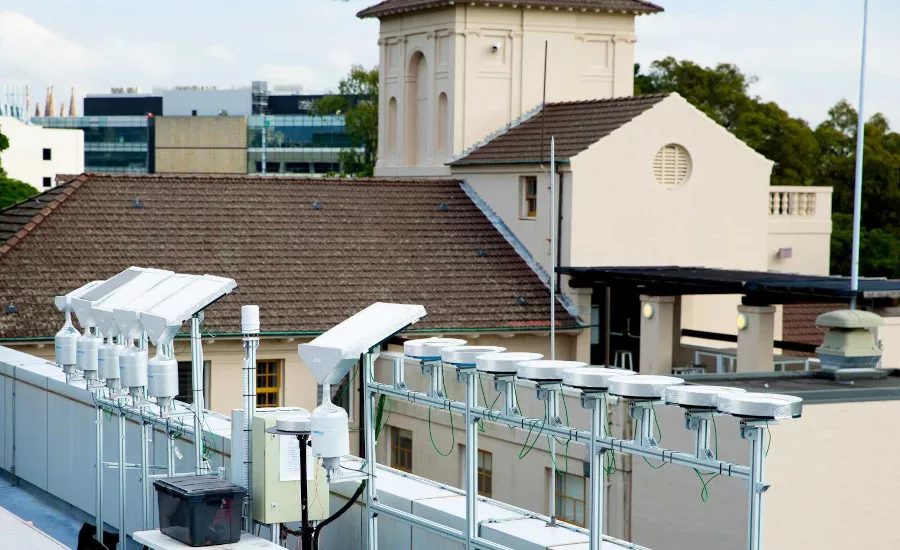
The experimental set-up on the roof of the Sydney Nanoscience Hub that tested its new coating that can extract water from the air and reduce indoor temperatures.
Australian researchers have developed a polymer roof coating that reflects the sun’s rays and extracts water from the atmosphere.
By working with commercial start-up Dewpoint Industries, researchers at the University of Sydney created a nano-engineered paint-like coating that, when applied to a roof, cools the structure while also pulling fresh water from the air.
“This technology not only advances the science of cool roof coatings but also opens the door to sustainable, low-cost and decentralised sources of fresh water — a critical need in the face of climate change and growing water scarcity,” said Professor Chiara Neto, who led the research team.
Cooling and Water Collection
According to trials conducted at the Sydney Nanoscience Hub, the coating captured dew more than 32% of the year, generating as much as 13 fluid ounces per 10.8 square feet daily.
That means roughly 129 square feet of treated roof could provide about 1.25 gallons of water per day — enough daily water to cover “basic water needs,” according to Dewpoint’s website.
Like other cool roof coatings, this formula reflects the sun’s rays. Testing showed it reflected 97% of sunlight and radiated heat into the air, reducing the indoor temperature by up to 11 degrees Fahrenheit compared to the outdoor air.
The cooler surface creates the necessary conditions for water vapor in the atmosphere to condense into droplets, much like how a bathroom mirror steams up during hot showers. The coating can be used in conjunction with angled roofs or rooftop rainwater collection systems. Dewpoint said the coating is compatible with any existing collection system.
“While humid conditions are ideal, dew can form even in arid and semi-arid regions where night-time humidity rises. It’s not about replacing rainfall but supplementing it — providing water where and when other sources become limited,” said Neto.
Real-World Applications
The research team’s six-month outdoor trial consisted of applying the coating to panels on the roof of the Sydney Nanoscience Hub building. Minute-by-minute data was collected on the coating’s cooling and water collection properties. In addition to these properties, the coating showed no degradation under the harsh Australian sun.
Instead of using components like titanium dioxide to reflect the sun’s rays, the coating uses polyvinylidene fluoride-co-hexafluoropropene, or PVDF-HFP, to reflect the rays with microscopic pores.
“Our design achieves high reflectivity through its internal porous structure, delivering durability without the environmental drawbacks of pigment-based coatings,” said Dr. Ming Chiu, the study’s lead author and chief technology officer of Dewpoint Innovations. “By removing UV-absorbing materials, we overcome the traditional limit in solar reflectivity while avoiding glare through diffuse reflection.
“This balance between performance and visual comfort makes it easier to integrate and is more appealing for real-world applications.”
The team posits applications like collecting water for animals, horticulture of high-value plants, for use in cooling by misting, or for use in hydrogen production.
The Dewpoint website notes that at least half of the world’s population can expect to face water scarcity in 2025, so improving water collection can reduce that shortage. The heat reduction contributes to mitigating urban heat islands, the term used to describe how urban regions are hotter due to more surfaces being dry and impermeable, such as buildings, roads, and parking lots.
When Can You Get Some?
Roofing contractors will have to wait for Dewpoint Innovations to finish developing its water-based paint formulation, though they say the coating can be applied using regular rollers or sprayers. The team anticipates commercial release in the near future.
“At Dewpoint, we’re proud to partner with the University of Sydney to bring this breakthrough in passive atmospheric water harvesting to life through advanced paint-based coatings,” said Perzaan Mehta, CEO of Dewpoint Innovations.
“It’s a scalable, energy-free solution that transforms rooftops and remote infrastructure into reliable sources of clean water, helping address an urgent challenge of our time.”
Looking for a reprint of this article?
From high-res PDFs to custom plaques, order your copy today!