Sustainability
Japanese Companies Develop Lightweight Solar Cells for Industrial Roofs
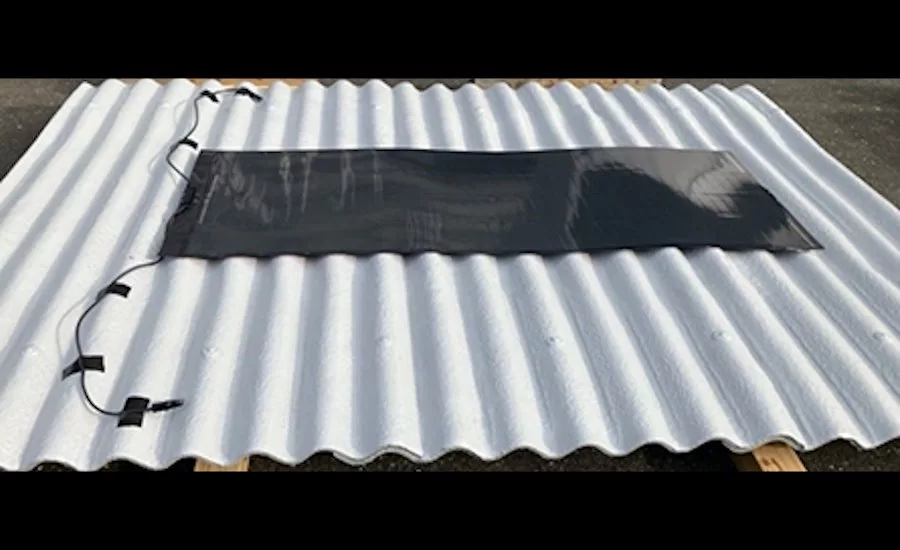
Low load-bearing roofs aren’t suitable for heavier, traditional solar panels, but they may become prime spots for an ultralight, film-like solar cell if a project in Japan proves successful.
Japanese companies PXP Inc. and Tokyo Gas Co. announced in a joint news release that they’re developing a next-generation solar cell that can be installed on industrial roofs with low load-bearing capacity.
The project pairs PXP’s chalcopyrite solar cells, which weigh less than .2 pounds per square foot, with Tokyo Gas’s construction method. This results in a solar cell that can be installed on roofing systems like slate without worrying about load capacity.
According to the companies, the capacity that can be installed on these types of roofs in Japan is an estimated 169 gigawatts by 2050, more than double the current amount of solar installed in Japan.
The project will establish panel structure and construction methods, critical in determining the performance of solar panels, like durability and safety, as well as verify installation methods. It will be the first time in Japan that film-type chalcopyrite solar cells will be installed.
The aim is to launch the service in fiscal 2026.
Chalcopyrite solar cells derive their name from the use of chalcopyrite semiconductors, using the elements copper, indium, gallium and selenium as light-absorbing materials. It offer an alternative to the traditional silicon solar cell.
“Chalcopyrite-based solar cells are becoming leading technologies for solar energy generators being champions in terms of efficiency (which is about 20%) among thin-film devices,” said researchers with the University of Stratchclyde’s Department of Physics, located in the U.K.
The U.K. researchers found that Chalcopyrite solar cells lasted 50 times longer in outer space than amorphous silicon solar cells in the same conditions, adding that “the material seems to repair itself at room temperature.”
According to the Seventh Strategic Energy Plan, solar power generation will become Japan's primary energy source, accounting for 22-29% of the power generation mix in 2040.
Looking for a reprint of this article?
From high-res PDFs to custom plaques, order your copy today!