Cool Roof Confusion
Despite conventional wisdom, temperature is simply not the issue when it comes to roof color and energy efficiency.
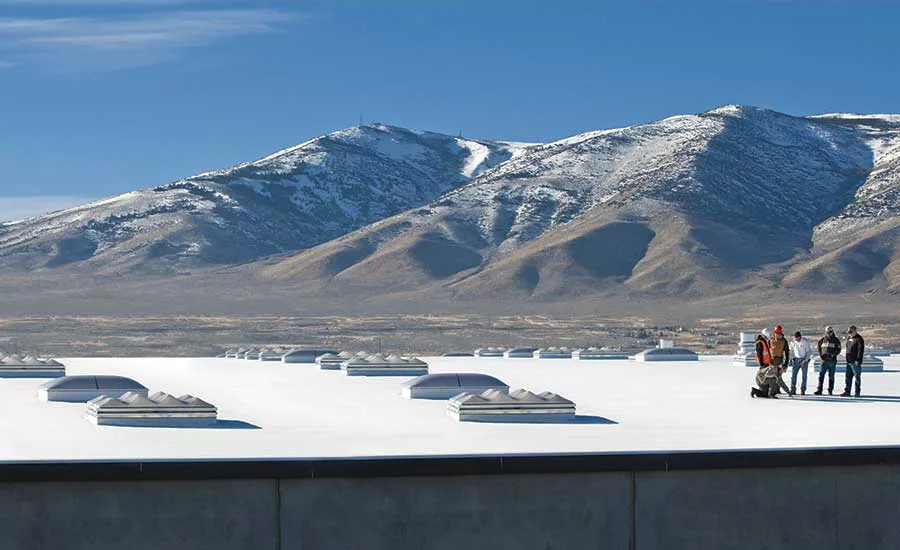
When it comes to energy efficiency, all agree that in the summer, white roof membranes reflect the sun’s rays, lowering air conditioning costs — while dark roofs absorb the sun’s rays, raising air conditioning costs. Despite summertime savings, some studies seem to indicate that black roofs provide a year-round net savings by helping to heat buildings during the winter. The truth is, those heating bill savings don’t outweigh the costs of air conditioning in the warmer months, even in the most northern states.
The Heating Degree Days Myth
Heating degree days (HDD) and cooling degree days (CDD) are measurements used to identify how cold or hot the temperature was on a given day or period of days. Working from the neutral temperature of 65 degrees Fahrenheit (no heat, no air conditioning needed) a HDD measures degrees lower than 65 and a CDD measures degrees higher than 65. For example, a day with a mean temperature of 40 degrees has 25 HDDs. Two 40-degree days in a row have a total of 50 HDDs, and so on. Conversely, a day with a mean temperature of 80 degrees has 15 CDDs. If the next day has a mean temperature of 83 degrees, it has 18 CDDs. The total for the two days is 33 CDDs.
Impact of Roof Color on Energy Costs
Many argue that buildings in cities that average more HDDs than CDDs should have dark roofs. This argument is flawed because temperature is simply not the issue when discussing roof color. Color is related, not to ambient temperature, but to the sun’s total effect on the roof.
Using 2015 energy costs and building codes, we calculated the difference in energy costs between black roofs and white reflective roofing for 18 cities across the United States. Results showed net savings for white compared to black in every location, including cities as far north as Fargo, N.D.
Miami experienced 7,115 CDDs and only 28 HDDs in 2015, so it was no surprise that a reflective roof there showed significant energy cost savings. Minneapolis, on the other hand, experienced 9,317 HDDs with only 1,432 CDDs in 2015. Can a building in a city with almost 8,000 more HDDs than CDDs still benefit from a white reflective roof? Yes, it can.
Reflective Roofs in the North Make Sense
This can be explained by examining the periods during which the sun has the greatest effect on the building. In Minneapolis, the longest summer day is 15 hours and 24 minutes, while the shortest winter day is 8 hours and 35 minutes. The sun’s rays hit a building for nearly twice as long in the height of summer as they do in the winter. And for 15 hours and 25 minutes during a long winter night, the sun has no effect on the roof. Minnesota also averages more than 90 days a year with at least 1 inch of snow cover. Since a black roof covered in snow is effectively a white roof, it actually reflects the sun’s energy away during much of the three months one would welcome its warming effects. Then, of course, it absorbs extra heat during the long summer days when one is paying to make the building cooler. Note that our calculations didn’t even take snow cover into account, so even without the snow factor, white reflective roofing saved on energy costs.
Heating vs. Cooling Costs
Northern cities also benefit from reflective roofs because of the relative costs of heating versus air conditioning. Since electricity is more expensive than the gas used for most building heat, air conditioning is inherently more expensive than heating. In fact, the same amount of energy in electricity compared to natural gas can be almost four times more expensive in some cities, without even factoring demand charges into consideration.
Demand Charges
Electric companies charge commercial building owners in two ways. The first is based on the total amount of energy used in a billing period. The second is called a demand charge, and is based on the customer’s peak energy usage during the billing period. Thanks to the demand charge, a large demand for electricity during a small interval of time — such as by an air conditioner — can drastically effect the entire month’s electric bill. Let’s look at a small office building:
The customer has a 2-ton air conditioner that draws 7.2kW at maximum load. Each month it runs at an average 50 percent load for 10 hours a day with an electric charge of $.09/kWh. That equates to a monthly usage charge of 10 hours x 30 days x 7.2k x 50 percent x $.09/kWhr, or $97.20.
But, on a sunny day during that same month, the air conditioner might run at maximum load for 15 minutes, triggering a demand charge of $15/kW. The resulting demand charge would be 7.2 kW x $15/ kW, or $108.
In this example, the demand charge is larger than the use charge; it’s not uncommon for demand charges to double the total electricity bill. Since dark roofs increase the need for air conditioning, they not only drive up monthly electricity consumption costs, they can significantly increase demand charges, as well. A cool roof, on the other hand, reflects heat away and helps lower the overall air conditioning load, reducing both monthly consumption and demand charges.
Location Doesn’t Matter
As the following data indicates, it doesn’t matter where a building is located; if it uses air conditioning then converting to a cool roof will result in savings.
Let’s compare buildings in the northern, southern, eastern and western U.S. The basic assumptions are:
Size: 100,000 sq.ft.
Electric use cost: $0.09/kWhr.
Electric demand cost: $15/kW
Gas cost: $0.80/therm
To make the calculations conservative, we assumed a high insulation level of R-30, a heater efficiency of 80 percent, and an air conditioner coefficient of performance of 3.2. Using the Cool Roof Calculator tool developed by the U.S. Department of Energy, we estimated the impact of converting from a dark roof to a reflective membrane, such as TPO, in the following locations across the U.S.:
| Region | City | Savings |
| Southern | Houston | $5,200/yr. |
| Northern | Minneapolis | $2,600/yr. |
| Western | San Francisco | $2,400/yr. |
| Eastern | Raleigh, N.C. | $4,100/yr. |
Do Cool Roofs Always Provide Savings?
Some studies appear to show that dark roofs are more energy efficient in the North. However, these studies were based on the use of electric heat, which is such an expensive heating choice for a northern building that the color of the roof would be the very least of that building owner’s problems. The results shown above, therefore, are based on the much more common use of natural gas heating. As long as the building in question has air conditioning and uses gas for heat, our calculations indicate building owners can save money regardless of location. Even northern buildings need a lot of air conditioning. Electricity costs are much higher than gas costs for heating, and electricity is subject to the significant cost of demand charges. Cool roofs make sense regardless of location.
Looking for a reprint of this article?
From high-res PDFs to custom plaques, order your copy today!
.webp?height=740&t=1781278983&width=auto "KEE(2).png")