search
cart
facebook twitter linkedin youtube instagram Spotify Podcasts Apple Podcasts Spotify Podcasts Apple Podcasts
  • Sign In
  • Create Account
  • Sign Out
  • My Account
  • NEWS
  • TOPICS
    • Cool Roofing
    • Event News
    • Latinos in Roofing
    • Low Slope
    • Legal
    • Metal
    • Project Profiles
    • Roofing Supply Pro
    • Roofing Safety
    • Steep Slope
    • Sustainable Roofing
    • Technology
  • EXCLUSIVES
    • Best of Success
    • Contractor Profile
    • IRE Show
    • Roofing Contractor of the Year
      • Enter Roofing Contractor of the Year
    • Top 100
      • Enter the Top 100
    • Young Guns
    • State of the Industry
  • MULTIMEDIA
    • Videos
    • Podcasts
    • Interactive Spotlights
    • Roofing Quizzes
    • IRE Videos
    • Webinars
    • Photo Galleries
  • PRODUCTS
    • New Products
    • Featured Products
  • COLUMNS
    • Editor's Note
    • Exit Planning
    • Guest Column
  • EVENTS
    • International Roofing Expo
    • Webinars
    • Best of Success Conference
    • Industry Events
  • DIRECTORY
    • Associations
    • Distributors
    • Manufacturer/Supplier
    • Business Services
    • Get Listed
  • MORE
    • Roofing Contractor Newsletters
    • Techos y Más Advisory Board
    • RC Store
    • Roofing Supply Pro
    • Custom Content & Marketing Services
    • Market Research
    • Sponsor Insights
    • Company Spotlights
    • Classifieds
      • Auctions
      • Business For Sale
      • Business Opportunities
      • Equipment For Sale
      • Positions Available
      • Products
      • Safety
      • Software
      • Services
      • Training
    • Contact Us
  • EMAGAZINE
    • eMagazine
    • Advertise
      • Editorial Calendar
      • Contact
    • Archive Issues
  • SIGN UP!
Columns

Technical Perspective

By Ray Corbin
October 18, 2002
During the last five years, thermoplastic membranes have been the fastest growing segment of the low-slope commercial/industrial membrane market. PVC (polyvinyl chloride) and TPO (thermoplastic polyolefin) are the two major membranes making up this share of the market, growing at the annual rate of 15 percent for each of the past five years. Since both PVC and TPO are polymer-based, they are able to be heat welded, forming a bond stronger than the sheet itself. As PVC was covered in this column in June 2002, this article will focus on TPO, the faster growing of the two types of thermoplastic membranes. The following questions were addressed at recent BURSI seminars.

When will ASTM issue a TPO Standard?

The American Society for Testing and Materials, continues to ballot its D-8 committee membership to form a consensus standard for a TPO membrane. It is felt that most technical issues have been resolved, and ASTM should accept the TPO Standard later in 2002. Like most consensus standards, the road to an acceptable standard has been a long process with many compromises. The most difficult part may very well have been in defining what encompasses a TPO product in terms of its material composition, thickness and reinforcement.
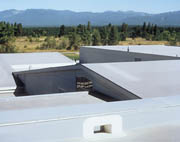
How durable is a TPO membrane?

The American Society for Testing and Materials, continues to ballot its D-8 committee membership to form a consensus standard for a TPO membrane. It is felt that most technical issues have been resolved, and ASTM should accept the TPO Standard later in 2002. Like most consensus standards, the road to an acceptable standard has been a long process with many compromises. The most difficult part may very well have been in defining what encompasses a TPO product in terms of its material composition, thickness and reinforcement.

What are the environmental issues?

The environmental issues can be divided into two segments: manufacture and proper disposal. In regards to manufacturing, current TPO membranes can now be assembled in a single manufacturing step using a coextrusion process, reducing by two-thirds the energy required to produce it.* Better production methods and process controls also reduce waste and out-of-spec material.

In terms of disposal, many of today’s TPOs use a mineral-hydrate flame retardant. This is far friendlier to the environment than the bromine-based flame retardant that was replaced. Being a polyolefin-based product, TPOs are the most environmentally friendly roofing membranes through manufacture, use and disposal.

What are the keys to TPO application?

TPOs are generally harder to apply than PVCs because they have a stiffer feel than a PVC sheet of similar weight and thickness. Unlike PVC, an aged TPO sheet cannot be re-worked or repaired as easily. This obviously places a high premium on getting the seam right the first time.

A major concern for the inexperienced seam welder is how to determine if a proper seam has been formed or if it is only a “cold” weld. Of course, the ultimate teacher is experience by making and checking seams. An experienced welder will probe the seam to verify its strength. When making a weld, and especially with a motorized welder, a sample should be taken and tested at the beginning and after every 100 feet to determine if the weld has been done properly. A proper weld will tear to either side of the weld but not in it.

If rooftop conditions change or if the welder is shut down and restarted, then another sample should be taken and tested. The advantages of a thermoplastic membrane (PVC and TPO) are that samples can easily be taken and a permanent patch installed over the tested area. When using a motorized welder, placing a welding guide, such as a narrow strip of walk board, along side the seam can help prevent membrane wrinkling and fishmouths at the seam.

The temperature range for welding TPO is narrower than for PVC. If the motorized welder is too hot or too slow, it’s very likely that the sheet will overheat or even burn. If the welder is too cold or the application is too fast, the seam will likely be a cold or temporary weld. Changes in ambient temperature, such as from morning to noon will affect the TPO weld more than it would PVC.

When probing a TPO seam, it is best to wait a few days because it is then easier to detect a marginal seam from a proper one. Care must be exercised when probing a TPO seam so as not to be overly aggressive and damage it. Since TPO seams do not set up the same as PVC, there isn’t the typical “bleed-out” of a PVC seam, which many welders have used as their indicator that the seam is a proper one. The welder must develop familiarity with how a proper TPO seam looks and feels.

The surface texture of the sheet also can influence the strength of the weld. Rough or uneven surfaces may bond only on their high points and not be fully adhered to each other. Rough surfaces usually require more heat to affect a proper weld. Of course, it is equally important to avoid using too much heat, which will lead to other problems. The applicator must have the experience to know how much heat to apply and for how long.

Another cold-weather application concern is the relative stiffness of the TPO sheet, making it more difficult to work with than a PVC sheet. This is a particular concern with flashing details, such as fitting it into corners and other tight areas. While creasing it apparently does not harm the sheet, once a TPO sheet has been bent or creased, the crease becomes permanent.

Do white colored TPOs qualify for an Energy Star rating?

The Energy Star rating is a measure of solar reflectance of a membrane’s surface. A white or light-colored TPO membrane can qualify for the Energy Star rating as long as it has been tested and the results accepted by the EPA. The membrane must achieve a solar reflectance of 0.65 or greater for a new sheet and 0.50 or greater for a sheet aged for three years.

White or light-colored sheets have been measured to be 50 to 60 degrees F cooler than black or dark-colored sheets. Using light-colored sheets should significantly reduce the heat load on one and two story buildings.

*Sharp, Stephen A., “TPOs-Commodity or specialty?”, Professional Roofing, June 2002

Share This Story

Looking for a reprint of this article?
From high-res PDFs to custom plaques, order your copy today!

Ray Corbin is Director of BURSI (The Better Understanding of Roofing Systems Institute), an educational program sponsored by Johns Manville. Corbin holds four U.S. roofing patents and is a nationally recognized speaker in the roofing industry.

Recommended Content

JOIN TODAY
to unlock your recommendations.

Already have an account? Sign In

  • two-roofers-in-harnesses-on-tile-roof

    How AI Is (and Isn’t) Impacting Roofing Jobs

    A new study from Microsoft shows artificial intelligence...
    Roofing Technology
    By: Chris Gray
  • Baker-Roofing-Company-employees-on-flat-roof-examinining-paperwork

    Exclusive: 2025’s Top 100 Roofing Contractors

    Roofing Contractor's 2025 Top 100 list reveals revenue...
    Top 100 Roofing Contractors
    By: Chris Gray
  • A before and after heat measurement comparison

    How Hot is Too Hot in the Attic?

    If the ventilation is working, how hot should the attic...
    Columns
    By: Paul Scelsi
You must login or register in order to post a comment.

Report Abusive Comment

Manage My Account
  • eMagazine Subscription
  • Sign Up for the Newsletter
  • Online Registration
  • Manage My Preferences
  • Subscription Customer Service

More Videos

Sponsored Content

Sponsored Content is a special paid section where industry companies provide high quality, objective, non-commercial content around topics of interest to the Roofing Contractor audience. All Sponsored Content is supplied by the advertising company and any opinions expressed in this article are those of the author and not necessarily reflect the views of Roofing Contractor or its parent company, BNP Media. Interested in participating in our Sponsored Content section? Contact your local rep!

close
  • A finished commercial roof, including flashings
    Sponsored byFlashCo

    It’s All in the Details – How to Avoid 4 Common Mistakes with Roofing Accessories

  • Happy mature couple using phone holding credit card making payments. Middle aged older man and woman doing ecommerce shopping on smartphone booking or buying online on mobile sitting at home table.
    Sponsored byWatercress Financial

    Meeting Modern Expectations: Why Offering Financing Is Essential for Roofers Today

  • A roofing contractor stands on a roof behind an American flag
    Sponsored byTAMKO®

    Building Roofs, Building Community: TAMKO’s Lasting Commitment to Veterans and the Military

Popular Stories

TWS Remodeling team

Private Equity Fallout Rocks Roofing; Pros Step In

Malarkey-logo-with-Charles-Collins-headshot

Malarkey Roofing Products Announces New President

roofer-safety-harness-construction.jpg

OSHA's Top 10 Most Cited Violations of 2025

Roofing Contractor Bookstore

Related Articles

  • Technical Perspective: Polyvinyl Chloride

    See More
  • Technical Perspective: Built-up Roofing

    See More
  • Technical Perspective: Polyisocyanurate Foam Insulation

    See More

Related Directories

  • Triangle Fastener Corp.

    TFC supplies standard and specialty fasteners, tools, sealants and accessories for commercial construction. We offer job-site support, technical assistance and product development with seven paint facilities and 27 locations.
×

Be in the forefront of the roofing industry!

Join thousands of professionals today. Shouldn’t you know what they know?

JOIN NOW!
  • RESOURCES
    • Advertise
    • Contact Us
    • Directories
    • Store
    • Want More
  • SIGN UP TODAY
    • Create Account
    • eMagazine
    • Newsletters
    • Customer Service
    • Manage Preferences
  • SERVICES
    • Marketing Services
    • Reprints
    • Market Research
    • List Rental
    • Survey/Respondent Access
  • STAY CONNECTED
    • LinkedIn
    • Facebook
    • Instagram
    • YouTube
    • X
  • PRIVACY
    • PRIVACY POLICY
    • TERMS & CONDITIONS
    • DO NOT SELL MY PERSONAL INFORMATION
    • PRIVACY REQUEST
    • ACCESSIBILITY

Copyright ©2025. All Rights Reserved BNP Media.

Design, CMS, Hosting & Web Development :: ePublishing