Why Per Square Pricing Does Not Work
It has been awhile since I broached the subject of per square pricing and the perils it presents for roofing contractors. It is such an important topic that I would like to revisit it and once again caution roofers as to why per square pricing does not work. We will start this discussion with a tale of two roofs being bid by the same contractor who uses per square pricing methods.

It has been awhile since I broached the subject of per square pricing and the perils it presents for roofing contractors. It is such an important topic that I would like to revisit it and once again caution roofers as to why per square pricing does not work. We will start this discussion with a tale of two roofs being bid by the same contractor who uses per square pricing methods.
Roof A is a 20-square steep roof with several dormers and valleys, and the sheeting must be replaced. Realizing this job takes longer and there is added cost for sheeting, the contractor bids this job at $400 a square or $8,000 total. This job will take three days for his crew to install. Since this $8,000 job will take three days to complete, it will generate an income of $2,666.67 per day.
Roof B is a 20-square ranch-style roof with no dormers or valleys. Realizing that this job will take much less time, the contractor quotes it at $200 per square or $4,000 total. This job will take his crew one day to install. Since this $4,000 job can be done in one day, it represents an income of $4,000 per day.
So why is the per day income so important?
We are not proposing the only kind of roofs contractors install should be simple ranch-style roofs. What we are suggesting is that the more complicated the job and the more time-consuming it is, the more you should charge. Unit prices have a way of evolving. I suppose that once upon a time someone actually calculated the price per square, but such prices tend to be more of an old wives' tale than an actual cost estimate. My experience has been that the easier it is to estimate a unit cost, the less profitable such prices can be.
This is true of drywall that is so much per square foot, or sod that is laid so much per yard, or wallpaper that is hung so much per roll. The tendency is to believe that if someone can install the job for $150 per square, you can do it for $140 because you are better and have less overhead.
So, what happens if you increase your price and win fewer of the more complicated jobs? Unit prices also have a way of being more competitive on less profitable work. For example, many years ago retailers sold chain link so much per installed foot. Most retailers never visited the site. The poor subcontractor who agreed to do the installation work for the retailer, site unseen, had to deal with all the access issues, such as rocks and trees, that the other independent contractors who visited the jobs built into their quotes. The retail sub worked himself to death and eventually quit or started his own business. Yes, unit prices will make your prices less competitive on the time-consuming difficult jobs, and you will probably lose more of those jobs to your competition. But is having your competition do all the losers really a bad thing? While they are tied up on that loser, your company is free to perform the more profitable work.
Too many roofing contractors mistakenly believe that if they use subs or pay piece rates, they cannot lose money on the job. Our example of the job taking longer and resulting in less income also applies to roofers who sub or use piece rates. Yes, you may have controlled the labor cost, but you still may not receive enough gross profit to adequately recover your overhead.
Each and every one of us has 24 hours each day. We may not know how many days we have left, but we do know the hours within that day are limited. It only makes sense to make as much money as we can each and every day.
It has been awhile since I broached the subject of per square pricing and the perils it presents for roofing contractors. It is such an important topic that I would like to revisit it and once again caution roofers as to why per square pricing does not work. We will start this discussion with a tale of two roofs being bid by the same contractor who uses per square pricing methods.
Roof A is a 20-square steep roof with several dormers and valleys, and the sheeting must be replaced. Realizing this job takes longer and there is added cost for sheeting, the contractor bids this job at $400 a square or $8,000 total. This job will take three days for his crew to install. Since this $8,000 job will take three days to complete, it will generate an income of $2,666.67 per day.
Roof B is a 20-square ranch-style roof with no dormers or valleys. Realizing that this job will take much less time, the contractor quotes it at $200 per square or $4,000 total. This job will take his crew one day to install. Since this $4,000 job can be done in one day, it represents an income of $4,000 per day.
So why is the per day income so important?
- Rent, administrative salaries, truck payments and most other overhead items are a function of time, so the more sales that can be completed in a given amount of time, the more profitable the company will be.
- Labor, whether it involves subs or your own employees, is not an endless commodity. By turning over more dollars per crew day, you are leveraging maximum profits out of your production capabilities.
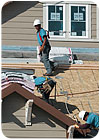
Photo courtesy of Owens Corning.
Crunching the Numbers
Running the numbers allows us to clearly see how this time factor can have a dramatic impact on your bottom line. Suppose your company worked five days a week, 50 weeks a year. This would equal 250 crew days. While rain and other inclement weather might make 250 days impossible to achieve, it is a good way to measure maximum sales productivity per crew. If the company only performed jobs such as Job A, the $400-a-square complicated tear-off, the company could perform $666,668 sales per crew ($2,666.67 per day times 250 days). However, if the company only performed jobs like the Job B, the simpler ranch-style roof, the company could perform $1,000,000 a year in sales ($4,000 per day times 250 days per year).We are not proposing the only kind of roofs contractors install should be simple ranch-style roofs. What we are suggesting is that the more complicated the job and the more time-consuming it is, the more you should charge. Unit prices have a way of evolving. I suppose that once upon a time someone actually calculated the price per square, but such prices tend to be more of an old wives' tale than an actual cost estimate. My experience has been that the easier it is to estimate a unit cost, the less profitable such prices can be.
This is true of drywall that is so much per square foot, or sod that is laid so much per yard, or wallpaper that is hung so much per roll. The tendency is to believe that if someone can install the job for $150 per square, you can do it for $140 because you are better and have less overhead.
So, what happens if you increase your price and win fewer of the more complicated jobs? Unit prices also have a way of being more competitive on less profitable work. For example, many years ago retailers sold chain link so much per installed foot. Most retailers never visited the site. The poor subcontractor who agreed to do the installation work for the retailer, site unseen, had to deal with all the access issues, such as rocks and trees, that the other independent contractors who visited the jobs built into their quotes. The retail sub worked himself to death and eventually quit or started his own business. Yes, unit prices will make your prices less competitive on the time-consuming difficult jobs, and you will probably lose more of those jobs to your competition. But is having your competition do all the losers really a bad thing? While they are tied up on that loser, your company is free to perform the more profitable work.
Too many roofing contractors mistakenly believe that if they use subs or pay piece rates, they cannot lose money on the job. Our example of the job taking longer and resulting in less income also applies to roofers who sub or use piece rates. Yes, you may have controlled the labor cost, but you still may not receive enough gross profit to adequately recover your overhead.
Avoid Unprofitable Jobs
Eliminating losing jobs by charging more on complicated work will have a dramatic impact on your company and your lifestyle. My consulting experience has shown me that 20 percent to 40 percent of the jobs contractors do represent almost 100 percent of the jobs they lose money on. In other words, due to improper pricing, many contractors lose money on the same type of work over and over and do not even realize it. You work just as hard, if not harder, on the losing jobs than you do on the profitable jobs. By pricing work smarter, you can reduce your headaches and do less volume with more profit.Each and every one of us has 24 hours each day. We may not know how many days we have left, but we do know the hours within that day are limited. It only makes sense to make as much money as we can each and every day.
Looking for a reprint of this article?
From high-res PDFs to custom plaques, order your copy today!
.webp?height=740&t=1781278983&width=auto "KEE(2).png")