Reports and Studies
Kingspan Sustainability Report Signals Building Shift
Kingspan report highlights carbon cuts, circularity gains and roofing innovation for contractors.
Key Takeaways
Key Takeaways
- Kingspan reached its 2030 target for reducing Scope 1 and Scope 2 greenhouse gas emissions five years early, demonstrating how manufacturers are accelerating decarbonization efforts across building envelope and roofing products
- The company surpassed one million metric tons of recycled and renewable materials used in manufacturing, highlighting the growing importance of circularity, embodied carbon reduction and sustainable material sourcing in construction.
- High-performance roofing, wall and insulated panel systems continue to play a critical role in achieving energy efficiency, resilience and net-zero building goals, reinforcing the building enclosure's central role in sustainable design.
Kingspan Insulated Panels North America releases its annual Sustainability Report recapping its North American project milestones for 2025. The report marks the fourth annual update on Kingspan’s Planet Passionate program and the halfway point in the company’s 10-year sustainability journey.
Planet Passionate is Kingspan’s global sustainability program focused on three major challenges: climate change, circularity and protection of the natural world. In 2025, Kingspan Insulated Panels North America continued to advance that work through measurable operational progress, expanded sustainability initiatives and investments designed to support a lower-carbon built environment.
“Sustainability has long been a core part of how we do business, and Planet Passionate has given us a strong framework to turn that commitment into action. Today, this mission is embedded across our operations and long-term planning,” said Brent Trenga, director of sustainability for Kingspan Insulated Panels North America. “At the midpoint of the program, we are seeing real progress and building momentum as we continue to reduce impacts, invest in innovation and support a more sustainable built environment.”
Sustainability Strides
Kingspan is focused on reducing emissions across manufacturing operations while supporting the delivery of high-performance building solutions that enable more efficient, lower-carbon buildings. By 2030 (using 2020 as the baseline year), Kingspan aims to reduce Scope 1 and 2 GHG emissions by 65 percent. Key 2025 carbon achievements include a 3.6 percent reduction in Scope 1 and 2 emissions from 2024 to 2025.
As global demand for lower-carbon buildings continues to accelerate, energy performance has become both a regulatory expectation and a market differentiator.
Operational Milestones
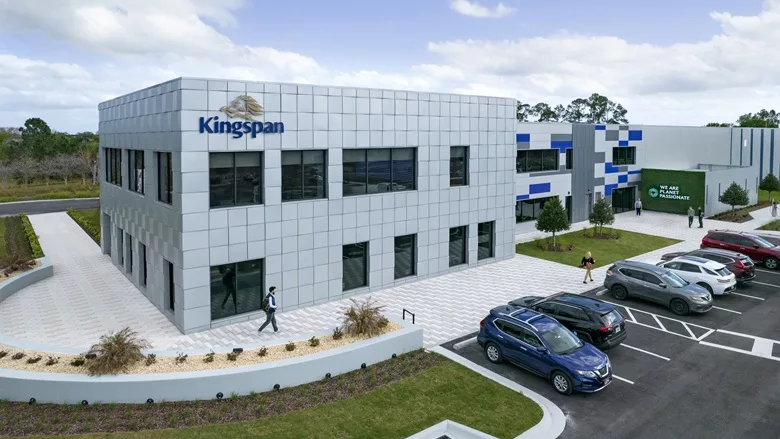
The report also highlights several major milestones from 2025. For example, Kingspan made significant strides in the construction of its new DeLand, Florida, headquarters, which was completed in early 2026. This new facility is targeting Leadership in Energy and Environmental Design (LEED) v4 BD+C Gold Certification and the International Living Future Institute (ILFI) Net Zero Carbon + Energy Certification, embodying Kingspan’s commitment to sustainability. Serving as the cornerstone of the company’s Planet Passionate efforts, the headquarters showcases the company’s dedication to high-performance, sustainable building practices.
In addition, Kingspan made significant strides toward ISO 50001 energy management certification, which enables organizations to systematically monitor and improve energy performance. Both the DeLand and Caledon sites progressed toward certification, with expected completion in 2026. This certification underscores Kingspan’s commitment to operational excellence and efficiency across its facilities.
Looking Forward
As Kingspan looks toward the next phase of its sustainability strategy, the company remains committed to reducing operational emissions, increasing renewable energy use and advancing circularity efforts. In the coming years, Kingspan will focus on accelerating its decarbonization efforts, with an emphasis on decarbonizing its supply chain and increasing renewable energy across its operations. This includes scaling up the adoption of renewable energy sources and optimizing energy efficiency at its manufacturing sites.
Kingspan will also continue to strengthen supplier engagement to ensure sustainable practices are embedded across its value chain. The company will also focus on expanding circularity initiatives, including material recovery and product life cycle innovations, to move closer to a circular economy. By offering high-performance building solutions, Kingspan aims to help customers meet evolving market and regulatory demands while driving environmental sustainability and operational efficiency.
“Sustainability is not a fixed destination, but an ongoing journey of progress, and we are committed to building on our momentum to deliver measurable impact,” continued Trenga. “The second half of our program will require continued discipline, creativity and accountability as we work to meet, and exceed, our targets. We remain dedicated to pushing boundaries, embracing new technologies and deepening partnerships that enable us to deliver meaningful outcomes.”
Where the Industry is Headed
The broader significance of the report is that it reflects where the construction industry is headed rather than where it has been. Whether discussing roofing systems, wall assemblies or complete building enclosures, performance expectations continue to expand. Energy efficiency, carbon reduction, resilience, durability and circularity are becoming interconnected parts of the same conversation.
The construction market is moving toward a future in which owners want buildings that consume less energy, emit less carbon, generate more renewable power and utilize resources more responsibly. Manufacturers that align products and operations with those expectations are positioning themselves for long-term relevance.
For readers across W&C, Building Enclosure and RC, Kingspan's 2025 Sustainability Report serves as more than a progress update. It is a roadmap illustrating the forces reshaping construction today. From embodied carbon reduction and circular manufacturing to energy-efficient roofing and advanced enclosure technologies, the report reinforces a central industry truth: sustainability is no longer a niche consideration. It has become a defining factor in how buildings are designed, specified, constructed and evaluated for decades to come.
Looking for a reprint of this article?
From high-res PDFs to custom plaques, order your copy today!