New LTTR Values and What They Mean for Roofing Industry Professionals
Graph courtesy of Johns Manville.
Graph courtesy of Johns Manville.
The ASTM C1289 Standard Specification for Faced Rigid Cellular Polyisocyanurate Thermal Insulation Board (ASTM C1289-13) was recently updated and features important improvements regarding the prediction of long-term thermal resistance (LTTR) R-values (R) for polyiso roof insulation boards.
As a result, LTTR values for polyisocyanurate (polyiso) roof insulation will change from a design value of 6.0 R per inch to 5.7 R per inch, which will impact the amount of polyiso needed to meet building-code requirements. Professionals involved in the design, procurement or installation of roof systems that include polyiso roof insulation should be aware of this change.
In the short term, during this transition, there may be some confusion with regard to the planning, bidding and construction of projects to meet building-code requirements. This article is intended to help design professionals, specifiers, roof consultants, contractors and distributors understand how to work through the transition, how to stay compliant with building code requirements and how polyiso manufacturers can help.
Background
Polyiso, like other blown insulating foams, experiences “aging,” meaning the R-value changes over time. This change in R-value, also known as “thermal drift,” is caused by the diffusion of gases in and out of the foam. The net result is that the R-value of the insulation will decrease slightly over time.
In 2003 the polyiso industry introduced the concept of long-term thermal resistance, or LTTR. LTTR is a 15-year, time-weighted average of the foam’s R-value [1],[2],[3]. It represents the actual R-value that the polyiso insulation will provide while in service. It enables building owners and designers to predict exactly how much insulating value will be provided and how much energy will be saved over the life of the roof.
There are two test methods for calculating LTTR as part of the ASTM C1289 standard — ASTM C1303 and CAN/ULC S770. Both rely on a technique called “slicing and scaling,” which accelerates the aging process of the foam and provides a prediction of product R-value after five years (the equivalent to a time-weighted thermal design R-value for 15 years) [4],[5].
Also in 2003, the Polyisocyanurate Insulation Manufacturers Association (PIMA) introduced the PIMA QualityMarkCM program — a voluntary program that allows polyiso manufacturers to obtain independent, third-party certification for the LTTR values of their polyiso roof insulation products. Polyiso is the only roof insulation to be certified for its LTTR value by this unique program. FM Global® administers the program.
PIMA recently announced that its QualityMarkCM certification program will begin reporting LTTR values in accordance with the updated ASTM C1289-13 standard on Jan. 1, 2014.
All polyiso manufacturers that participate in and meet the requirements of the PIMA QualityMarkCM program can exhibit the PIMA QualityMarkCM logo on their product.
What Are the Changes?
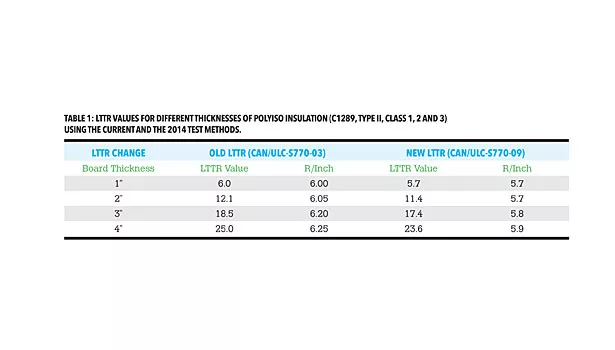
The LTTR test method has been updated to provide a more accurate prediction of the in-service R-value of polyiso roof insulation. Roofing design professionals should now use 5.7 R/inch as the design R-value for permeable-faced polyiso roofing products. This is a decrease from the current design value of 6.0 R/inch. Permeable-faced products are ASTM C1289, Type II, Classes 1, 2 and 3: essentially all facers except foil. The new LTTR values are compared to the old values in Table 1.
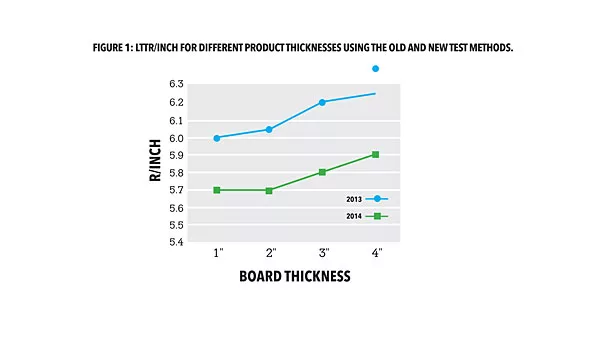
It is important to note that the polyiso products will not change; only the LTTR test method is changing. It should also be emphasized that 5.7 R/inch is only the design value or guideline. Note that the LTTR value per inch still increases with thickness, as it has done for the past decade, as shown in Figure 1.
Designers, distributors and contractors should take the following into consideration with respect to the upcoming LTTR transition.
Design Professionals
Specifically during the transition period, it is suggested that design professionals should allow ample time to factor the conversion into their designs and specify polyiso insulation by the required R-value, the full ASTM designation and the thickness required. This may be seen as redundant, but it could eliminate confusion and mistakes. Consider the following:
- For jobs that will pull a building permit in 2013, the design professional should specify insulation thickness based on the “6.0 R/inch” design guideline associated with the current S770-03 LTTR test method.
- For jobs that will pull a building permit in 2014, the design professional should specify insulation thickness based on the “5.7 R/inch” design guideline associated with the new S770-09 LTTR test method. If in doubt, err on the side of caution and use the information provided in Table 2 to navigate the situation.
Some manufacturers have already started labeling their products with both the old and the new values to help eliminate any potential confusion among code officials and building inspectors.
Distributors
Distribution should prepare for the Jan. 1, 2014 transition by analyzing their most-purchased sizes of polyiso roof insulation and anticipate a change in the mix. For example, a distributor today may sell significant quantities of 2.7-inch thick product with an old LTTR value of 16.6. To meet (or exceed) that R-value after Jan. 1, 2014, it is reasonable to assume that their customers would begin buying 2.9-inch product (with a new LTTR value of 16.8). Table 3 highlights some product thickness changes required for different ASHRAE climate zones.
Of course, good roofing practice dictates that two layers of polyiso, with an optional cover board for protection, should be used, with staggered joints. This will eliminate thermal shorts and provide a roof system with better thermal performance and strength when compared with a roof system using a single layer of insulation.
Contractors
Contractors are encouraged to talk to design professionals during this transition to ensure jobs are specified by the full ASTM designation, the R-value and the thickness. Providing the design professional has compensated for the change in the R-value, the contractor only needs to order the thickness specified. Contractors are also encouraged to consider the scenarios listed in Table 2.
Anticipated Thickness Requirements
In general, the test method change will result in an extra 0.1-inch of thickness per board, or four to six percent more material/thickness depending upon the desired R-value. Extra thickness requirements should be considered when designing blocking heights and specifying fastener lengths.
Conclusions
The PIMA QualityMarkCM program, the only third-party program for the certification of the thermal value of roof insulations, will begin reporting LTTR values in accordance with ASTM C1289-13 on Jan. 1, 2014. The new polyiso design value will be 5.7 R/inch. Details of specific thicknesses and R-values can be obtained from polyiso manufacturers.
Some confusion is anticipated during this transition period, but essentially, if the roofing permit is pulled in 2013, the old LTTR values apply. If the permit is pulled in 2014, the new LTTR values should be used. If in doubt, contact your polyiso manufacturer.
For the next six to 12 months, it would be helpful if specifiers and designers specify the insulation they need using the full ASTM designation, the R-value required and the thickness required. This will help to eliminate mistakes and confusion, and will help ensure that projects comply with the applicable building codes. Distributors should look at their current product mix and prepare for changes to that mix as the new LTTR values start to take effect.
Additionally, for projects where designers specify polyiso insulation by R-value only, requests for information (RFIs) should be submitted to clarify whether the current or new LTTR values are applicable.
Through proper communication and education, this transition period will be smoother for all involved parties.
References
- Hilyard, N. C., and Cunningham, A., Eds., Low Density Cellular Plastics, Physical Basis of Behaviour: Chapter 6, “Thermal Aging” by C. J. Hoogendoorn; Chapter 5, “Heat Transfer in Foams,” L. R. Glicksman, Chapman & Hall, London, 1994
- Singh, S. N., Ntiru, M. and Dedecker, K., “Long–Term Thermal Resistance of Pentane Blown Polyisocyanurate Laminate Boards,” Proceedings of the Polyurethane Expo 2002, pp. 19–26.
- Stovall, T., Venderlen, M., Atchley, J., Oak Ridge National Lab Report number ORNL/TM-2012/214, “Evaluation of Experimental Parameters in the Accelerated Aging of Closed-Cell Foam Insulation,” December 2012.
- Christian, J. E., Courvillle, G. E., Graves, R. S., Linkous, R. L., McElroy, D. L., Weaver, F. J., and Yarbrough, D. W., “Thermal Measurement of In-Situ and Thin-Specimen Aging of Experimental Polyisocyanurate Roof Insulation Foamed with Alternative Blowing Agents, Insulation Materials, Testing and Applications,” 2nd Vol., R. S. Graves and D. C. Wysocki, Eds., ASTM STP 1116, ASTM, 1991, pp. 142–166.
- Bomberg, M. T., “Scaling Factors in Aging of Gas-Filled Cellular Plastics,” Journal of Thermal Insulation, Vol. 13, January 1990, p. 149.
Looking for a reprint of this article?
From high-res PDFs to custom plaques, order your copy today!

.webp?height=740&t=1781278983&width=auto "KEE(2).png")