Roof Hatch Safety: Understanding and Meeting OSHA Regulations
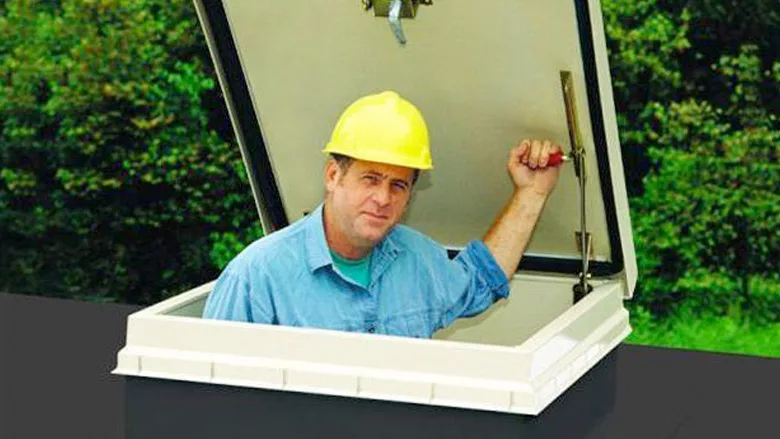
Roof hatches, known sometimes as roof scuttles, are designed to allow workers safe access to roof areas for HVAC equipment maintenance, roof renovations, etc. They are present on most nonresidential buildings. While they provide great convenience to building personnel, unattended roof hatches left in the open position can be dangerous. An open roof hatch areaway presents a fall hazard, one that building owners and managers must address. At the very least, a fall hazard such as this could result in a fine from the Occupational Health and Safety Administration. More importantly, the risk of injury or even death from this hazard creates a serious safety and liability concern for building owners.
OSHA has set forth regulations codifying the steps building owners must take to protect roof openings, including roof hatches. These standards are flexible, providing multiple options for maintaining compliance. This article will explain these options and discuss the penalties for nonconformity.
Roof Hatch Design
As previously mentioned, roof hatches provide workers (along with their tools and equipment) easy access to roof areas. The most common types of hatches that serve this purpose are single-leaf models, which have one cover and accommodate a single person. These hatches are typically located over a ladder or staircase that provides access to the roof. Double-leaf or two-cover roof hatches are also available on the market. These hatches are generally larger in order to accommodate the installation or removal of equipment or machinery into a building. All open roof hatches, regardless of size or number of covers, can present fall hazards. When a hatch is left in the open position, personnel working atop a roof can lose their footing, trip over the hatch's curb, or even step backward into the areaway without looking, thereby sustaining debilitating or even fatal injuries.
OSHA Standard for Roof Openings
Roof hatch protection is addressed by OSHA standard 26 CFR 1910.23, entitled "Guarding Floor and Wall Openings and Holes." Full text of this standard is available online at www.osha.gov. It states that, "every ladder-way, floor opening, or platform shall be guarded by a standard railing with standard toe-board on all exposed sides (except at the entrance to an opening), with the passage through the railing either provided with a swinging gate or so offset that a person cannot walk directly into an opening."
Compliance Tips
There are several options for building owners and managers to protect roof hatches in order to comply with OSHA fall protection standards. The first and least expensive option is to simply insist that workers close the hatch immediately after stepping onto the roof, and open it only to exit the rooftop area. In this scenario, the closed hatch cover eliminates the potential fall hazard. It is important that the cover is securely closed and latched to ensure that it cannot be accidentally opened. In reality, however, many building owners and managers have reservations about using this method to maintain OSHA compliance, fearing that they cannot enforce all building personnel to comply with this policy. Likewise, from the worker's standpoint, this option may compound the natural fear of being locked onto the roof.
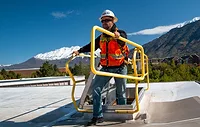
Another option is to install a hatch railing system around the roof hatch to protect the opening when the cover is in the open position. Because railing systems are permanently affixed to the hatch, it is not necessary for workers to close the hatch cover when they are on the roof. Instead, they are only required to protect the entrance of the railing system while they are on the roof. Railing systems are typically supplied with one of the following devices that meet OSHA regulations for protecting the entrance:
A railing system with a self-closing gate is the simplest and most effective because it takes the safety decision completely out of the worker's hands. Upon entering or exiting a hatch, the gate automatically swings shut to maintain a barrier around the opening and ensure continuous OSHA compliance.
Hatches that utilize a safety chain closure are also code-compliant. However, there is one warning to this approach: the chain must afford protection "at least as effective as" a swinging gate. An interpretation of standard 1910.23 (available for public review on OSHA's Web site) states: "the safety chains would be adequate and noted as a de minimus violation." A de minimus violation is defined by OSHA as one "which has no direct or immediate relationship to the safety and health of employees, carries no penalties and does not require abatement of the violation." The largest difference between the safety chain closure and the self-closing gate is that the former requires personnel to take action to re-latch the chain to create the safety barrier.
In the end, when considering fall protect for a roof hatch, the building owner should consider the following questions:
If a worker were to fall into the roof hatch opening, what is the likeliest scenario for injury?
Can I trust my personnel to close the roof hatch every time it is used, thereby ensuring compliance?
Does my own peace of mind rely on having a more permanent means of protection, such as a hatch railing system?
Can I trust that my workers will safely operate a safety chain-equipped hatch railing system by resecuring the chain after every use?
Penalties for Noncompliance
In truth, the most severe penalty for leaving a hatch opening unprotected is a worker injury or even worse, death. It is important to keep that in mind as the most compelling reason to protect a building's roof openings. In addition to this safety and liability concern, a building owner must also consider OSHA penalties and fines for noncompliance. OSHA determines its own means of enforcing standards with a system of checks and citations. According to the agency's Web site, over 37,000 workplace inspections were conducted in 2002, and a full 55 percent were targeted not because of a specific complaint or referral, but simply because the buildings were identified as high-risk.
There are five major types of violations cited by OSHA, each of which carries its own penalty and fine structure. They are:
Willful violation: This occurs when an employer intentionally and knowingly commits a safety violation. Penalties range from $5,000 to $7,000.
Serious violation: A serious violation is characterized by substantial probability that death or serious physical harm could result. In this case, an employer did or should have known of the hazard. Penalties are capped at $7,000.
Repeat violations: These can incur the heaviest penalties, of up to $70,000.
Failure to abate: This refers to a previously noted violation that was not corrected by the assigned due date. A penalty of up to $7,000 can be issued for each day of lateness.
Other violations: This general category refers to standard violations that do not represent a hazard likely to cause death or serious harm. Penalties of up to $7,000 can be levied.
Conclusion
There are three options available to building owners to satisfy liability concerns and OSHA's regulations for fall protection on roof hatches. While all of these options will work, the ultimate decision depends entirely on the building owner's and building manager's comfort levels. In addition to the fall protection system chosen, it is also important that these decision makers are comfortable with the quality of the roof hatch itself. Hatches should be constructed of durable materials and have long-lasting, corrosion-resistant latches and hardware to ensure positive latching and safe, reliable operation. As is the case with any construction product, it is always important to carefully consider the product benefits and features from each manufacturer before making a product selection.
Looking for a reprint of this article?
From high-res PDFs to custom plaques, order your copy today!