Roof Replacement
Roof Replacement Costs Jump as Claims Decline
Verisk report highlights rising severity
Residential roof replacement and repair costs continued to climb in 2025 despite a sharp decline in overall claims activity, according to Verisk's 2026 U.S. Roof Report.
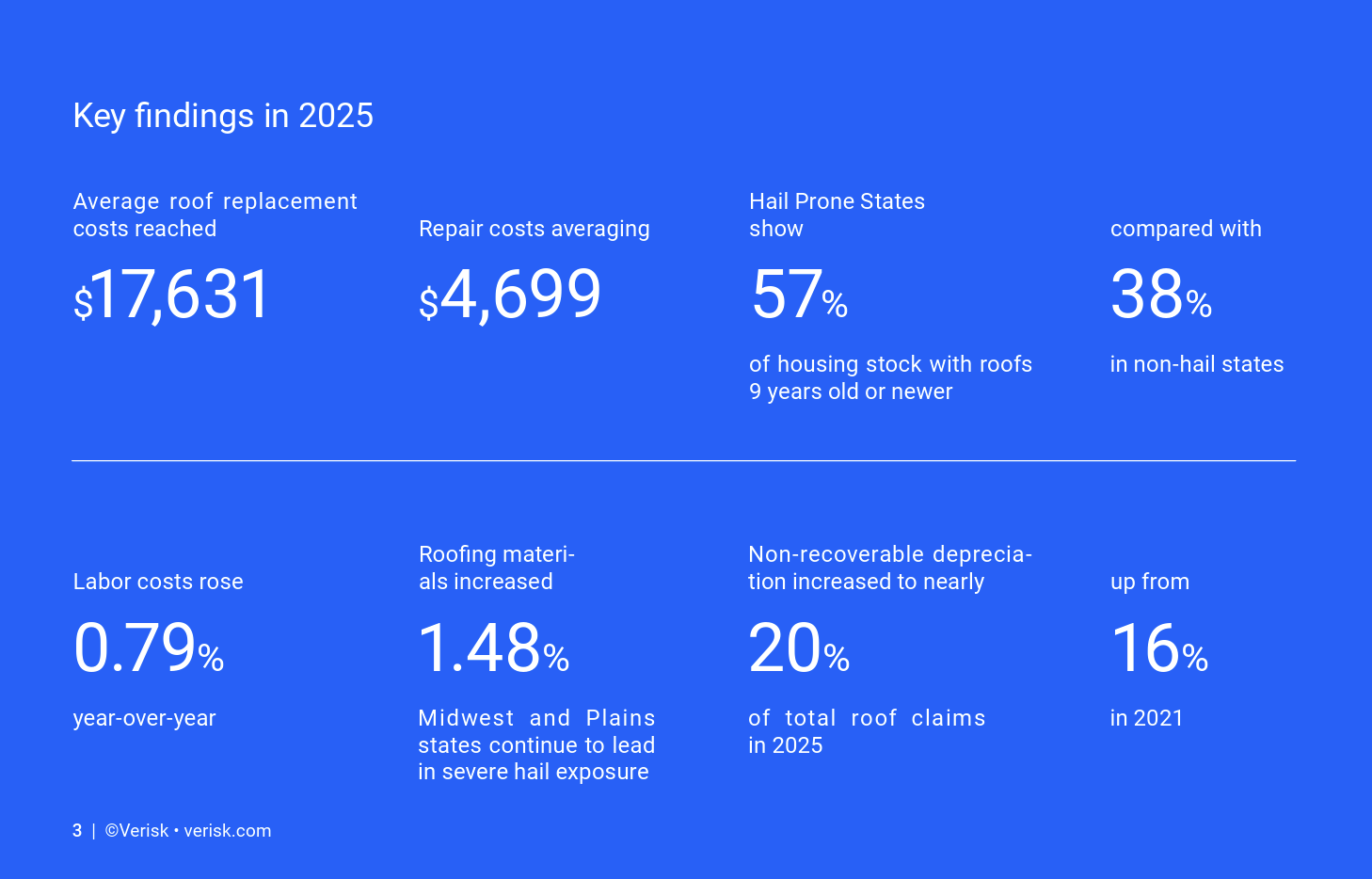
The report found average residential roof replacement costs reached $17,631 in 2025, up 33% from the 2021-2024 average. Repair costs averaged $4,699, a 25% increase over the same period.
While overall roof claims volume fell nearly 20% in 2025, replacement cost value totaled $23 billion, only slightly below the $24.4 billion average recorded from 2021 through 2024. Verisk attributed the decline primarily to a quieter hurricane season rather than lower claim severity.
The report said wind and hail events that do not meet catastrophe thresholds continue to be a major driver of roof losses. Sixteen states experienced severe hail impacts on more than 20% of roofs in 2025, up from 12 states a year earlier. Arkansas, Kansas, Nebraska, Oklahoma and South Dakota ranked among the states with the highest share of roofs affected by severe hail.
Severe hail—hail greater than or equal to 1 inch in diameter—remains the dominant weather-related threat to roofs across much of the United States. In 2025, Verisk Weather Solutions Respond® data revealed:
- Severe hail activity was concentrated in the Central Plains, while previous years have been more impactful to the Northern and Southern Plains.
- Arkansas, Kansas, Nebraska, Oklahoma and South Dakota rank among the top states by the share of roofs impacted by severe hail.
- Sixteen states in the U.S. experienced severe hail impacts on more than 20 percent of roofs, up from twelve in 2024.
- Year-to-year, “giant” hail (greater than or equal to 2 inches) tends to follow more stable geographic patterns, while “large” hail (1–2 inches) shows much wider metro-level volatility, with hundreds of local markets experiencing meaningful year-to-year increases in hail activity.
“Hail risk is not just about one monster storm; it’s the cadence of frequent, smaller-scale events that can rapidly age and weaken a roof,” said Tory Farney, vice president, Verisk Weather Solutions. “Large hail may cause less damage per event than giant hail, but its wider footprint and year-to-year variability can drive unexpected concentrations of damage. Understanding where hail is most likely to cluster helps insurers, contractors and communities prepare for faster, more resilient recovery.”
 Source: Verisk.
Verisk also reported significant regional differences in roof age.
- South: 28 percent of roofs are 0–4 years old, and only 4 percent are 31 years or older, reflecting a higher turnover driven by severe weather events and rapid housing growth.
- Midwest: 21 percent of roofs are 0–4 years old, while 17 percent are 31 years or older.
- Northeast: 14 percent of roofs are 0–4 years old; 18 percent are 31 years or older.
- West: 20 percent of roofs are 0–4 years old; 11 percent are 31 years or older.
According to Verisk, 38% of U.S. homes showed moderate to poor roof condition in 2025. The company said roofs in moderate or poor condition generate approximately 60% higher loss costs than those rated in good or excellent condition.
Material costs continued to outpace labor inflation. Roofing material prices increased 1.48% nationally in 2025, compared with a 0.79% rise in roofer labor costs, with significant variations among states.
Looking for a reprint of this article?
From high-res PDFs to custom plaques, order your copy today!