Manufacturing News
IBHS 2025 Hail Impact-Resistant Shingle Ratings Show 18 Products as 'Good'
None of the 23 shingle lines tested received an "Excellent" after enhanced testing
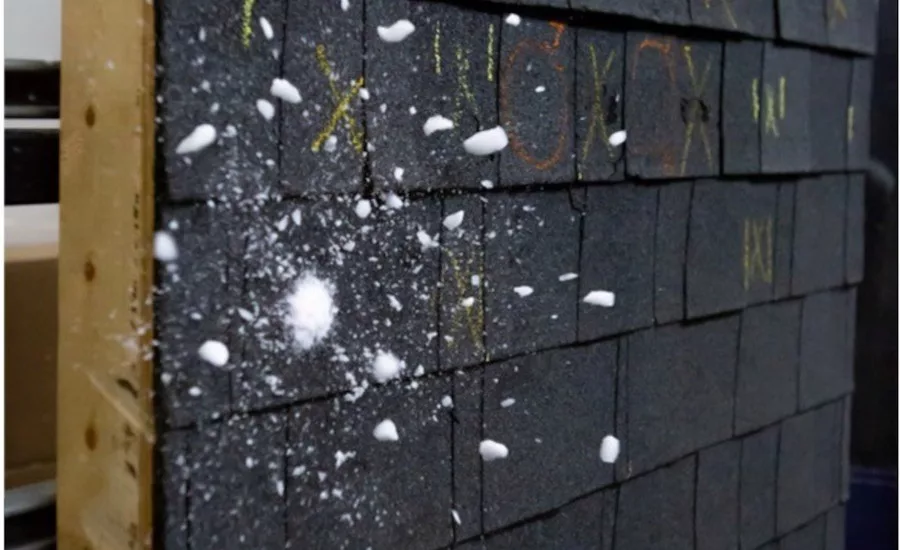
IBHS fires synthetic hail using CO2-powered guns against impact-resistant shingles to simulate real-world hail conditions.
Editor's Note: Story and rating scorecard updated 12/18/2025
The Insurance Institute for Business & Home Safety has released its 2025 Hail Impact-Resistant Shingle Ratings, showing how roughly 95% of the impact-resistant shingles on the market perform in severe weather conditions.
Now in its fourth edition, this year researchers evaluated 23 impact-resistant shingle products — IBHS' most expansive assessment to date. This year’s ratings include a numerical score, from zero to 10, in addition to IBHS’ standard “Excellent,” “Good,” “Marginal,” and “Poor” rating system.
Of those 23 shingle products, 18 received a “Good” rating, and five were rated “Marginal.” None of the products earned an “Excellent.” Product ratings are based on how well the shingles withstand the modes of damage hailstorms cause: dents/ridges, tears and granule loss.
Dr. Ian Giammanco, managing director of atmospheric science at IBHS, said receiving an overall “Excellent” is a high bar to reach. In the program’s history, only one product received an “Excellent” rating.
“Within that, there's a spectrum, of course, but one that was encouraging for us that we saw a whole lot of products available now that meet that ‘Good’ criteria even though we didn't have one reach that upper bar of ‘Excellent’ this time,” he said.
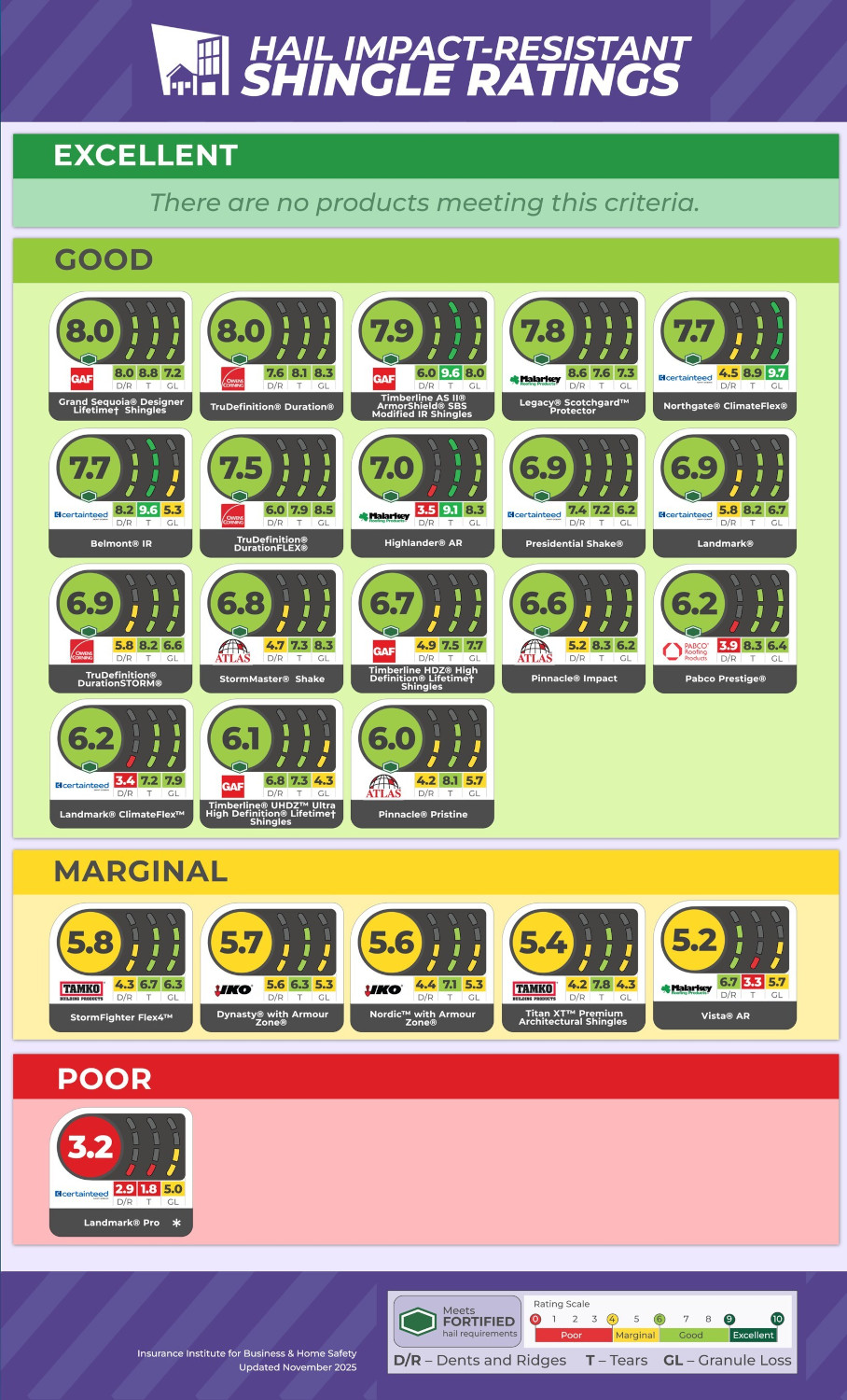
Image courtesy of IBHS
This isn’t to say the products that received a “Good” aren’t up to snuff. In fact, four products earned an “Excellent” in at least one of the three categories tested, and IBHS recommends all 18 of them for performance against hail.
“There’s a variety that spans the cost spectrum,” Giammanco said. “We've got a couple of designer shingles in there. We've got a lot of just typical impact-resistant ones that have been around for quite a while, and even a number that's been in our test program for quite a while."
The ratings are designed to empower homeowners to make informed decisions and help roofing contractors select materials that deliver reliable protection. For contractors, it means backing their recommendations on science instead of marketing claims.
"Homeowners are willing to pay more for impact‑resistant shingles, trusting they'll stand up to severe weather. But when hail strikes, not every product delivers on that promise," said IBHS Chief Engineer Dr. Anne Cope. "At IBHS, we buy shingles straight from the retail shelves, just like consumers do, and test them against realistic hail impacts to see how they perform.
“These results give property owners and roofing pros science-backed insights to choose products proven to stand up to hail."
Improved Testing
One reason this year’s ratings are so comprehensive is that IBHS enhanced its testing.
As in years past, IBHS used synthetic hail created in its labs to test the shingles, as opposed to the traditional method of steel balls. These hailstones, based on real-world samples, are fired out of a CO2-powered gun to simulate hail striking a roof. Three-tab shingles were struck 20 times while architectural shingles were struck 40 times.
IBHS used a new instrument called a Keyence Impact Damage Measurement system in its testing. This provided more efficiency in processing damage input data and allowed researchers to obtain better pre- and post-impact 3D imaging analyses.
Pre- and post-impact scans were also requested by manufacturers to ensure that there was nothing fundamentally wrong with the shingles being tested.
The entire test protocol is commercially available equipment, so manufacturers can invest in the technology for their own research and development purposes and continue to refine their products.
“Over the history of the program, we have moved the bar up in performance as a whole, and that is a positive. That's one of the big things … we set out to do with this program,” Giammanco said.
Market Analysis
Paying attention to how well impact-resistant shingles perform does more than earn trust for contractors when talking to customers. Local and state building codes may soon require them in areas with hail activity.
IBHS partnered with Principia, a building materials research firm, to conduct a market share analysis of “Hail Alley” states that stretches from Texas to South Dakota. This enabled IBHS to expand its testing to be the most comprehensive assessment yet of products sold and installed in hail-prone regions.
This analysis revealed that Texas comprised 43% of the amount of impact-resistant asphalt shingles sold. Giammanco said Texas not only deals with the highest frequency of hail in the states, but also the largest hailstones. The next two states were Missouri and Colorado, at 10% each.
Four code jurisdictions in Colorado have a hail provision in their building code that requires impact-resistant roofing, the latest being Boulder County, where it took effect March 31, 2025.
They are the only four in the country with this amendment, and Giammanco expects more jurisdictions will look to adopt it, as hail has ballooned from a $10 billion problem in 2008 to a $30 to $40 billion problem today.
“I do think there's going to be increased pressure to start putting things into our building codes related to hail. The amount of material that's getting damaged each year and that dollar number is just not sustainable both for homeowners, business owners and the insurance industry,” he said.
Looking for a reprint of this article?
From high-res PDFs to custom plaques, order your copy today!